
Introduction
The Reyna juror public trial violation highlights a critical constitutional safeguard: in Washington, jury selection and juror challenges must be conducted in open court, accessible to the public and press. In State v. Reyna, the Washington Court of Appeals reversed convictions because a juror was dismissed out of public view, violating the public trial guarantee under Article I, Section 10 of the Washington Constitution. This article explains why that issue mattered, how the appellate court analyzed it, and what lessons criminal practitioners should draw.
The Facts of State v. Reyna
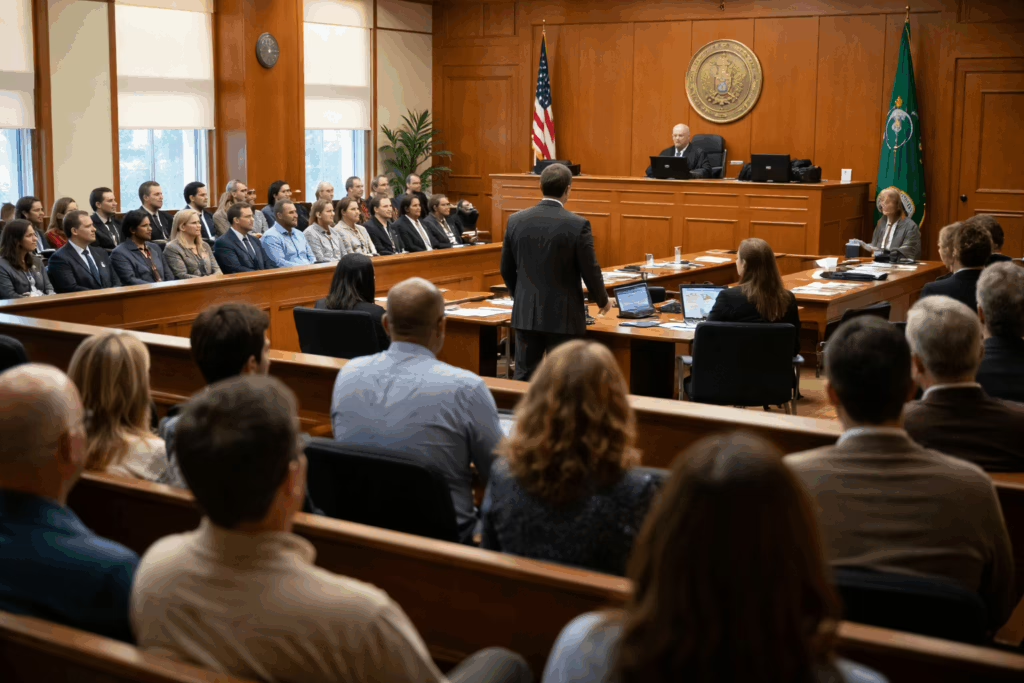
In State v. Reyna, No. 39859‑5‑III (Wash. Ct. App. Nov. 10, 2025) (published), defendant Reyna was charged with first‑ and second‑degree assault for incidents occurring while incarcerated. On the first day of trial, a prospective juror stated she was a victim of a prior misdemeanor and expressed fear about serving on the case. Instead of handling the question in open court, the trial judge summoned counsel into chambers, outside the view of the public and press, to discuss dismissing the juror “for cause.” Defense counsel objected, asserting that Washington’s public trial guarantee required the discussion and ruling to occur publicly. The judge dismissed the juror in private over defense objection, and the jury ultimately convicted Reyna on both counts. State v. Reyna, slip op. at 3–5.
The Washington Public Trial Guarantee
The Washington Constitution provides that: “Justice in all cases shall be administered openly.” Wash. Const. art. I, § 10. This public trial guarantee protects not only the defendant but also the public’s interest in observing judicial proceedings to ensure fairness, accountability, and legitimacy in the criminal justice system. State v. Sublett, 176 Wn.2d 58, 67, 292 P.3d 715 (2013).
Under settled Washington precedent, the public trial right attaches to any portion of a criminal proceeding that historically has been open and that implicates the core purposes of openness, including jury selection and challenges for cause. State v. Wise, 176 Wn.2d 1, 17–18, 292 P.3d 620 (2013); see also State v. Bone‑Club, 128 Wn.2d 254, 904 P.2d 1248 (1995).
Why the Dismissal Was a Public Trial Violation
On appeal, the Washington Court of Appeals applied the governing framework for public trial rights:
- Attachment of the Right:
The court held that challenges to jurors and related voir dire proceedings qualify as “trial proceedings” traditionally open to the public, given their historical and constitutional significance. Reyna, slip op. at 8. - Closure of Proceedings:
By conducting the discussion and dismissal of the prospective juror in chambers, the trial court excluded the public and press from a proceeding that should have been open — a de facto closure. Merely having a court reporter present or providing a transcript does not cure a closure. Id. - Lack of Justification:
To justify closure, a court must articulate specific findings showing that: (a) there is an overriding interest that cannot be protected without closure; (b) closure is no broader than necessary; (c) reasonable alternatives to closure have been considered; (d) the court makes findings on the record; and (e) the closure is no broader than necessary. This is the Bone‑Club framework. Bone‑Club, 128 Wn.2d at 259–60. The trial court made no such analysis in Reyna, nor did it show why public proceedings posed a compelling threat to safety or fairness. Reyna, slip op. at 9.
Because the trial court never performed the required Bone‑Club analysis, the appellate court concluded the proceeding was improperly closed. Reyna, slip op. at 9.
Why Harmless Error Doesn’t Apply
The State argued the violation was harmless. The appellate court rejected this view because the public trial right is a structural guarantee that cannot be tested solely by whether the error affected the verdict. A closure in contravention of Article I, Section 10 is a constitutional defect that warrants reversal unless properly justified. Sublett, 176 Wn.2d at 75.
Reversing Reyna’s convictions, the court remanded for a new trial in which the juror challenge must be handled in open court consistent with constitutional requirements. Reyna, slip op. at 10–11.
Practical Takeaways for Criminal Defense
The Reyna juror public trial violation underscores several key points:
- Public trial rights are fundamental — not procedural formalities.
- Voir dire and juror challenges must be handled in open court unless there is a clear, articulated, compelling reason for closure.
- Trial courts must use the Bone‑Club framework and make specific findings on the record if closure is considered.
- Defense counsel should object early and insist on an open record when juror issues arise.If you have questions about protecting your constitutional rights in trial proceedings — especially regarding jury selection or public trial protections — contact Blanford Law today at ken@blanfordlaw.com or 253‑720‑9304 for guidance on your legal matter.
Additional Resources
- State v. Smith: Washington Supreme Court Juror Bias Ruling
This article analyzes the Washington Supreme Court’s decision on juror bias and its implications for voir dire procedures.
https://blanfordlaw.com/state-v-smith-washington-supreme-court-juror-bias-ruling/ - Optimizing for SEO and Readability: Understanding the Importance of ER 606 in Jury Trials
A discussion of how ER 606 limits post-verdict juror testimony and how to present trial content for clarity and SEO compliance.
https://blanfordlaw.com/optimizing-for-seo-and-readability-understanding-the-importance-of-er-606-in-jury-trials/ - Washington Open Court Bail
Explores how Washington law ensures bail hearings are conducted in public, reinforcing the state’s open court mandate.
https://blanfordlaw.com/washington-open-court-bail/ - Washington’s Open Container Law: A Guide to RCW 46.61.519 (Orphaned)
Offers a breakdown of Washington’s open container statute, including when and where alcohol can legally be transported.
https://blanfordlaw.com/washingtons-open-container-law-a-guide-to-rcw-46-61-519/ - Open Container Law (Orphaned)
Covers the legal consequences of violating open container laws in Washington and how to handle related charges.
https://blanfordlaw.com/open-container-law/