
Understanding RPC 3.9 Nonadjudicative Proceedings
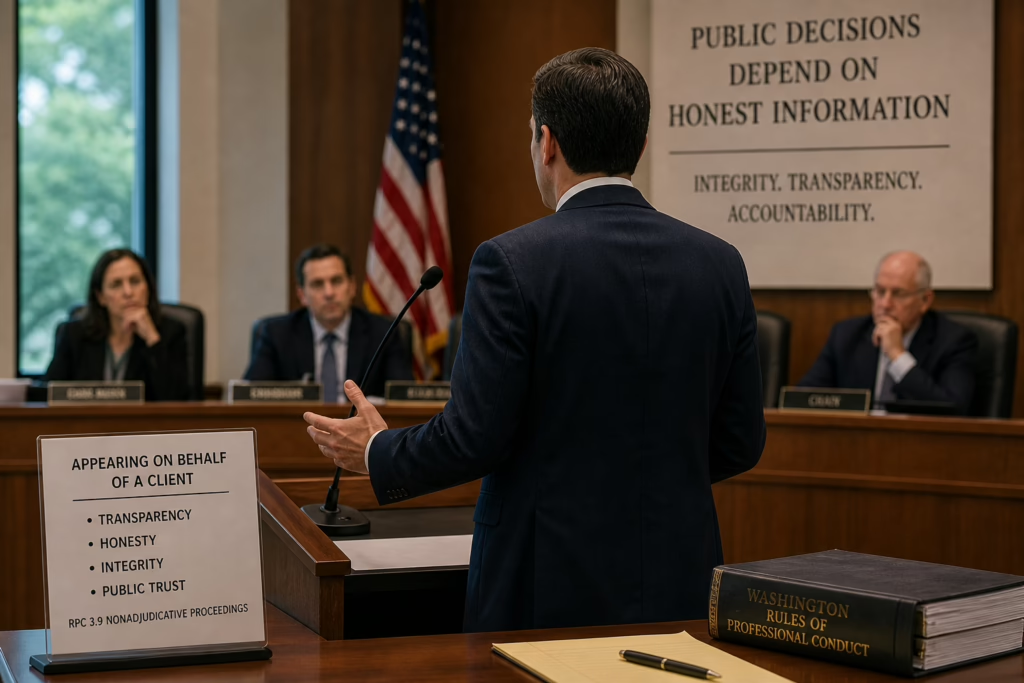
When lawyers step outside the courtroom and into legislative hearings or administrative meetings, the rules do not disappear—they shift. Under RPC 3.9 nonadjudicative proceedings, Washington attorneys must maintain the same core principles of honesty and professionalism, even when the setting is less formal.
These proceedings often involve shaping policy rather than resolving disputes. Still, the integrity of the process depends on the reliability of what lawyers present. That is exactly what RPC 3.9 is designed to protect.
What Makes a Proceeding “Nonadjudicative”?
Not every interaction with a government body falls under this rule. RPC 3.9 applies when a lawyer represents a client in front of a legislative or administrative body acting in a policy-making capacity.
This typically includes situations where laws or regulations are being developed. For example, a lawyer advocating for a client during a city council hearing or presenting arguments during an agency rule-making session would fall squarely within the rule.
By contrast, routine dealings with government agencies—like filing applications, negotiating terms, or responding to investigations—are governed by different ethical rules. The distinction matters because RPC 3.9 imposes specific duties tied to public decision-making.
The Core Requirement: Transparency
At its most basic level, RPC 3.9 requires one simple but critical step: lawyers must disclose that they are appearing in a representative capacity.
That disclosure ensures decision-makers understand who the lawyer represents and why they are speaking. Without it, there is a risk that statements could be misunderstood as neutral or personal rather than advocacy-driven.
This requirement reflects a broader principle—government bodies are entitled to know when they are being asked to rely on information presented on behalf of a client.
Honesty Still Governs the Process
Even though these proceedings are not court cases, the same ethical backbone applies. RPC 3.9 incorporates duties from other rules, including candor, fairness, and respect for the process.
In practical terms, that means a lawyer cannot treat a legislative hearing as a place where advocacy is less constrained. The expectation is the opposite. Decision-makers must be able to rely on the accuracy of the information presented, just as a court would.
A lawyer who exaggerates facts, omits critical information, or misleads a government body risks more than just a bad outcome—they risk violating professional conduct rules.
Why RPC 3.9 Matters in Practice
The importance of RPC 3.9 becomes clearer when you consider how much influence these proceedings can have. Legislative and administrative bodies shape laws, policies, and regulations that affect entire communities.
Because of that, the system depends on trustworthy advocacy. Lawyers play a key role in presenting information, framing issues, and guiding decision-makers through complex topics. If that input is unreliable, the entire process is weakened.
This is why the rule holds lawyers to a high standard, even in settings that might feel less formal than a courtroom.
Where the Rule Draws the Line
RPC 3.9 is not a catch-all rule for every interaction with the government. It applies specifically to official hearings or meetings where evidence or argument is presented.
It does not apply to:
- Negotiations with agencies
- Licensing or permit applications
- Routine regulatory filings
- Government investigations
Those situations are covered by other ethical rules, particularly those dealing with truthfulness and communication.
Understanding where RPC 3.9 applies—and where it does not—is essential for staying compliant.
A Practical Way to Think About It
A helpful way to approach RPC 3.9 is to ask a simple question:
“Am I presenting information or argument to help a government body make a policy decision?”
If the answer is yes, the rule likely applies.
In that moment, the lawyer’s role is not just to advocate, but to do so in a way that preserves the integrity of the decision-making process.
Key Takeaways on RPC 3.9 Nonadjudicative Proceedings
RPC 3.9 reinforces a straightforward but important idea:
honesty and transparency do not depend on the setting.
Even outside the courtroom:
- Lawyers must clearly identify who they represent
- Information presented must be accurate and reliable
- The process must be treated with the same respect as judicial proceedings
Contact Blanford Law
Contact Blanford Law today at ken@blanfordlaw.com or 253-720-9304 for guidance on your legal matter.
Additional Resources
RCW 46.29.090 – Insurance Requirements in Washington
An overview of Washington’s financial responsibility laws and when proof of insurance is required.
https://blanfordlaw.com/rcw-46-29-090-insurance/
About Blanford Law
Learn more about the firm’s experience, approach, and commitment to guiding clients through complex legal matters.
https://blanfordlaw.com/the-firm/about/
RPC 1.11 – Washington Conflicts of Interest
Explains how conflict of interest rules apply to former and current government lawyers.
https://blanfordlaw.com/rpc-1-11-washington-conflicts/
Washington RPC 1.18 – Duties to Prospective Clients
Covers a lawyer’s ethical obligations when consulting with potential clients.
https://blanfordlaw.com/washington-rpc-1-18-comments/
Washington RPC 3.7 – Lawyer as Witness Rule
Discusses when a lawyer may be disqualified from acting as both advocate and witness.
https://blanfordlaw.com/washington-rpc-3-7/