
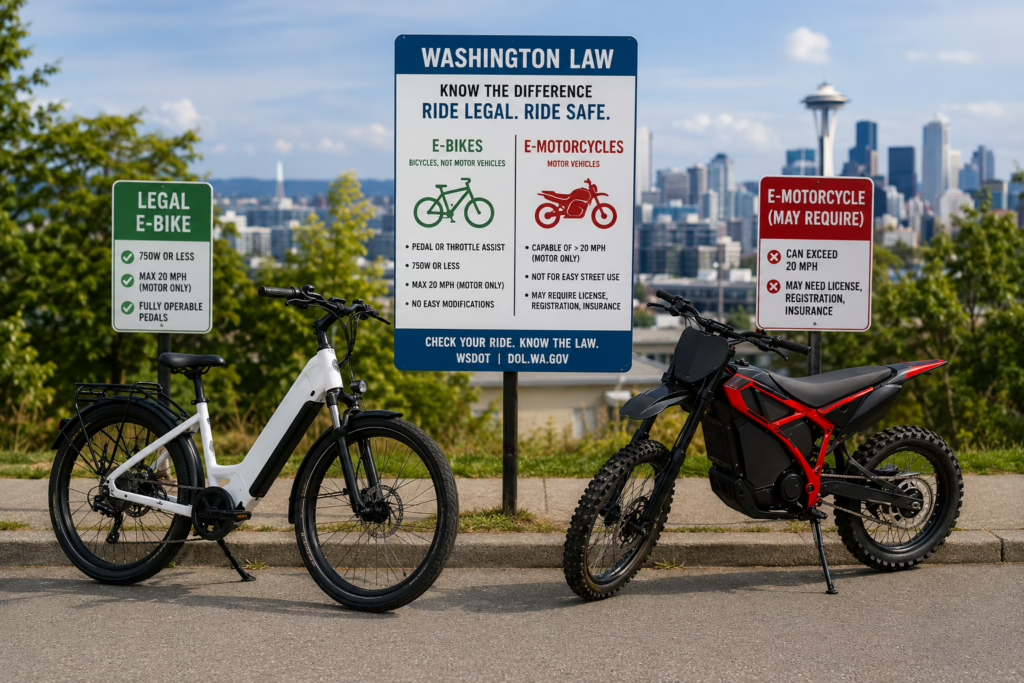
As electric bicycles and electric motorcycles become increasingly popular across Washington State, lawmakers have taken steps to clarify how these vehicles are classified and regulated. Recent legislation aims to address growing confusion surrounding high-powered electric two-wheel vehicles that are often marketed as e-bikes but function more like motorcycles.
The evolving Washington e-bike law is intended to improve safety, provide clearer guidance for riders and parents, and help law enforcement distinguish between legal electric-assisted bicycles and electric motorcycles.
Why Washington Is Updating E-Bike Regulations
Electric transportation has expanded rapidly in recent years. While traditional e-bikes offer riders a convenient and environmentally friendly transportation option, newer electric motorcycles (often called “e-motos”) can reach speeds and power levels far beyond what Washington law permits for electric-assisted bicycles.
The concern for lawmakers is that some vehicles are being marketed as e-bikes despite having capabilities that exceed legal limits. In some cases, these vehicles can be easily modified through software settings, mobile applications, or switches that unlock higher speeds.
This creates confusion for:
- Riders
- Parents purchasing vehicles for children
- Law enforcement officers
- Local governments
- Insurance providers
The result is uncertainty about which rules apply and whether certain vehicles should legally be treated as bicycles or motorcycles.
Current E-Bike Classifications Under Washington Law
Washington generally follows the national three-class e-bike system.
Class 1 E-Bikes
Class 1 e-bikes provide motor assistance only when the rider is pedaling and stop providing assistance at 20 miles per hour.
Class 2 E-Bikes
Class 2 e-bikes may be powered by a throttle but cannot provide motor assistance beyond 20 miles per hour.
Class 3 E-Bikes
Class 3 e-bikes provide pedal-assist only and stop assisting at 28 miles per hour. They must also be equipped with a speedometer.
Under existing law, electric-assisted bicycles must also:
- Have fully operable pedals
- Use an electric motor rated at 750 watts or less
- Fit within one of the three approved classifications
How the Washington E-Bike Law Clarifies E-Motorcycles
A key component of the legislation is defining what does not qualify as an electric-assisted bicycle.
Under the revised law, an electric-assisted bicycle does not include:
- Any vehicle capable of exceeding 20 mph using only electric motor power; or
- Any vehicle designed or marketed to be easily modified to exceed legal e-bike limits through software, apps, switches, buttons, or similar methods.
The law also clarifies that foot pegs are not considered pedals.
This change targets vehicles that may technically appear to be e-bikes but are capable of operating as motorcycles after minimal modifications.
Closing Potential Loopholes
Lawmakers are specifically attempting to address situations where manufacturers market powerful electric motorcycles as e-bikes and rely on simple software settings to comply with regulations at the point of sale.
If a vehicle can easily be reconfigured to exceed legal e-bike limitations, it may now fall outside the definition of an electric-assisted bicycle altogether.
What Happens If a Vehicle Is Classified as an Electric Motorcycle?
If a vehicle exceeds Washington’s e-bike limits, it may be regulated as:
- A motorcycle
- A moped
- Another type of motor vehicle
Depending on classification, riders may be required to have:
- A valid driver’s license
- Vehicle registration
- Insurance coverage
- Motorcycle endorsements
- Approved safety equipment
Failure to comply could result in citations or other legal consequences.
Parents Should Pay Close Attention
Law enforcement agencies throughout Washington have expressed concerns about increasing numbers of minors operating high-powered electric motorcycles.
Officials have emphasized that parents may face legal consequences if they knowingly allow an unlicensed juvenile to operate a vehicle that legally qualifies as a motorcycle.
Many families mistakenly assume that because a vehicle is battery-powered, it is automatically an e-bike. Under Washington law, that is not necessarily true.
As electric motorcycles become more common, parents should carefully review vehicle specifications before purchasing them for younger riders.
Enforcement Challenges Remain
One of the biggest challenges lawmakers face is enforcement.
Appearance alone is not enough to determine whether a vehicle is a legal e-bike. Many electric bicycles are intentionally styled to resemble motocross motorcycles while remaining fully compliant with Washington law.
As a result, the Department of Licensing has been directed to convene a work group consisting of representatives from:
- Washington State Department of Transportation
- Washington State Patrol
- Local governments
- Traffic safety organizations
- Bicycle and motorcycle advocacy groups
- Tribal governments
- Recreation organizations
The group will study:
- Vehicle classifications
- Registration requirements
- Licensing standards
- Consumer disclosures
- Marketing practices
- Enforcement strategies
- Potential penalties for deceptive marketing
The Department of Licensing is expected to provide recommendations and proposed legislation through 2027.
What Riders Should Know Moving Forward
The updated Washington e-bike law is designed to improve public safety while providing clearer distinctions between bicycles and motorcycles.
Riders should ensure that any electric vehicle they purchase complies with Washington’s e-bike requirements before operating it on public roads, bike paths, or trails. If a vehicle exceeds legal speed or power limits—or can easily be modified to do so—it may be subject to motorcycle regulations.
As enforcement guidance develops, riders, parents, and retailers should expect greater scrutiny regarding how these vehicles are marketed, sold, and used throughout Washington State.
Contact Blanford Law
Contact Blanford Law today at ken@blanfordlaw.com or 253-720-9304 for guidance on your legal matter.
Additional Resources
Ellensburg Motorcycle Crash Highlights Risks Riders Face in Washington
This article examines a serious motorcycle crash in Ellensburg and discusses the legal and safety issues that often arise after a motorcycle collision.
https://blanfordlaw.com/ellensburg-motorcycle-crash/
What Crimes Did Ferris Bueller Commit Under Washington Law?
A fun but informative legal analysis of the classic movie character’s actions and how they might be treated under Washington law.
https://blanfordlaw.com/ferris-bueller-crimes-washington-law/
Cowlitz County Rider Bond Policy Raises Questions for Motorcyclists
Learn about the Cowlitz County rider bond policy and how it may affect motorcyclists facing legal issues in Washington.
https://blanfordlaw.com/cowlitz-county-rider-bond-policy/
Ellensburg I-90 Motorcycle Fatality Serves as a Safety Reminder
A review of a fatal motorcycle crash on Interstate 90 and the legal considerations that can arise following serious or fatal accidents.
https://blanfordlaw.com/ellensburg-i90-motorcycle-fatality/
Oak Harbor Motorcycle Accident and Potential Injury Claims
This article explores a motorcycle accident in Oak Harbor and discusses potential legal options available to injured riders and their families.
https://blanfordlaw.com/oak-harbor-motorcycle-accident/