
RCW 9.41.040 DUI Firearm Prohibition Explained
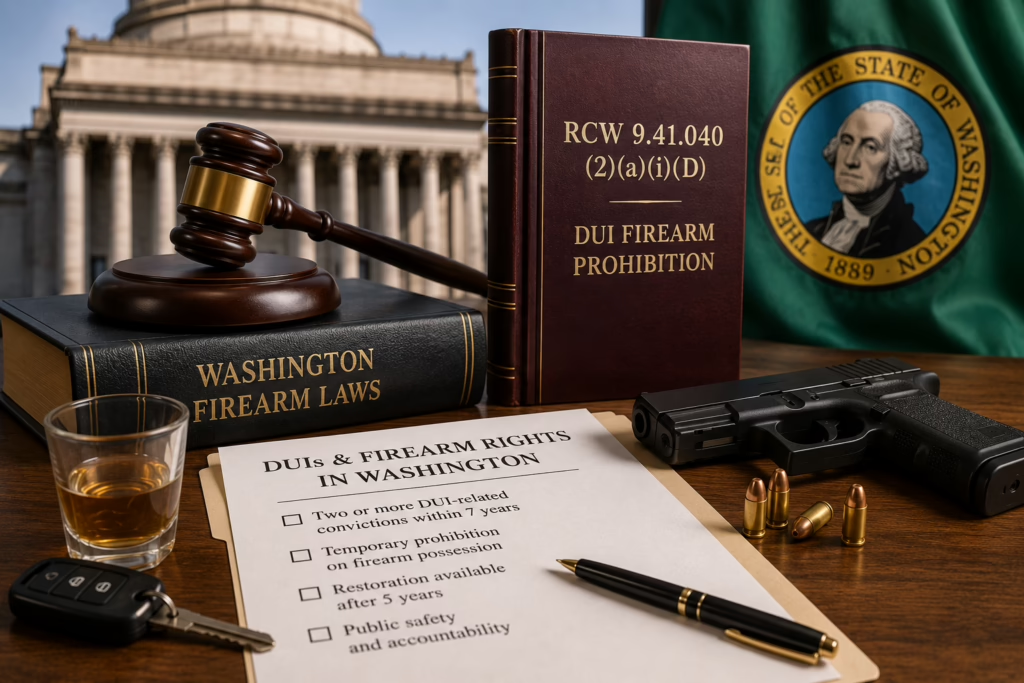
Washington law places restrictions on firearm possession for certain individuals convicted of criminal offenses. One of the newest restrictions is found in RCW 9.41.040(2)(a)(i)(D), which temporarily prohibits firearm possession by people with multiple DUI-related convictions.
The RCW 9.41.040 DUI Firearm Prohibition became effective in 2023 and has already been the subject of significant constitutional litigation. As a result, anyone facing DUI charges should understand how repeat convictions may affect firearm rights.
What Does RCW 9.41.040(2)(a)(i)(D) Say?
Under RCW 9.41.040(2)(a)(i)(D), a person may not possess a firearm if they have:
- Two or more qualifying DUI-related convictions within seven years, or
- Two or more qualifying DUI-related prior offenses as defined by Washington law.
The statute applies even if the convictions are misdemeanors rather than felonies.
Importantly, this firearm prohibition is separate from any criminal penalties imposed for the DUI offenses themselves.
What Offenses Count Under the Statute?
The law covers more than traditional DUI convictions.
Qualifying offenses may include:
- Driving Under the Influence (DUI)
- Physical Control of a Vehicle While Under the Influence
- Vehicular Assault involving alcohol or drugs
- Vehicular Homicide involving alcohol or drugs
- Certain amended offenses that qualify as DUI prior offenses under RCW 46.61.5055
Because Washington’s DUI statutes are complex, a person may accumulate qualifying prior offenses without realizing those offenses could later affect firearm rights.
Why Did Washington Pass This Law?
The Washington Legislature enacted the statute through House Bill 1562 in 2023.
Lawmakers cited research suggesting a connection between repeated alcohol-related offenses and an increased risk of future violence. The legislature concluded that individuals with multiple DUI convictions present a heightened public safety concern.
As a result, lawmakers expanded Washington’s firearm prohibition laws to include repeat DUI offenders.
Is the RCW 9.41.040 DUI Firearm Prohibition Constitutional?
This question reached the Washington Supreme Court in McLellan v. Brown, No. 103799-6 (2026).
The plaintiffs argued that the law violated the Second Amendment because DUI offenses are generally not classified as violent crimes. They contended that the government lacked a historical tradition of disarming individuals based solely on repeat drunk-driving convictions.
The Washington Supreme Court disagreed.
The court held that the temporary firearm restriction is constitutional because it fits within historical traditions of regulating dangerous conduct, restricting firearm possession among certain groups, and addressing risks associated with alcohol abuse.
As a result, the law remains enforceable throughout Washington.
How Long Does the Firearm Prohibition Last?
Unlike some firearm prohibitions, the restriction imposed under RCW 9.41.040(2)(a)(i)(D) is not necessarily permanent.
Washington law allows certain individuals to seek restoration of firearm rights after satisfying statutory requirements.
The waiting period generally requires:
- Five consecutive years in the community,
- No new disqualifying convictions,
- No pending criminal charges, and
- Compliance with applicable restoration procedures.
Each case is different, and eligibility for restoration depends on the individual’s criminal history and circumstances.
Criminal Penalties for Possessing a Firearm While Prohibited
A person who possesses a firearm while prohibited under RCW 9.41.040 may face additional criminal charges.
Washington takes unlawful firearm possession seriously. Depending on the circumstances, a violation may result in felony charges and substantial penalties.
Because firearm restrictions can arise from multiple legal sources, individuals should verify their eligibility before possessing or purchasing a firearm.
Why This Law Matters
The RCW 9.41.040 DUI Firearm Prohibition significantly expanded Washington’s firearm laws.
Before 2023, many firearm restrictions focused on felony convictions, domestic violence offenses, or certain court orders. Now, repeat DUI-related offenses can also result in the temporary loss of firearm rights.
For many Washington residents, this consequence may be just as significant as the underlying DUI penalties.
Anyone facing a DUI charge should understand that future convictions could affect not only driving privileges but also constitutional firearm rights.
Key Takeaways About RCW 9.41.040 DUI Firearm Prohibition
RCW 9.41.040(2)(a)(i)(D) prohibits firearm possession by individuals with multiple DUI-related convictions within seven years.
The law reflects the legislature’s determination that repeat alcohol-related driving offenses present a significant public safety concern.
In 2026, the Washington Supreme Court upheld the statute against a Second Amendment challenge, confirming that the restriction is constitutional under current law.
Understanding these consequences is critical for anyone charged with a DUI or seeking restoration of firearm rights in Washington.
Contact Blanford Law
If you have questions about DUI charges, firearm rights, or restoring your right to possess firearms in Washington, contact Blanford Law today at ken@blanfordlaw.com or 253-720-9304 for guidance on your legal matter.
Additional Resources
Washington’s Untraceable Firearms Law Explained
Washington has enacted comprehensive regulations addressing so-called “ghost guns” and other untraceable firearms. This article explains the state’s restrictions, compliance requirements, and criminal penalties related to untraceable firearms.
https://blanfordlaw.com/washington-untraceable-firearms-law/
RCW 9.41.325: Undetectable and Untraceable Firearms
Learn how RCW 9.41.325 regulates the manufacture, possession, and transfer of undetectable and untraceable firearms in Washington. The article also discusses the penalties that may result from violations of the statute.
https://blanfordlaw.com/washington-rcw-9-41-325-undetectable-and-untraceable-firearms/
RCW 9.41.327 and Washington Firearm Regulations
This article examines RCW 9.41.327 and its role in Washington’s broader effort to regulate firearm safety, serialization requirements, and prohibited firearm possession.
https://blanfordlaw.com/washington-rcw-9-41-327/
Why Unpublished Opinions Cannot Be Cited in Washington State Courts
Washington generally prohibits citing unpublished Court of Appeals opinions as binding authority. This article explains GR 14.1, the policy behind the rule, and the limited circumstances in which unpublished decisions may still be referenced.
https://blanfordlaw.com/why-unpublished-opinions-cannot-be-cited-in-washington-state-courts/