
State v. Peterson Drug Court Decision Explained
The Washington Supreme Court issued an important new decision on September 10, 2026, addressing the continuing effects of State v. Blake on people whose criminal cases involved Washington’s former felony drug possession statute.
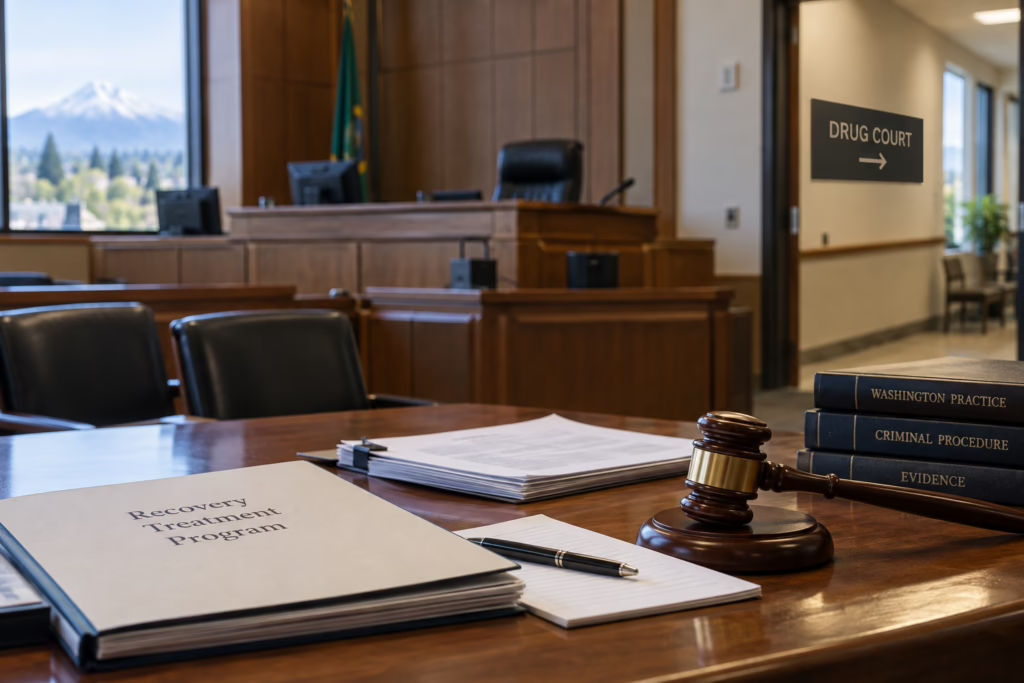
In State v. Peterson drug court litigation, the Court considered whether a person who avoided a drug possession conviction by successfully completing drug court could obtain a refund of the fee she paid to participate in that program.
The Court held that she could use Criminal Rule 7.8 to challenge the court order connected to her participation in drug court. But it ultimately ruled that the federal Due Process Clause did not require Washington to refund the $900 participation fee.
The distinction matters for people seeking relief from old Washington drug cases after Blake. A refund that may be available when money was imposed because of an invalid conviction is not necessarily available when money was paid pursuant to an agreement that allowed the defendant to avoid conviction altogether.
What Happened in State v. Peterson?
Karen Peterson was charged in Snohomish County in 2015 with felony possession of a controlled substance under former RCW 69.50.4013.
Rather than proceed toward trial and a possible conviction, Peterson entered Snohomish County’s Adult Drug Treatment Court program. Her agreement required her to waive certain rights, comply with drug court requirements, and pay a nonrefundable $900 participation fee.
In exchange, prosecutors agreed that if she successfully completed the program, the possession charge would be dismissed with prejudice.
Peterson completed drug court in 2017, and the criminal charge was dismissed.
Four years later, the Washington Supreme Court decided State v. Blake, holding Washington’s former simple drug possession statute unconstitutional because it permitted criminal punishment without requiring proof that a person knowingly possessed the controlled substance.
People who were actually convicted under the unconstitutional statute became eligible to seek vacatur of those convictions and reimbursement of legal financial obligations imposed because of them. Blanford Law has previously discussed the significant consequences of the Blake ruling and its application to Washington criminal cases.
Peterson’s situation was different: she had never been convicted.
Can CrR 7.8 Apply When There Was No Criminal Judgment?
One of the most significant parts of Peterson concerns Washington Criminal Rule 7.8.
CrR 7.8 allows a court, under specified circumstances, to provide relief from a final “judgment, order, or proceeding.” The Court of Appeals had concluded that Peterson could not obtain relief under the rule because her case ended in dismissal rather than a judgment of conviction.
The Supreme Court disagreed with that narrow interpretation.
Reading the rule as a whole, the Court concluded that CrR 7.8 can apply not only to judgments, but also to certain final orders and proceedings. That means a person does not necessarily need a judgment of conviction before CrR 7.8 becomes relevant.
For Peterson, the important order was the court-approved order permitting her to enter drug treatment court under an agreement requiring the $900 fee.
The Court further concluded that Blake constituted the type of extraordinary circumstance that could permit Peterson to seek relief under CrR 7.8(b)(5).
That procedural ruling could have importance beyond this particular refund dispute because it clarifies that CrR 7.8 is not categorically restricted to challenges to judgments of conviction.
Why CrR 7.8(b)(4) Did Not Apply
Peterson also argued that the earlier proceedings were “void” because the possession statute was later held unconstitutional.
The Supreme Court rejected that argument.
Relying on its 2024 decision in State v. Olsen, the Court explained that Blake did not retroactively transform the former possession statute into a legal nullity for every purpose. In other words, the later constitutional ruling did not automatically make every plea agreement, order, diversion agreement, or other proceeding connected with the statute void from the beginning.
That distinction allowed Peterson to seek relief under CrR 7.8(b)(5), but not under the provision governing void judgments or orders.
Why the Supreme Court Denied the Drug Court Fee Refund
The central substantive question was whether federal due process required Washington to return Peterson’s $900 fee.
Peterson relied on the United States Supreme Court’s decision in Nelson v. Colorado. There, individuals whose convictions had been invalidated sought reimbursement of money that Colorado had collected because of those convictions.
The Washington Supreme Court distinguished Peterson’s situation.
Peterson’s $900 was not an LFO imposed as part of a criminal sentence. She was never convicted and never sentenced. Instead, she agreed to pay the participation fee in exchange for admission into a program that gave her the opportunity to avoid conviction.
According to the Court, that difference was decisive.
The Court reasoned that Nelson applies to financial assessments whose legal basis was an invalid conviction. Because Peterson’s fee resulted from her drug court agreement rather than from a conviction, federal due process did not require the State to refund it.
The Court summarized the distinction by explaining that Peterson voluntarily entered a valid agreement to participate in drug court and that Blake did not retroactively invalidate that agreement.
What Does State v. Peterson Mean for Washington Defendants?
The decision creates several important takeaways for people reviewing older Washington drug cases.
First, a Blake-affected conviction and a dismissed Blake-era charge are not treated the same way. A person whose money was collected as a legal financial obligation following an unconstitutional possession conviction may have reimbursement rights that a drug court participant does not.
Second, CrR 7.8 may still be available even when the challenged court action is an order rather than a criminal judgment. The Supreme Court expressly rejected a reading of the rule that would categorically limit relief to judgments.
Third, obtaining permission to file a CrR 7.8 claim does not mean the person will ultimately win. The Court concluded that Peterson made a sufficiently substantial showing to have her claim heard in superior court, yet nevertheless rejected her constitutional argument on the merits.
Finally, the case reinforces the Supreme Court’s reasoning in State v. Olsen: Blake requires specific relief from unconstitutional drug possession convictions, but it does not necessarily invalidate every voluntary agreement or collateral proceeding associated with the former statute.
A Divided Washington Supreme Court
The opinion also produced significant disagreement among the justices.
Justice Mungia concurred in the result but would have dismissed the case as moot because Peterson had already received the $900 refund and the State was not seeking repayment.
Chief Justice Stephens agreed that Peterson was not entitled to the refund but disagreed with the lead opinion’s broad interpretation of CrR 7.8.
Justice González dissented and would have allowed the refund, reasoning that courts possess inherent equitable authority to correct injustices arising from proceedings based on an unconstitutional statute. The dissent also disputed the characterization of drug court participation as entirely voluntary, emphasizing the pressure faced by a defendant choosing between treatment court and possible felony conviction.
Those separate opinions show that the procedural reach of CrR 7.8 and the consequences of Blake remain legally significant subjects even several years after the original decision.
Questions About a Blake Case or Washington Criminal Record?
Cases involving State v. Blake, prior drug possession charges, legal financial obligations, diversion programs, and motions under CrR 7.8 can involve important factual and procedural distinctions.
Whether relief is available may depend on whether there was a conviction, what money was paid, why it was imposed, how the original case was resolved, and what court orders remain in the record.
Contact Blanford Law today at ken@blanfordlaw.com or 253-720-9304 for guidance on your legal matter.
Additional Resources
For more information about Washington drug possession laws, State v. Blake, and related criminal defense issues, see these resources from Blanford Law:
- Washington Drug Possession Law Declared Unconstitutional — Explains the Washington Supreme Court’s landmark State v. Blake decision and why the state’s former felony drug possession statute violated due process.
- Washington Supreme Court Declares Drug Possession Statute Unconstitutional: The City of Marysville Recriminalizes Drug Possession — Discusses the aftermath of Blake and local efforts to address drug possession after the former statewide statute was invalidated.
- Washington’s Proposed Drug Decriminalization Law: Implications and Debate — Reviews proposed changes to Washington drug laws and the broader debate surrounding criminal penalties, treatment, and decriminalization.
- How to Post Bail at Kitsap County Jail: Your Essential Guide — Provides practical information about posting bail at the Kitsap County Jail and what defendants and families should know about the process.
- State v. Olsen and Blake: Washington Supreme Court Addresses Guilty Pleas — Examines the Washington Supreme Court’s treatment of plea agreements following Blake, an important precedent relied on by the Court in State v. Peterson.