
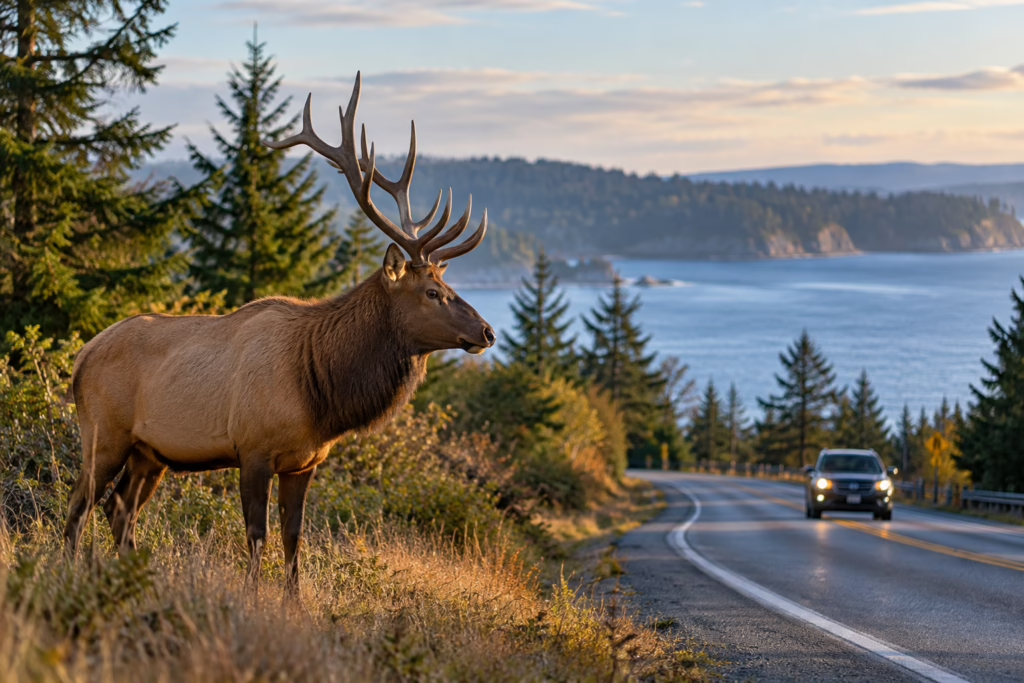
For more than a decade, a solitary bull elk named Bruiser became one of Whidbey Island’s most recognizable residents. News of his death has prompted an outpouring of memories from people who encountered him over the years. His passing also provides an opportunity to discuss Whidbey Island wildlife collisions and the very real danger large animals can create when they cross Washington roads.
Bruiser reportedly arrived on Whidbey Island around 2012 after swimming across Skagit Bay from the mainland. He became the island’s lone resident elk and was particularly associated with the Strawberry Point area of North Whidbey.
Over the years, Bruiser became famous for more than his size. His antlers occasionally became tangled with objects such as tarps, bicycles, and other items, sometimes requiring intervention or monitoring by wildlife officials.
According to recent reports, Bruiser lived on Whidbey Island for approximately 14 years. His unusual story made him a familiar part of the North Whidbey community.
Remembering Bruiser, Whidbey Island’s Lone Elk
Bruiser’s story was remarkable because elk are not normally associated with Whidbey Island in the way deer are.
The Whidbey Camano Land Trust documented Bruiser’s presence around protected habitat near Strawberry Point for years. His enormous size and solitary lifestyle made a sighting memorable for residents and visitors fortunate enough to encounter him.
Bruiser also demonstrated why people should give large wildlife plenty of space.
An adult bull elk is an extremely powerful wild animal. Even an animal familiar to a community remains unpredictable, particularly during certain times of year. Drivers and pedestrians should never assume that familiarity with a particular animal makes approaching it safe.
Whidbey Island Wildlife Collisions Are a Real Roadway Hazard
Bruiser’s passing comes against a broader roadway-safety issue that deserves attention.
The Washington State Department of Transportation identifies Whidbey Island as one of Western Washington’s areas with high wildlife-vehicle collision rates. WSDOT specifically identifies State Route 20 and State Route 525 on Whidbey Island.
WSDOT also reports that deer and elk account for most reported wildlife-vehicle collisions because these incidents can cause significant property damage and human injuries.
A collision with a large animal can be serious. Drivers may also suffer injuries without directly striking the animal. A motorist who suddenly swerves to avoid a deer or elk could leave the roadway, enter another traffic lane, strike a fixed object, or collide with another vehicle.
That makes wildlife awareness especially important on rural stretches of Whidbey Island.
Reducing the Risk of Whidbey Island Wildlife Collisions
Drivers cannot control when wildlife enters a roadway, but careful driving can reduce the likelihood or severity of some collisions.
Motorists traveling on SR 20, SR 525, and other rural Whidbey Island roads should remain alert, particularly where wildlife warning signs are posted. Visibility can be limited at night, around curves, and in areas surrounded by vegetation.
Drivers should also avoid distractions and maintain enough following distance to respond safely when traffic suddenly slows.
When an animal appears in or near the roadway, drivers should use reasonable care and avoid making a sudden maneuver that creates an even greater danger to surrounding motorists.
Who Is Responsible When Avoiding Wildlife Causes a Crash?
A collision involving wildlife does not automatically mean another person is legally responsible.
For example, if a deer unexpectedly runs directly in front of a vehicle and no other driver contributed to the accident, there may be no negligent third party against whom to bring a personal injury claim. Insurance coverage may still be available depending on the circumstances and the driver’s policy.
The situation can be different when another driver’s negligence contributes to the crash.
Suppose one driver encounters an animal and safely slows down, but a distracted driver behind that vehicle fails to stop and causes a rear-end collision. The presence of wildlife does not necessarily excuse the second driver’s negligent conduct.
Similarly, speeding, following too closely, impaired driving, distracted driving, or unsafe passing may become important when determining why a wildlife-related accident resulted in injuries.
Washington follows a comparative-fault system, meaning responsibility can potentially be allocated among parties according to their respective fault.
Every collision must therefore be evaluated based on its particular facts.
What to Do After a Wildlife-Related Accident in Washington
Safety and medical needs should come first after any serious collision.
If someone has been injured, call 911 and obtain appropriate medical care. When it can be done safely, preserve information about the accident scene, including photographs of vehicle damage, the roadway, skid marks, surrounding conditions, and any relevant warning signs.
Witness names and contact information can also become important.
Drivers should report collisions when required by Washington law and promptly notify their insurance company. However, injured people should be cautious about giving detailed recorded statements or accepting a quick settlement before they understand the extent of their injuries and their legal rights.
Evidence can disappear quickly. In a disputed accident, photographs, vehicle data, witness testimony, surveillance footage, dash-camera recordings, medical documentation, and law-enforcement reports may all help establish what happened.
Washington Rules for Deer and Elk Killed by Vehicles
Washington also has specific rules concerning deer or elk accidentally killed in motor-vehicle collisions.
Under WAC 220-400-040, a person may salvage and transport a deer or elk accidentally killed by a motor vehicle, but a salvage permit generally must be obtained from the Washington Department of Fish and Wildlife within 24 hours of taking possession.
The rule also requires the entire carcass, including entrails, to be removed from the road right-of-way. Additional requirements may apply in areas affected by chronic wasting disease.
Importantly, an individual generally may not kill an injured animal encountered after a collision for the purpose of salvage. Wildlife officials or authorized law enforcement should handle an injured animal when necessary.
Bruiser’s Legacy and Safer Whidbey Island Roads
Bruiser was unusual: one enormous elk living largely alone on an island where residents came to recognize him as a local character.
His story is worth remembering on its own.
It also reminds us that people and wildlife routinely share the same environment in Washington. On Whidbey Island, that includes sharing roads where WSDOT has documented significant wildlife-collision concerns.
Drivers cannot prevent every encounter with wildlife. Staying alert, respecting wildlife warning areas, avoiding distractions, and driving at an appropriate speed for conditions can nevertheless make an important difference.
Injured in a Whidbey Island Car Accident?
Wildlife-related crashes can raise complicated questions about negligence, insurance coverage, comparative fault, and compensation for injuries.
When another driver’s negligence contributes to a collision, an injured person may have a claim for medical expenses, lost income, pain and suffering, and other legally recoverable damages depending on the circumstances.
Contact Blanford Law today at ken@blanfordlaw.com or 253-720-9304 for guidance on your legal matter.
Additional Resources
Personal Injury Lawyer – Blanford Law
Learn about Blanford Law’s representation of people injured in car accidents and other incidents involving negligence.
https://blanfordlaw.com/areas-of-practice/personal-injury/
Whidbey Deer Collisions: Washington Driver Safety
Read Blanford Law’s earlier discussion of deer collisions and roadway safety issues affecting Whidbey Island motorists.
https://blanfordlaw.com/whidbey-deer-collisions-washington/
Washington Fatal Accidents: How Blanford Law Can Help
Learn about legal issues that can arise after serious and fatal motor-vehicle accidents in Washington.
https://blanfordlaw.com/washington-fatal-accidents/
Washington State Department of Transportation – Wildlife Habitat Connectivity
WSDOT explains wildlife-vehicle collision risks, including areas with elevated collision rates on Whidbey Island.
https://wsdot.wa.gov/construction-planning/protecting-environment/wildlife-habitat-connectivity
Washington Administrative Code – WAC 220-400-040
Washington’s current rule addresses possession and salvage requirements for deer and elk accidentally killed in motor-vehicle collisions.
https://app.leg.wa.gov/WAC/default.aspx?cite=220-400-040