
State v. Blake is a significant case in Washington State that challenged the state’s drug possession law. The case involved Shannon Blake, who was convicted of drug possession after police officers found a small amount of methamphetamine in her purse. Blake argued that the state’s drug possession law was unconstitutional because it criminalized the possession of any amount of a controlled substance without requiring the state to prove that the defendant had knowledge of the substance’s presence.
The Washington Supreme Court agreed with Blake, holding that the state’s drug possession law was unconstitutional under the due process clause of the state constitution. The court found the law to be overbroad and ambiguous, which could potentially criminalize innocent conduct. The court emphasized that the law did not require the state to prove that the defendant knew they possessed the drugs and could result in individuals being convicted of drug possession without any knowledge or intent.
The Blake decision is significant because it effectively struck down the state’s drug possession law, which was one of the strictest in the country. The law criminalized the possession of any amount of a controlled substance, including marijuana, and did not distinguish between possession for personal use and possession for distribution. As a result of the Blake decision, individuals who have been convicted of drug possession under the now-unconstitutional law may have the opportunity to challenge their convictions.
Furthermore, the Blake decision highlights the importance of protecting individuals’ constitutional rights, even in the context of drug offenses. Historically, drug possession offenses have been subject to harsh criminal penalties, and the Blake decision emphasizes the need to ensure that these penalties are imposed fairly and in accordance with constitutional principles.
In conclusion, the Blake decision is a critical case in Washington State that has significant implications for individuals, law enforcement agencies, and prosecutors. The decision strikes down the state’s drug possession law as unconstitutional, criminalizing the possession of any amount of a controlled substance without requiring the state to prove the defendant’s knowledge of the substance’s presence. The Blake decision underscores the importance of protecting individuals’ constitutional rights, especially in the context of drug offenses, and ensuring that criminal penalties are imposed fairly and in accordance with constitutional principles.
Contact Blanford Law
If you have questions about traffic infractions, Department of Licensing issues, or court obligations in Washington, contact Blanford Law today at ken@blanfordlaw.com or 253-720-9304 for guidance on your legal matter.
Additional Resources
If you are interested in learning more about Washington’s drug possession laws and the impact of the Washington Supreme Court’s landmark Blake decision, review these related resources:
Washington Supreme Court Declares Drug Possession Statute Unconstitutional – The City of Marysville Recriminalizes Drug Possession
Learn how local governments responded after the Blake decision and how the City of Marysville moved to recriminalize knowing drug possession under a municipal ordinance.
https://blanfordlaw.com/washington-supreme-court-declares-drug-possession-statute-unconstitutional-the-city-of-marysville-recriminalizes-drug-possession/
RCW 69.50.4013 Unconstitutional: What the Decision Means
A detailed discussion of why the Washington Supreme Court found RCW 69.50.4013 unconstitutional and what that means for individuals previously convicted of simple drug possession.
https://blanfordlaw.com/rcw-69-50-4013-unconstitutional/
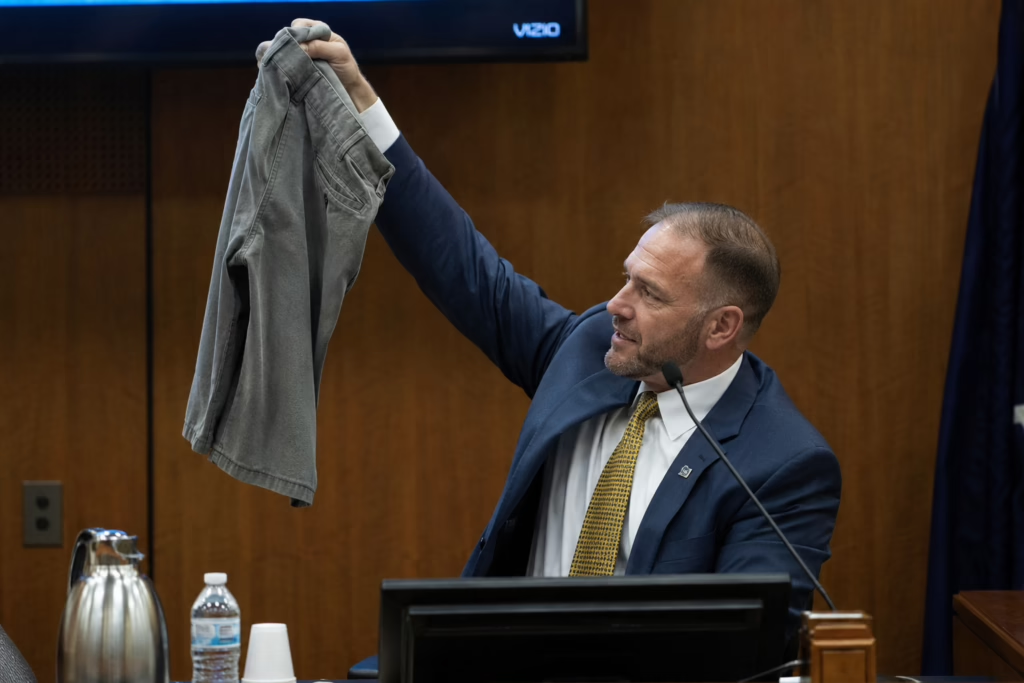
“Those Are Not My Pants!” Are They Your Drugs? Washington Supreme Court Finds RCW 69.50.4013 Unconstitutional
Explore the facts behind the Blake case and how Washington’s former strict liability drug possession statute resulted in convictions even when individuals lacked knowledge of the drugs.
https://blanfordlaw.com/those-are-not-my-pants-are-they-your-drugs-washington-supreme-court-finds-rcw-69-50-4013-unconstitutional/
Balles Case Washington: Post-Blake Appeals Decision
This case examines how Washington courts have addressed legal issues arising after Blake, including the validity of community custody supervision and warrants based on now-invalid possession convictions.
https://blanfordlaw.com/balles-case-washington/
State v. Olsen: Washington Supreme Court Guilty Plea Blake Ruling
Review how the Washington Supreme Court analyzed challenges to guilty pleas following Blake and the limitations imposed by Washington’s post-conviction time-bar rules.
https://blanfordlaw.com/state-v-olsen-blake/