
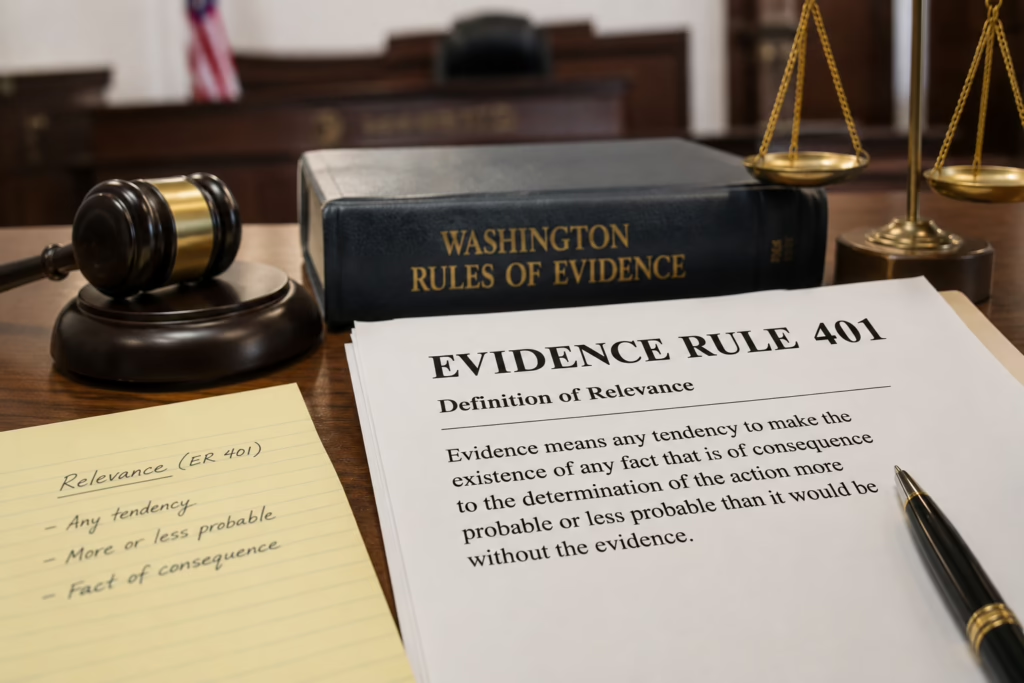
The relevant evidence rule is the cornerstone of Washington’s Rules of Evidence. Under Evidence Rule 401 (ER 401), courts determine whether information presented in a case actually matters to the issues being decided. Without this rule, trials could quickly become cluttered with unrelated or misleading information.
In simple terms, ER 401 answers a critical question: Does this evidence help prove or disprove something important in the case? If the answer is yes, the evidence is considered relevant and may be admitted—subject to other rules.
What Is the Relevant Evidence Rule Under ER 401?
The relevant evidence rule defines relevant evidence as anything that has any tendency to make a fact more or less probable than it would be without that evidence, and that fact must be of consequence to the case.
This is a deliberately low threshold. Evidence does not need to prove a case on its own—it only needs to make a fact slightly more or less likely. Because of this broad definition, most evidence offered in court will meet the standard of relevance.
However, relevance alone does not guarantee admissibility. Other rules, such as ER 403, may still exclude evidence if it is unfairly prejudicial or misleading.
Why the Relevant Evidence Rule Matters in Washington Cases
The relevant evidence rule plays a critical role in ensuring fairness and efficiency in Washington courts. By limiting evidence to what actually matters, the rule helps prevent confusion, reduces unnecessary delays, and keeps the focus on the key issues in dispute.
In both criminal and civil cases, relevance is often the first hurdle evidence must clear. Attorneys frequently argue over whether certain testimony, documents, or physical evidence should be allowed, and judges rely on ER 401 to make those determinations.
For example, in a personal injury case, evidence about the accident itself—such as witness testimony or photographs—is likely relevant. On the other hand, unrelated personal history may not be relevant unless it directly connects to the claims being made.
How Courts Apply the Relevant Evidence Rule
In practice, courts apply the relevant evidence rule by examining the connection between the evidence and the facts at issue. This often involves a practical, common-sense evaluation rather than a rigid formula.
Judges consider whether the evidence helps establish elements of a claim or defense. If it does, even in a small way, it will typically be considered relevant. This flexible approach allows courts to adapt to a wide variety of cases, from criminal prosecutions to complex civil disputes.
That said, relevance is often closely tied to strategy. Attorneys must carefully decide what evidence to present and how to argue its importance. Even marginally relevant evidence can influence a case if it is presented effectively.
Limitations on Relevant Evidence
Although the relevant evidence rule sets a broad standard, it does not operate in isolation. Other rules can limit or exclude evidence that technically meets the definition of relevance.
For example, under ER 403, courts may exclude evidence if its probative value is substantially outweighed by the risk of unfair prejudice, confusion, or waste of time. This ensures that even relevant evidence does not undermine the fairness of the trial.
Understanding how these rules interact is essential for anyone involved in a legal dispute, particularly in personal injury or criminal cases where evidence can significantly impact the outcome.
About Blanford Law:
We are no-nonsense, relentless, fair, and honest. We are great listeners instead of fast talkers, that is just who we are. More than 20 years ago, Ken began practicing law with a deeply-seeded belief that every person has the right to the best legal representation available. He built his law firm on that belief. Another belief that he strongly adheres to is his fundamental belief that clients deserve respect, with no assumptions or preconceived notions. If you or someone you know is accused of a crime or injured as a result of the negligence of another, please have them call us at 253-720-9304 or email us info@blanfordlaw.com
Additional Resources
- Relevant Evidence Rule (ER 401)
Review how Washington defines relevant evidence and why it is the foundation for admissibility in court.
https://blanfordlaw.com/relevant-evidence-rule/ - Washington Rules of Evidence Guide
Explore a comprehensive overview of Washington’s evidence rules and how they apply in legal proceedings.
https://blanfordlaw.com/washington-rules-of-evidence-guide/ - Washington Evidence Rule 404
Learn how character evidence and prior acts are limited in Washington courts.
https://blanfordlaw.com/washington-evidence-rule-404/ - Washington Evidence Rule 403
Understand when relevant evidence may be excluded due to unfair prejudice or confusion.
https://blanfordlaw.com/washington-evidence-rule-403/ - Witness Tampering FAQ in Washington State
Get answers to common questions about witness tampering laws and potential legal consequences.
https://blanfordlaw.com/45-faq-witness-tampering-washington-state/