
Insufficient Evidence Escape Conviction in State v. Walker
In State v. Walker, No. 40441-2-III (Wash. Ct. App. Feb. 17, 2026), the Washington Court of Appeals reversed a conviction for second-degree escape because the State failed to prove a required statutory element: that the defendant was confined in a detention facility for a qualifying legal reason.
The case is a straightforward but important reminder that presence in jail alone is not enough to sustain an escape conviction. The State must prove why the defendant was lawfully confined.
Background of the Case
Jason Michael Walker was incarcerated at the Yakima County Jail when a disturbance occurred in March 2020. During the chaos, an annex door was breached and Walker left the facility. He was apprehended shortly thereafter.
The State charged Walker with escape in the second degree under RCW 9A.76.120, which requires proof that a person knowingly escapes from a “detention facility.”
At trial, the prosecution simplified its theory to avoid referencing the nature of Walker’s underlying charges. The amended information removed language specifying that he had been charged with a felony.
That strategic decision ultimately became critical on appeal.
The Legal Issue: What Must the State Prove?
Washington law defines “detention facility” in RCW 9A.76.010. The Court of Appeals reiterated that the definition contains two distinct components:
1. The “Place” Element
The facility must be one used for the confinement of persons charged with or convicted of offenses.
2. The “Person” Element
The defendant must actually be confined because he or she was:
- Arrested for an offense,
- Charged with an offense, or
- Convicted of an offense.
Both elements must be supported by sufficient evidence.
Where the State’s Case Failed
The Court found sufficient evidence of the place element. Testimony established that the Yakima County Jail is a detention facility.
However, the State failed to prove the person element.
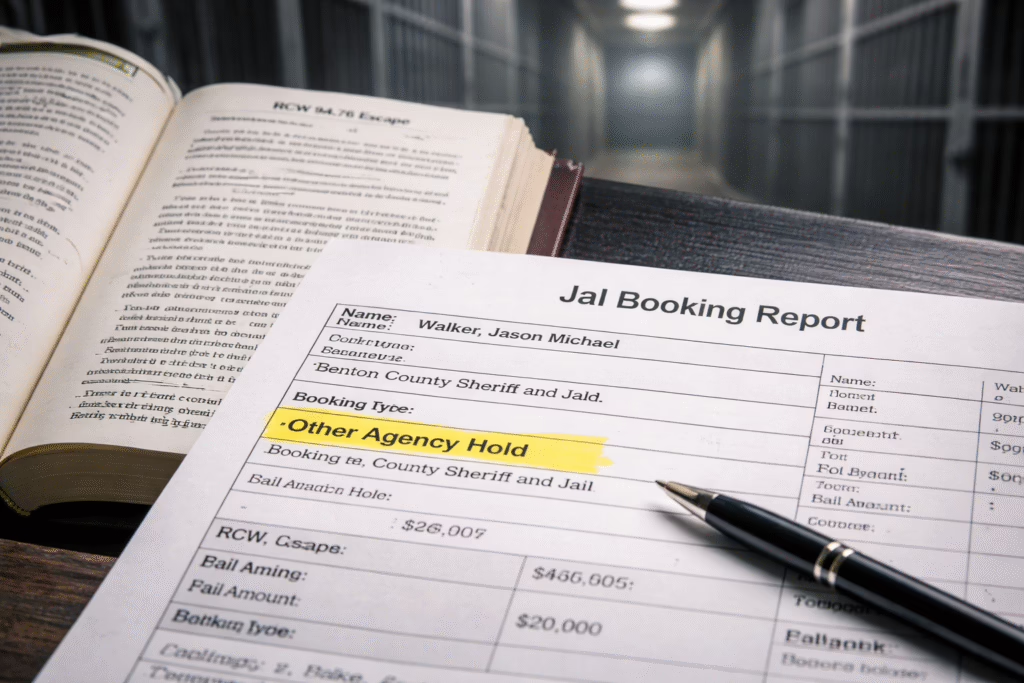
The primary documentary evidence was a jail “release report” showing Walker was booked under an “Other Agency Hold.” The Court held that this vague booking designation did not permit a reasonable inference that Walker was confined because he had been arrested, charged, or convicted of a qualifying offense.
Importantly, the jury was left without evidence establishing the legal basis for Walker’s confinement. Without proof of lawful detention for a statutorily recognized reason, the conviction could not stand.
The Standard of Review
On appeal, sufficiency of the evidence claims are reviewed in the light most favorable to the State. The question is whether any rational trier of fact could have found the essential elements beyond a reasonable doubt.
Even under that deferential standard, the Court concluded the evidence was insufficient.
Because the reversal was based on insufficiency—not trial error—the proper remedy was dismissal with prejudice, not retrial.
Why the Amendment to the Charging Document Mattered
The opinion notes that the State amended the information on the morning of trial to simplify jury instructions and avoid potential prejudice.
While the Court commended the prosecutor’s candor and professionalism, the amended theory eliminated the explicit allegation that Walker was being held on felony charges. That omission contributed directly to the evidentiary gap.
This case illustrates how charging decisions can materially affect proof requirements.
This Is an Unpublished Opinion — What That Means
State v. Walker is an unpublished Court of Appeals opinion.
Under General Rule (GR) 14.1, unpublished opinions:
- Are not binding precedent in Washington.
- May be cited as nonbinding, persuasive authority.
- Do not establish new law.
Walker does not create a new rule. Instead, it applies established statutory interpretation principles to a specific evidentiary record.
Even so, unpublished opinions can be valuable. They provide insight into how appellate courts apply sufficiency standards in real prosecutions and highlight evidentiary weaknesses that may arise in escape cases.
For defense attorneys, Walker offers persuasive support where the State fails to prove the legal basis for confinement.
Practical Takeaways for Washington Criminal Defense
This decision reinforces several important points:
- The State must prove every statutory element, including the legal reason for confinement.
- Jail records must clearly establish arrest, charge, or conviction status.
- Vague booking entries such as “hold” may be insufficient.
- Strategic amendments to charging documents can create unintended proof problems.
- Sufficiency reversals result in dismissal with prejudice.
When facing an escape charge, careful attention to the statutory definition of “detention facility” is critical.
Protecting Your Rights in Washington Criminal Cases
Criminal convictions must be supported by legally sufficient evidence. If the State fails to prove each element beyond a reasonable doubt, the conviction cannot stand.
Understanding decisions like State v. Walker can make a decisive difference at trial and on appeal.
Review our client resources here
Contact us anytime for your urgent legal needs.
About Blanford Law:
We are no-nonsense, relentless, fair, and honest. We are great listeners instead of fast talkers, that is just who we are. More than 20 years ago, Ken began practicing law with a deeply-seeded belief that every person has the right to the best legal representation available. He built his law firm on that belief. Another belief that he strongly adheres to is his fundamental belief that clients deserve respect, with no assumptions or preconceived notions. If you or someone you know is accused of a crime or injured as a result of the negligence of another, please have them call us at 253-720-9304 or email us info@blanfordlaw.com
Additional Resources
State v. Jackson Restraints
A detailed analysis of the Washington Supreme Court’s decision reinforcing the requirement for individualized, on-the-record findings before imposing courtroom restraints.
https://blanfordlaw.com/state-v-jackson-restraints/
State v. Damon Restraints
Explains the foundational Washington Supreme Court case establishing that defendants are entitled to appear free from restraints absent specific judicial findings.
https://blanfordlaw.com/state-v-damon-restraints/
Courtroom Restraints at Sentencing in Washington
Examines how restraint rules apply not only at trial but also during sentencing proceedings in Washington courts.
https://blanfordlaw.com/courtroom-restraints-at-sentencing-washington/
Washington RPC 3.7 – Lawyer as Witness Rule
Discusses the ethical limitations on attorneys serving as both advocate and witness in the same proceeding under Washington’s Rules of Professional Conduct.
https://blanfordlaw.com/washington-rpc-3-7/
Washington RPC 3.6 – Trial Publicity Rule
Analyzes restrictions on extrajudicial statements by attorneys and how improper publicity can affect criminal proceedings.
https://blanfordlaw.com/washington-rpc-3-6/