
Understanding Juvenile Strike Sentencing in Washington
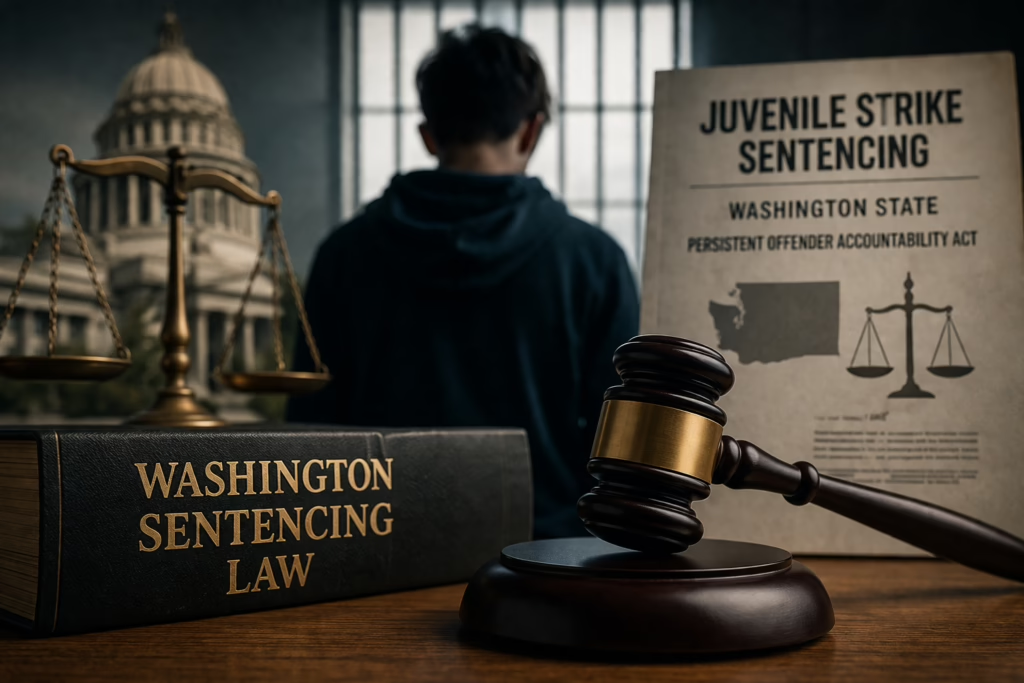
Juvenile strike sentencing became a major issue in State v. Reynolds, a Washington Supreme Court decision involving the state’s Persistent Offender Accountability Act. The case asked whether Washington courts may count an adult conviction for a crime committed as a juvenile as a “strike” when sentencing someone later as a persistent offender.
The Washington Supreme Court held that they may. In a divided decision, the court ruled that counting Reynolds’ prior conviction from conduct committed at age 17 did not violate either the Eighth Amendment or article I, section 14 of the Washington Constitution.
What Happened in State v. Reynolds?
Michael Scott Reynolds Jr. was sentenced to life in prison without the possibility of parole after being classified as a persistent offender. His sentence was based on three qualifying strike offenses.
One of those strikes came from conduct he committed when he was 17. Reynolds argued that using a juvenile offense as part of a mandatory life-without-parole sentence was unconstitutional. He relied heavily on Washington cases recognizing that children are different from adults for sentencing purposes.
The court rejected that argument. It emphasized that Reynolds was not being sentenced for a juvenile crime alone. Instead, he was being sentenced as an adult persistent offender after committing another serious offense at age 33.
How the Court Viewed Juvenile Strike Sentencing
The court acknowledged that Washington’s constitution gives broader protection than the federal constitution in some juvenile sentencing cases. Prior cases, including State v. Bassett, prohibit sentencing juveniles to life without parole.
But the court drew a distinction. Reynolds was an adult when he committed the offense that triggered the persistent offender sentence. The juvenile offense was used as part of his criminal history, not as the sole basis for punishing him as a child.
That distinction was central to the ruling.
The Persistent Offender Accountability Act
Washington’s Persistent Offender Accountability Act, often called the “three strikes” law, requires life without parole for certain repeat offenders. Under RCW 9.94A.570, a persistent offender must receive a sentence of total confinement for life without the possibility of release.
In Reynolds’ case, the sentencing court found that he had three qualifying strike offenses. Because of that finding, the statute required a life sentence.
Why the Decision Matters
The Reynolds decision matters because it confirms that some juvenile conduct can still have lifelong consequences in Washington sentencing. Even though Washington law treats youth differently in many contexts, the court did not create a categorical rule barring juvenile-based strikes from later persistent offender sentencing.
For defendants, this means old convictions may still affect future sentencing exposure. For attorneys, it means criminal history must be reviewed carefully, especially in serious felony cases.
Constitutional Concerns and the Dissent
The case was not unanimous. The dissent would have found it unconstitutional to use juvenile criminal conduct to impose a mandatory life-without-parole sentence under the three-strikes law.
That disagreement shows how difficult this area of law remains. Washington courts recognize that youth matters, but Reynolds shows there are limits to how far that principle extends.
Practical Takeaway
Juvenile strike sentencing remains legally valid in Washington after State v. Reynolds. A prior conviction based on juvenile conduct may still count as a strike if it qualifies under the persistent offender statute.
Anyone facing a serious felony charge should understand how prior convictions may affect sentencing. In Washington, criminal history can change the entire outcome of a case.
Contact Blanford Law
Contact Blanford Law today at ken@blanfordlaw.com or 253-720-9304 for guidance on your legal matter.
Additional Resources
AI-Generated Art Not Protected by Copyright Law
This article explores why AI-generated artwork does not qualify for copyright protection, examining the legal nuances and implications for creators and businesses in the digital age.
Read more
Exploring Washington State Evidence Rule 404: Character Evidence in Legal Proceedings
A comprehensive breakdown of Washington’s Evidence Rule 404, focusing on how character evidence is handled in court and its potential impact on both civil and criminal cases.
Read more
Virtual Court: How Do I Find the Virtual Court in Washington State?
A helpful guide for navigating the virtual court system in Washington State, complete with steps for accessing hearings and tips for proper courtroom conduct in a virtual environment.
Read more
Understanding ER 609: Impeachment by Evidence of Conviction of Crime
This article explains Washington’s Evidence Rule 609, which allows the use of prior criminal convictions to challenge the credibility of witnesses during legal proceedings.
Read more
“Those Are Not My Pants” — Are They Your Drugs? Washington Supreme Court Finds RCW 69.50.4013 Unconstitutional
A deep dive into a Washington Supreme Court ruling that found RCW 69.50.4013, which criminalized simple drug possession, unconstitutional, and the far-reaching effects of this decision.
Read more
Tragic Three-Vehicle Crash Near Cle Elum Claims One Life and Shakes Community
A report on the fatal three-vehicle accident near Cle Elum that claimed one life, examining the role of negligence and the legal implications for those involved.
Read more
Tragic Head-On Collision Claims Life of Methow Valley Man: Importance of Road Safety Highlighted
This article details a tragic head-on collision in Methow Valley, underscoring the importance of road safety and the potential legal ramifications of such accidents.
Read more
Tragic Accident in Kittitas County Claims Life of Sunnyside Boy
A heartbreaking account of an accident in Kittitas County that led to the death of a young boy from Sunnyside, highlighting the legal aspects of wrongful death and negligence cases.
Read more
Review our client resources here
Contact us anytime for your urgent legal needs.
About Blanford Law:
We are no-nonsense, relentless, fair, and honest. We are great listeners instead of fast talkers, that is just who we are. More than 20 years ago, Ken began practicing law with a deeply-seeded belief that every person has the right to the best legal representation available. He built his law firm on that belief. Another belief that he strongly adheres to is his fundamental belief that clients deserve respect, with no assumptions or preconceived notions. If you or someone you know is accused of a crime or injured as a result of the negligence of another, please have them call us at 253-720-9304 or email us info@blanfordlaw.com