
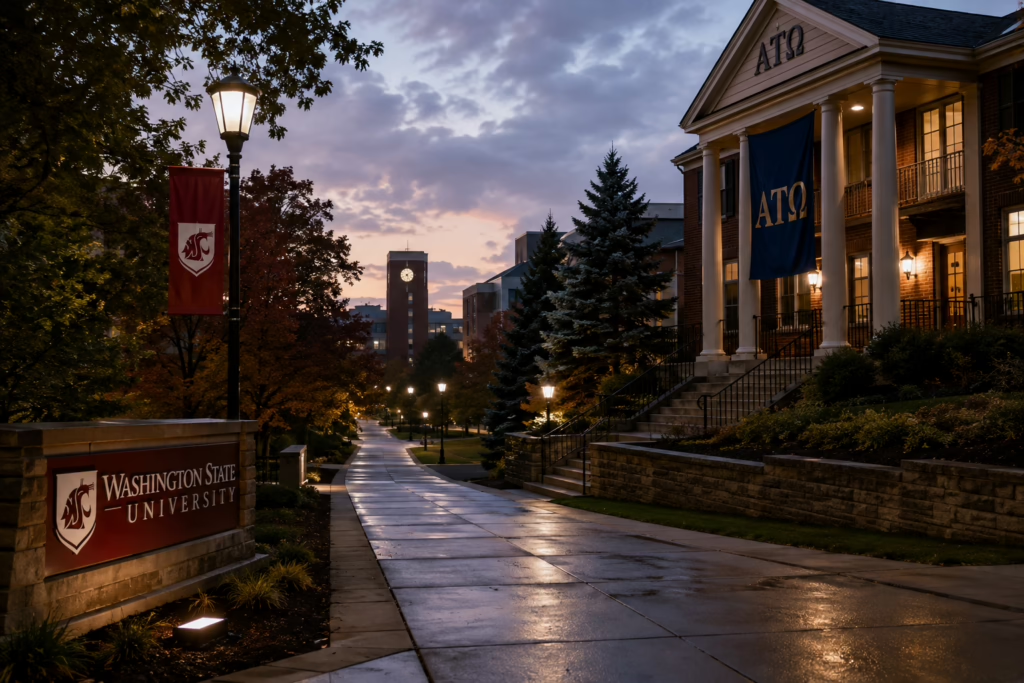
When does a university become legally responsible for harm caused by a recognized fraternity? That question was at the center of Martinez & Houtz v. Washington State University, a landmark Washington Supreme Court decision that could shape future fraternity hazing liability claims across the state.
The Court did not decide that Washington State University caused Sam Martinez’s death. Instead, it answered a threshold legal question: whether WSU owed Sam Martinez a duty of reasonable care because of its relationship with the Gamma Chi chapter of Alpha Tau Omega. The Court concluded that it did.
That distinction matters. Duty is only the first element of negligence. The Martinez family must still prove that WSU breached its duty and that the breach caused Sam’s death.
The Tragic Events Leading to the Lawsuit
According to the Supreme Court’s opinion, Sam Martinez was a 19-year-old freshman who accepted a bid to join Gamma Chi, the WSU chapter of Alpha Tau Omega. On November 12, 2019, he died from acute alcohol intoxication during a fraternity initiation event involving hazing.
His parents filed suit individually and on behalf of his estate against WSU, the fraternity, fraternity members, and others. Although the lawsuit raised multiple claims, the appeal before the Washington Supreme Court focused on a single legal issue: whether WSU owed Sam a duty.
Why the Court Found That WSU Owed a Duty
The Court analyzed the case under Restatement (Second) of Torts § 315(a), which recognizes that a duty may arise when a defendant has a special relationship with a third party and enough ability to control that third party to protect foreseeable victims.
The majority concluded that WSU’s long-standing recognition of Gamma Chi created precisely that type of relationship.
Recognition was not merely symbolic. According to the opinion, WSU granted the fraternity significant benefits, including access to university resources, use of university trademarks, advising, recruitment opportunities, and participation in campus programs. In return, Gamma Chi agreed to comply with university policies governing alcohol, hazing, risk management, reporting obligations, and student conduct.
The Court also emphasized that WSU retained meaningful enforcement authority. It could investigate misconduct, impose sanctions, suspend recognition, or permanently revoke a fraternity’s recognition. The majority concluded that these powers demonstrated sufficient control to create a legal duty.
Foreseeability Was Equally Important
The opinion also explains that duty depended on foreseeability.
The Court pointed to evidence that WSU understood the risks associated with fraternity alcohol abuse and hazing, particularly for first-year students. It reviewed the university’s own policies, investigations, and efforts to address those dangers.
Because WSU allegedly possessed both knowledge of the risks and authority over Gamma Chi, the majority concluded that Sam Martinez fell within the class of foreseeable victims.
Why the Court Rejected WSU’s Arguments
WSU argued that an earlier Washington Supreme Court decision, Barlow v. State, controlled the outcome.
The majority disagreed.
Unlike Barlow, which involved an individual student, Martinez involved a continuing institutional relationship between the university and a recognized fraternity. According to the Court, that relationship included both continuing oversight and practical enforcement authority, making the cases materially different.
What the Decision Means for Fraternity Hazing Liability
The decision does not establish that WSU is liable.
Instead, it establishes that the university owed Sam Martinez a legal duty under the circumstances presented. Whether WSU breached that duty and whether any breach caused Sam’s death remain questions for the trial court.
The opinion nevertheless represents an important development in Washington law. Universities that recognize student organizations, impose conduct rules, monitor compliance, and retain disciplinary authority may face increased scrutiny when foreseeable hazing injuries occur.
For students, families, and educational institutions, the decision highlights how recognition agreements, oversight policies, and enforcement practices can become central evidence in negligence litigation involving fraternity hazing liability.
Contact Blanford Law today at ken@blanfordlaw.com or 253-720-9304 for guidance on your legal matter.
Additional Resources
Barbie Jeep DWI Incident: Legal Issues After a Child Vehicle Crash
A look at the criminal and civil legal issues that can arise when impaired driving allegedly leads to a child being injured in an unconventional vehicle.
https://blanfordlaw.com/barbie-jeep-dwi-incident/
Tragic Motorcycle Accident on Whidbey Island: Understanding Washington Wrongful Death Claims
Learn how Washington law addresses wrongful death claims after a fatal motorcycle collision and what surviving families should know.
https://blanfordlaw.com/tragic-motorcycle-accident-on-whidbey-island/
Domestic Violence Treatment in Pierce County
An overview of domestic violence treatment programs in Pierce County and how they may affect criminal cases and court proceedings.
https://blanfordlaw.com/domestic-violence-treatment-pierce-county/
RCW 5.50.010: Electronic Signatures Under Washington Law
Explains Washington’s electronic signature statute, including when electronic signatures are legally valid and enforceable.
https://blanfordlaw.com/rcw-5-50-010-electronic-signatures-washington/
Lawyer-Client Conflicts of Interest: RPC 1.8 Explained
A guide to Washington Rule of Professional Conduct 1.8 and the ethical rules governing conflicts of interest between lawyers and clients.
https://blanfordlaw.com/lawyer-client-conflicts-interest-rpc-1-8/