
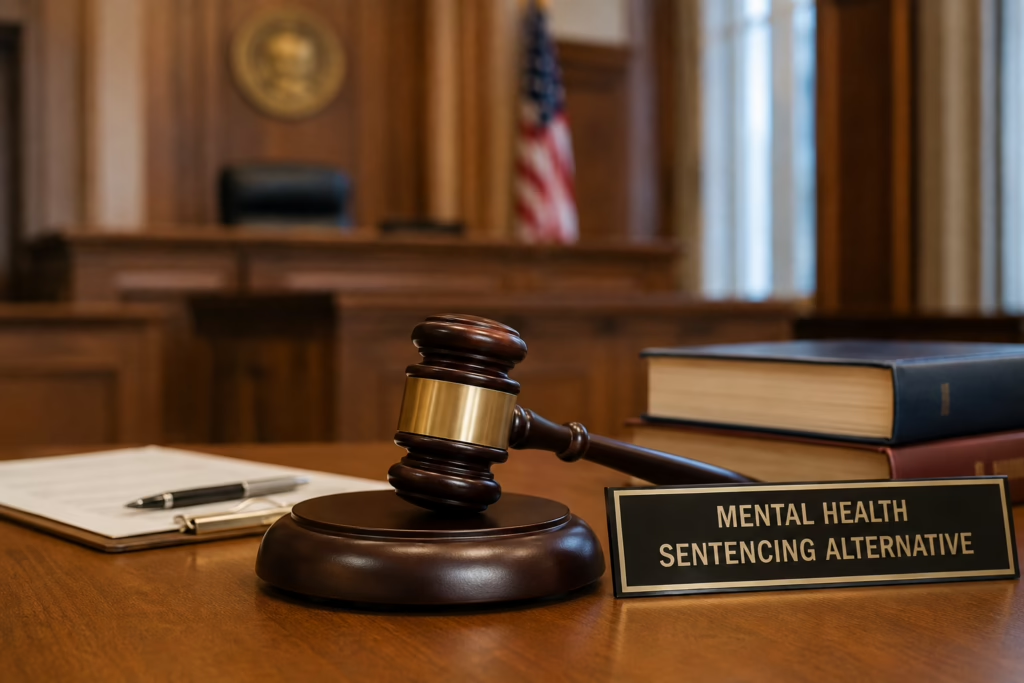
The mental health sentencing alternative gives eligible Washington defendants an opportunity to receive treatment and community supervision instead of a standard-range prison sentence. In State v. Perrin, No. 104816-5, the Washington Supreme Court clarified that this alternative can also permit a judge to waive confinement tied to a deadly weapon enhancement.
The court filed its unanimous en banc opinion on July 30, 2026. It affirmed the trial court’s decision to impose community custody without additional confinement for the weapon enhancement. The ruling explains how two parts of Washington’s Sentencing Reform Act work together.
Mental Health Sentencing Alternative Under Washington Law
RCW 9.94A.695 establishes Washington’s mental health sentencing alternative. The statute does not make the option available in every felony case.
A defendant must satisfy several eligibility requirements. Among other things, the defendant must:
- Have a qualifying serious mental illness diagnosis.
- Be convicted of a felony that is not a serious violent offense or sex offense.
- Be willing to participate in treatment.
- Show that both the defendant and the community would benefit from treatment and supervision.
The court must also determine that the alternative is appropriate. Before imposing it, the judge considers available treatment services, the proposed treatment plan, public safety, and the defendant’s willingness to participate.
When the court approves the alternative, RCW 9.94A.695(4) directs the court to waive the sentence within the standard range. The court then imposes community custody with treatment and supervision requirements.
What Happened in State v. Perrin?
According to the Supreme Court’s opinion, Scott Perrin left harassing messages for a woman, damaged Troy Brisby’s bicycle, and assaulted Brisby with a sword. A jury found Perrin guilty of second-degree assault with a deadly weapon, felony harassment, and third-degree theft.
Perrin requested the mental health sentencing alternative for his felony convictions. The trial judge granted the request and imposed 36 months of community custody.
However, the judge did not impose confinement for the deadly weapon enhancement. The State appealed and argued that Washington law required the enhancement to be served in total confinement.
The Court of Appeals found the Sentencing Reform Act ambiguous on that question. It applied the rule of lenity, which generally requires courts to interpret an ambiguous criminal law in the defendant’s favor. The appellate court then affirmed the sentence.
The Washington Supreme Court accepted review of the weapon-enhancement issue.
How the Court Applied the Mental Health Sentencing Alternative
Washington’s deadly weapon enhancement statute generally states that qualifying enhancements are mandatory. It also says they must be served in total confinement and consecutively to other sentencing provisions.
At the same time, RCW 9.94A.695 requires a court using the mental health sentencing alternative to waive the standard-range sentence. The central question was whether the weapon enhancement remained separate from that standard range.
The Supreme Court held that it did not.
The court relied in part on its earlier decision in State v. Yancey. That case treated a statutory enhancement as part of the defendant’s standard sentencing range once the enhancement had been calculated.
Washington’s sentencing statutes also state that additional time for a deadly weapon finding must be added to the entire standard sentence range.
Therefore, once Perrin’s deadly weapon enhancement was determined, it became part of his standard-range sentence. Because the trial court waived that sentence under RCW 9.94A.695, it also properly waived confinement associated with the enhancement.
Why the “Mandatory” Language Did Not Change the Result
The State emphasized that RCW 9.94A.533 describes deadly weapon enhancements as mandatory “notwithstanding any other provision of law.”
The Supreme Court rejected the argument that this language controlled the case by itself. Courts must read statutory language in the context of the entire statutory scheme. The justices concluded that the two provisions could be harmonized.
The enhancement remains mandatory when a court imposes a standard-range sentence. However, when a judge lawfully grants the mental health sentencing alternative, the judge waives that standard-range sentence. Because the enhancement is part of the range, it is waived with the rest of the sentence.
The court also explained that prior decisions describing weapon enhancements as mandatory had not addressed this specific sentencing alternative.
The Rule of Lenity Provided Additional Support
The Supreme Court found that the statutes could be read together without creating a direct conflict. Still, the court addressed what would happen if uncertainty remained.
Under the rule of lenity, courts construe genuinely ambiguous criminal statutes in favor of the defendant. The Supreme Court concluded that this rule would support the same outcome if the Sentencing Reform Act were ambiguous.
Therefore, both the court’s reading of the statutes and the rule of lenity supported affirming Perrin’s sentence.
What the Perrin Decision Means for Washington Cases
The decision does not make every defendant with a mental health condition eligible for an alternative sentence. Eligibility remains limited by RCW 9.94A.695, and the sentencing judge must decide whether the alternative is appropriate.
The ruling also does not eliminate deadly weapon enhancements generally. Instead, it addresses what happens after a judge approves this particular sentencing option.
For eligible defendants, Perrin confirms that the court may waive the complete standard-range sentence. That waiver can include confinement connected to a deadly weapon enhancement.
The decision may be important in cases involving serious mental illness, a viable treatment plan, willing treatment providers, and a felony that does not fall within the statute’s excluded categories. However, the result of any sentencing request depends on the individual facts, statutory eligibility, treatment resources, and the judge’s assessment.
A defense attorney can help gather mental health records, identify treatment providers, develop a proposed plan, and explain why structured treatment and supervision would benefit the defendant and the community.
6. Call to Action
Contact Blanford Law today at ken@blanfordlaw.com or 253-720-9304 for guidance on your legal matter.
Additional Resources
- RCW 9A.08.010: Understanding Culpability and Mental States in Washington Criminal Law
Learn how Washington law defines intent, knowledge, recklessness, and criminal negligence when determining criminal responsibility. - State v. Fuller: Deadly Weapon Enhancement Requires Total Confinement in Washington
This article reviews Washington law governing mandatory deadly weapon enhancements and explains the confinement rule addressed in State v. Fuller. - Unranked Felony Sentencing | State v. Soto
Explore how Washington courts sentence unranked felonies and why certain firearm enhancements may not apply when an offense lacks a designated seriousness level. - Pierce County ATC Program: Jail Alternatives in Superior Court
Learn about Pierce County’s Alternative to Confinement program and the structured options that may be available to eligible defendants instead of jail. - Pennsylvania Car Crash: Vehicle Slams Into Second Story of Home
Read about an unusual vehicle collision and the legal and safety issues that may arise when a crash causes significant damage to residential property.