
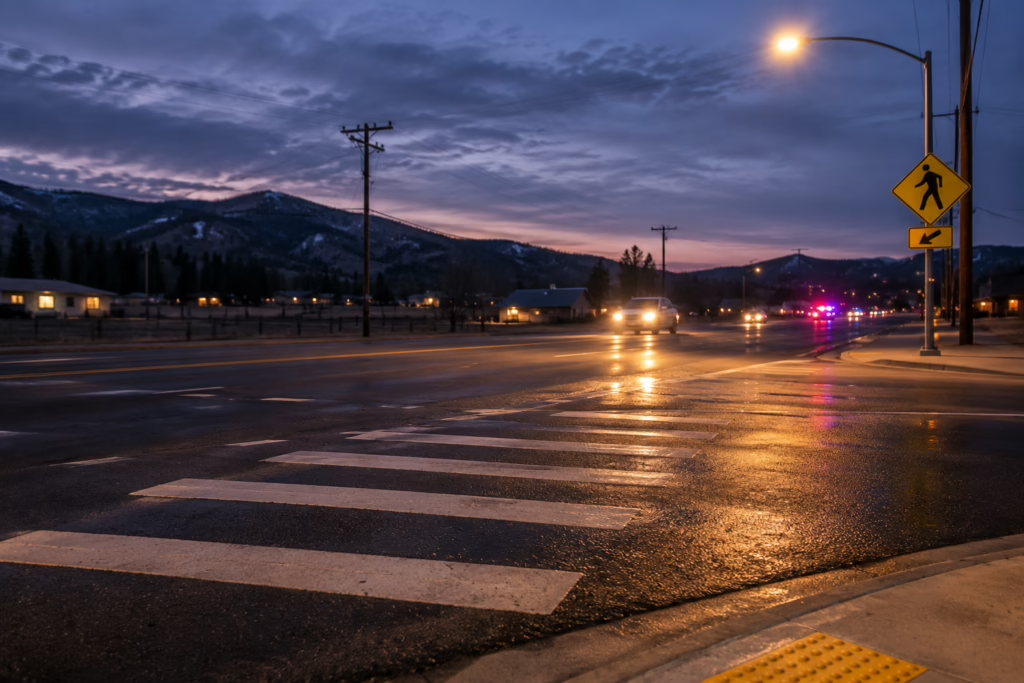
A serious Omak pedestrian accident on Halloween night has raised important questions about crosswalk safety, driver responsibility, and the legal rights of people injured while walking across Washington roads. According to a November 2, 2026, report from NewsRadio 560 KPQ, a pedestrian suffered significant injuries after being struck by a vehicle while entering a crosswalk along U.S. Highway 97 in Omak.
Although the Washington State Patrol continues to investigate the collision, the incident highlights an important legal issue: When a pedestrian is struck in a crosswalk, who may be responsible for the resulting injuries and financial losses?
Washington law provides important protections for pedestrians. When a driver’s negligence causes a collision, an injured pedestrian may have the right to seek compensation through a personal injury claim.
What Happened in the Omak Pedestrian Accident?
According to NewsRadio 560 KPQ, the collision occurred on Saturday, October 31, 2026, at approximately 9:15 p.m. near the intersection of U.S. Highway 97 and Engh Road in Omak, Washington.
The Washington State Patrol reported that 45-year-old Omak resident Larry O’Bryan was entering a crosswalk when he was struck by a sedan driven by 59-year-old Denise Schulz of Riverside.
O’Bryan sustained significant injuries and was airlifted to Sacred Heart Medical Center in Spokane for treatment.
Authorities reported that neither individual was intoxicated. As of the November 2 news report, the cause of the collision remained under investigation, and no charges were known to be pending against the driver.
Importantly, the fact that a pedestrian was struck in a crosswalk does not automatically establish driver negligence. Investigators must examine the circumstances, including vehicle speed, visibility, traffic signals, the pedestrian’s movements, and whether the driver had sufficient time to stop.
No determination of civil liability has been reported.
Washington Crosswalk Laws and Driver Responsibility
Washington has specific laws designed to protect pedestrians crossing public roadways.
Drivers Must Stop for Pedestrians in Crosswalks
Under RCW 46.61.235, drivers must stop and remain stopped for pedestrians in marked or unmarked crosswalks when the pedestrian is upon or within one lane of the half of the roadway in which the vehicle is traveling or turning.
This requirement is especially important at intersections where pedestrians and vehicles share the roadway.
However, the statute also prohibits pedestrians from suddenly entering the path of a vehicle that is too close for the driver to stop.
Whether a driver violated the law depends on the specific facts of the collision.
Drivers Have a Duty to Exercise Reasonable Care
Washington law also imposes a broader responsibility on motorists.
Under RCW 46.61.245, drivers must exercise due care to avoid colliding with pedestrians.
Depending on the circumstances, reasonable care may require drivers to:
- Watch carefully for pedestrians near intersections.
- Adjust their driving to account for darkness and limited visibility.
- Maintain a safe and lawful speed.
- Avoid distractions that interfere with attention to the roadway.
- Respond appropriately when pedestrians are visible near a crosswalk.
A driver may potentially be negligent even when alcohol or drugs are not involved.
Can an Injured Pedestrian File a Personal Injury Claim in Washington?
Yes. A pedestrian injured by a negligent driver may be able to pursue a personal injury claim under Washington law.
Generally, a successful negligence claim requires proof that the driver owed a duty of care, breached that duty, and caused injuries resulting in legally compensable damages.
In a crosswalk collision, important evidence may include:
- The Washington State Patrol collision report.
- Witness statements and nearby surveillance footage.
- Traffic signals, lighting, and roadway conditions.
- Vehicle speed, braking evidence, and driver conduct.
- Emergency medical records and subsequent treatment documentation.
Because the Omak collision remains under investigation, it would be premature to conclude that the driver was legally responsible. Nevertheless, the reported circumstances illustrate why a careful independent review can be important following a serious pedestrian injury.
What if the Pedestrian Was Partially at Fault?
Washington follows a pure comparative fault system under RCW 4.22.005.
This means an injured pedestrian may still recover damages even if they share some responsibility for the collision. Their compensation is reduced according to their percentage of fault.
For example, if a pedestrian sustained $200,000 in recoverable damages but was found 20% responsible, the award would generally be reduced to $160,000.
Fault must be determined from evidence, not assumptions about who was involved in the collision.
What Compensation May Be Available After a Pedestrian Accident?
Pedestrian collisions can result in serious injuries because people walking have little physical protection against moving vehicles.
Depending on the circumstances, injuries may include fractures, traumatic brain injuries, spinal injuries, internal injuries, and lasting mobility limitations. These are possible consequences of pedestrian collisions generally, not confirmed diagnoses in the Omak case.
A personal injury claim may seek compensation for several categories of losses.
Medical Expenses and Rehabilitation
Recoverable damages may include emergency transportation, hospital care, surgery, rehabilitation, medication, and reasonably anticipated future medical treatment.
Lost Income and Reduced Earning Capacity
A seriously injured pedestrian may be unable to return to work for weeks or months. Some injuries may permanently affect the person’s ability to earn a living.
Pain, Suffering, and Loss of Enjoyment of Life
Washington personal injury law also permits recovery of appropriate noneconomic damages, including physical pain, emotional distress, and the loss of enjoyment of normal activities.
The amount of compensation depends on the severity of the injuries, available evidence, insurance coverage, and the facts establishing liability.
Why Evidence Matters After a Serious Crosswalk Collision
Evidence can disappear quickly after a pedestrian accident.
Surveillance footage may be overwritten, witnesses may become difficult to locate, and roadway conditions may change.
When possible, injured pedestrians and their families should preserve photographs, medical records, witness information, insurance correspondence, and other relevant documentation.
They should also avoid making recorded statements to an opposing insurance company or accepting an early settlement without understanding the full extent of their injuries and legal rights.
A personal injury attorney can help evaluate liability, identify applicable insurance coverage, preserve evidence, and assess potential future damages.
How Long Do Pedestrian Accident Victims Have to File a Claim?
Under RCW 4.16.080, most Washington personal injury lawsuits must be filed within three years of the injury.
However, exceptions and different procedural requirements may apply, particularly when a government entity is involved or the injured person is a minor.
Waiting until the deadline approaches can make a case more difficult because important evidence may no longer be available.
Seeking legal advice early can help protect an injured person’s options.
Speak With Blanford Law About a Washington Pedestrian Injury Claim
The Halloween night collision in Omak is a reminder of how devastating pedestrian accidents can be. While the investigation must determine what happened in this particular incident, Washington law provides avenues for injured pedestrians to pursue compensation when another party’s negligence caused their injuries.
At Blanford Law, we understand that a serious injury can create substantial physical, emotional, and financial challenges.
If you or someone you love has been injured in a pedestrian accident in Washington, understanding your rights is an important first step.
Contact Blanford Law today at ken@blanfordlaw.com or 253-720-9304 for guidance on your legal matter.
Additional Resources
1. Snoqualmie Pass Chain Requirements and WSP Enforcement — Explains Washington’s winter driving requirements and Washington State Patrol enforcement, highlighting the importance of following traffic safety laws to prevent serious collisions.
2. Washington DUI License Suspension — Discusses the consequences of impaired driving in Washington, including license suspension and the legal responsibilities motorists face when operating a vehicle.
3. Washington Recall Petition Requirements — Explores Washington’s legal process for recalling elected officials and the standards for government accountability under state law.
Additional Blanford Law Personal Injury Articles
4. Washington Pedestrian Accident Claim: What Injured Pedestrians Should Know After the Martin Way Crash — Explains how Washington pedestrian injury claims work, including negligence, comparative fault, compensation, and the importance of preserving evidence after a collision. Blanford Law
5. Washington Pedestrian Accident: Spokane Valley Man Hit by Bus Near Gorge — Examines driver responsibility, nighttime visibility, pedestrian right-of-way laws, and potential compensation following a serious pedestrian collision. Blanford Law
Blanford Law internal article links will be added after verification against the SEO Article Tracker and unused orphaned-content pool.
Disclaimer: This article provides general information about Washington law and is not legal advice. The facts concerning the Omak collision are based on publicly available reporting as of November 4, 2026. No conclusion regarding fault or legal liability is intended.