
A recent Oroville Semi Truck Crash on U.S. Highway 97 near the Canadian border highlights the dangers of impaired driving and head-on collisions involving commercial trucks. Although neither driver was reportedly injured, the incident raises important questions about negligence, commercial vehicle accidents, and the legal rights of motorists injured in similar crashes throughout Washington State.
Collisions between passenger vehicles and tractor-trailers can have devastating consequences. When a driver crosses the centerline of a highway, particularly while allegedly impaired, the resulting collision may involve significant property damage, serious injuries, and complicated insurance claims.
Understanding how Washington personal injury law applies to these situations can help injured drivers and passengers protect their legal rights.
Washington State Patrol Investigates US 97 Collision Near Oroville
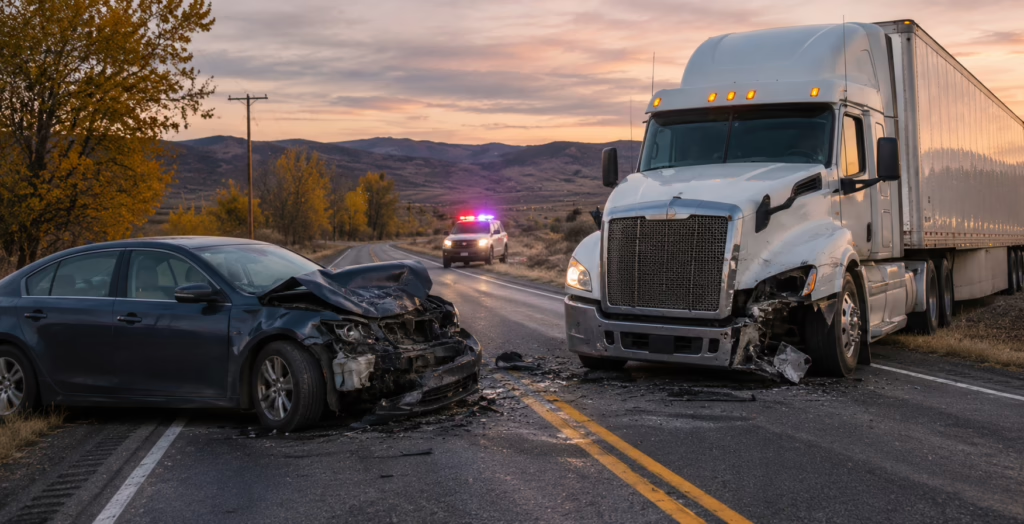
On Saturday, November 14, 2026, at approximately 5:55 p.m., a two-vehicle collision occurred on U.S. Highway 97 about one mile south of Oroville in Okanogan County.
According to the reported Washington State Patrol investigation, a sedan driven by a 54-year-old Oroville resident crossed the highway’s centerline and collided with a tractor-trailer operated by a 55-year-old driver from Lake Country, British Columbia.
Despite the collision, neither driver was reported injured.
Investigators identified suspected impairment as a contributing factor. The sedan driver was reportedly cited for driving under the influence and booked into jail.
The collision blocked traffic along US 97 for several hours, affecting travel near the United States–Canada border.
The DUI allegation is not a criminal conviction, and the available reporting does not establish that the truck driver was negligent.
For information about highway collision investigations, visit the official Washington State Patrol website.
Oroville Semi Truck Crash: How Washington Law Determines Liability
Crossing the Centerline Can Establish Evidence of Negligence
Washington drivers must generally remain on the appropriate side of the roadway.
Under RCW 46.61.100, motorists generally must drive on the right half of the roadway, subject to specified exceptions.
Crossing the centerline into oncoming traffic can violate this duty and create a serious risk of a head-on collision.
When a driver enters an opposing lane and strikes another vehicle, investigators may consider whether the driver was distracted, impaired, fatigued, speeding, or otherwise operating the vehicle negligently.
In a civil personal injury case, evidence of an improper lane departure may help establish responsibility for resulting injuries.
However, a statutory traffic violation does not automatically establish every element of a negligence claim.
DUI Violations and Negligence Per Se
Washington law prohibits driving while under the influence of alcohol, cannabis, or other drugs.
Under RCW 46.61.502, a person may commit DUI by operating a vehicle while affected by intoxicating substances to the degree specified by law.
Washington also has a special rule for negligence claims involving impaired driving.
Under RCW 5.40.050, qualifying violations of Washington’s DUI laws constitute negligence per se.
This can be particularly significant in personal injury litigation because a proven qualifying DUI violation establishes the breach-of-duty element of negligence.
The injured person must still prove that the negligent conduct caused the claimed injuries and damages.
A criminal DUI conviction is not necessarily required before an injured person can pursue a separate civil claim.
Why Collisions With Semi-Trucks Can Be Especially Dangerous
Commercial tractor-trailers are substantially larger and heavier than most passenger vehicles.
Their size and weight can create significant differences in how vehicles respond during a collision.
A passenger vehicle that crosses into the path of a semi-truck may expose its occupants to severe crash forces, even when the truck driver attempts to brake or avoid the collision.
Potential injuries in serious truck accidents include traumatic brain injuries, spinal injuries, broken bones, internal injuries, and permanent disabilities.
Fortunately, the Oroville collision reportedly did not result in injuries.
Nevertheless, the incident illustrates why maintaining proper lane position and avoiding impaired driving are critical safety responsibilities.
Does a Semi-Truck Collision Automatically Mean the Trucking Company Is Liable?
No.
The involvement of a commercial truck does not automatically make the truck driver or trucking company responsible for an accident.
Liability depends on the evidence.
For example, a trucking company may face responsibility in certain circumstances when its employee negligently causes a collision while acting within the scope of employment.
Other potential issues in commercial vehicle cases include negligent maintenance, unsafe loading, driver fatigue, and violations of applicable commercial vehicle safety requirements.
However, those issues should not be assumed simply because a tractor-trailer was involved.
In the Oroville incident, the available reporting attributes the collision to the sedan crossing the centerline while the driver was allegedly impaired. There is no reported basis to conclude that the commercial truck driver caused the collision.
What Compensation Is Available After a Washington Truck Accident?
When a person suffers injuries because of another driver’s negligence, Washington law may allow recovery of economic and noneconomic damages.
Depending on the circumstances, compensation may include:
- Medical expenses: Emergency care, hospitalization, surgery, rehabilitation, and future treatment.
- Lost wages: Income lost because injuries prevent someone from working.
- Reduced earning capacity: Financial losses resulting from long-term or permanent limitations.
- Pain and suffering: Physical pain and the effects of injuries on everyday life.
- Emotional distress: Psychological harm caused by a traumatic collision.
- Property damage: Repair or replacement costs for damaged vehicles and other property.
The amount recoverable depends on the evidence, the severity of the injuries, available insurance coverage, and applicable Washington law.
Because neither driver was reportedly injured in the Oroville collision, the incident should not be characterized as an established personal injury case.
How Comparative Fault Works in Washington Truck Accident Cases
Washington generally follows a comparative fault system.
Under RCW 4.22.005, a claimant’s contributory fault generally reduces the amount of damages recoverable in proportion to that person’s percentage of responsibility.
For example, if an injured person establishes $200,000 in damages but is found 25% responsible for the collision, the recovery would generally be reduced to $150,000.
Washington also has a special statutory defense involving intoxicated claimants.
Under RCW 5.40.060, a claimant’s intoxication may provide a complete defense in certain circumstances when the intoxication proximately caused the injury and the claimant was more than 50% at fault.
The statute contains important conditions and exceptions, including provisions affecting claims against intoxicated drivers.
Because these rules can substantially affect compensation, careful investigation of fault is essential.
Why Evidence Matters in Commercial Truck Collision Claims
Truck accident investigations can involve evidence beyond an ordinary passenger vehicle collision.
Depending on the circumstances, relevant materials may include:
- Washington State Patrol collision reports and photographs.
- Witness statements and roadway evidence.
- Vehicle damage and accident reconstruction findings.
- Commercial vehicle electronic data, when available.
- Driver qualification and hours-of-service records, when relevant.
- Maintenance and inspection documentation.
- Insurance information and communications.
In a serious injury case, preserving evidence promptly can be important.
Some electronic records and commercial documents may be retained only for limited periods, depending on the applicable requirements and circumstances.
A personal injury attorney can help determine which records should be requested or preserved.
What Should You Do After Being Injured in a Semi-Truck Accident?
Seek Medical Attention
Your health should be the first priority.
Even when injuries initially appear minor, medical evaluation may reveal conditions requiring further treatment.
Document the Collision
When safe, photograph the vehicles, roadway, visible injuries, and surrounding conditions.
Obtain witness contact information and preserve available insurance and driver information.
Preserve Financial Records
Keep medical bills, repair estimates, proof of lost income, and other documents showing collision-related losses.
Avoid Premature Settlements
Insurance companies may offer settlements before the full extent of an injury is known.
Signing a release may prevent additional recovery for the same claim.
Consult a Washington Personal Injury Attorney
Commercial vehicle claims can involve complicated questions about liability, insurance coverage, and evidence preservation.
Legal guidance can help injured people understand their options before making important decisions about settlement.
How Long Do You Have to File a Washington Truck Accident Lawsuit?
Under RCW 4.16.080(2), most Washington personal injury lawsuits arising from motor vehicle collisions must be filed within three years.
Certain exceptions and special circumstances may affect the deadline.
Claims involving government entities may also require additional procedural steps.
Because evidence can become harder to obtain over time, seeking legal advice promptly after a serious collision is often beneficial.
Blanford Law Represents Victims of Washington Truck and DUI Accidents
The November 14 collision near Oroville demonstrates how quickly a suspected impaired-driving incident can create dangerous conditions on a major Washington highway.
Although no injuries were reported, similar collisions can leave drivers and passengers facing extensive medical treatment, lost income, and long-term physical limitations.
At Blanford Law, we represent people injured through the negligence of other motorists, including accidents involving commercial trucks, impaired driving, and head-on collisions.
Our personal injury practice helps clients evaluate liability, understand insurance issues, and pursue compensation supported by the facts and applicable law.
If you or a loved one has been injured in a truck accident or DUI-related collision anywhere in Washington State, we can help you understand your legal options.
Contact Blanford Law today at ken@blanfordlaw.com or 253-720-9304 for guidance on your legal matter.
Additional Resources
1. Three Injured in Head-On Crash on U.S. 97 Near Blewett Pass
Examines a collision involving a passenger SUV and a semi-truck on US 97, including injuries, accident investigation, and legal considerations.
2. Washington Semi-Trailer Accident on I-90 Injures State Trooper
Discusses a commercial truck collision involving a Washington State Patrol vehicle and the consequences of negligent driving.
3. Snoqualmie Pass Semi Crash and Brush Fire Cause Major I-90 Disruptions
Reviews a serious semi-truck collision near Snoqualmie Pass and the safety concerns associated with major commercial vehicle accidents.
4. Auburn SR 167 Crash Injures Two Men
Explores a suspected DUI collision that injured two drivers and explains how impaired driving evidence may affect personal injury liability.
5. RCW 5.40.060: Intoxication Defense in Washington Personal Injury and Wrongful Death Cases
Explains how intoxication and comparative fault can affect recovery in Washington personal injury litigation.