
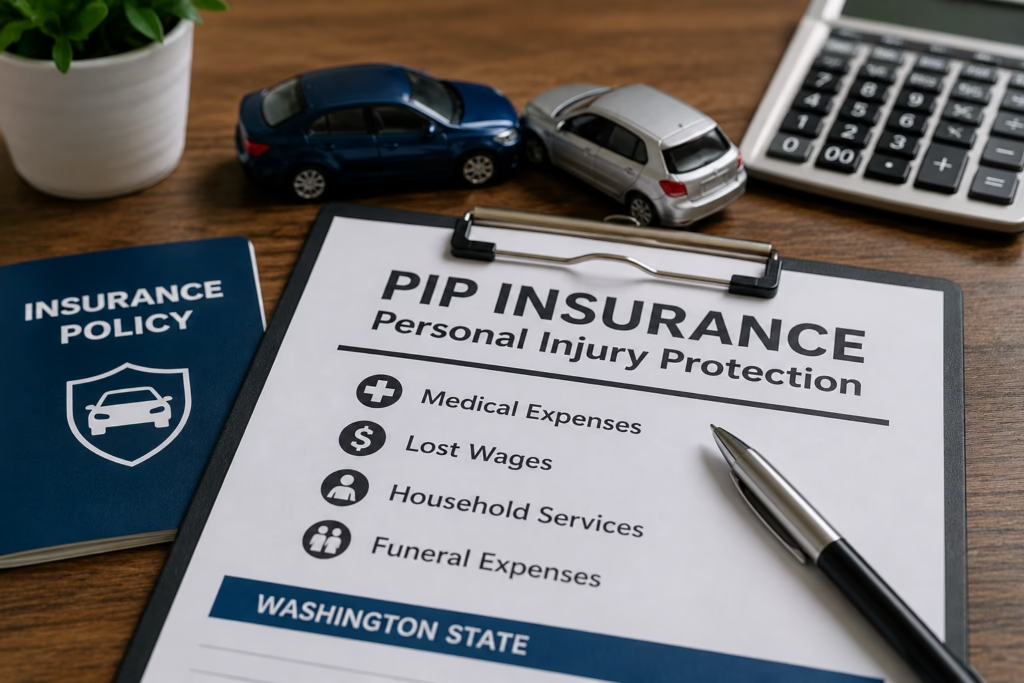
If you are injured in a car accident, PIP insurance in Washington can help pay certain expenses without waiting to determine who caused the crash. Personal Injury Protection, commonly called PIP, is optional auto insurance coverage that can pay medical bills, some lost income, certain household-service expenses, and funeral costs after a covered accident.
Washington does not require drivers to purchase PIP. However, an auto insurer must offer it when issuing or renewing a qualifying automobile liability policy. If the named insured does not want PIP coverage, the coverage must generally be rejected in writing.
That distinction matters after an accident. Many people do not realize they have PIP until medical bills begin arriving.
How Does PIP Insurance in Washington Work?
PIP is often described as no-fault coverage because benefits may be available regardless of which driver caused the collision.
For example, suppose another driver runs a red light and hits your car. Liability may ultimately be clear, but the other driver’s insurance company may still need time to investigate the collision.
If you have PIP coverage, you may be able to submit qualifying medical expenses to your own insurer while the liability claim is developing.
That can be particularly important when an injury requires emergency care, physical therapy, diagnostic testing, medication, or other ongoing treatment.
What Does Washington PIP Cover?
Washington law establishes minimum PIP benefits that insurers must offer.
The minimum limits include:
- $10,000 in medical and hospital benefits
- $2,000 in funeral expense benefits
- $10,000 in income continuation benefits, limited to $200 per week
- $5,000 in loss-of-services benefits, subject to a $200 weekly limit
Drivers may also request higher PIP limits. Washington law requires insurers to offer an enhanced option that includes $35,000 in medical and hospital benefits, $35,000 in income continuation benefits subject to a $700 weekly limit, $2,000 in funeral benefits, and $14,600 in loss-of-services benefits.
Your declarations page should show whether PIP is included and what limits apply.
Medical and Hospital Expenses
PIP medical benefits can pay reasonable and necessary health-care expenses related to injuries from the automobile accident.
Under Washington law, covered medical expenses generally must be incurred within three years of the accident.
Depending on the circumstances and policy, those expenses may include emergency treatment, physician visits, imaging, rehabilitation, medications, ambulance services, and other qualifying care.
An insurer may dispute treatment that it believes is not reasonable, necessary, related to the accident, or otherwise covered by the policy. The Washington Office of the Insurance Commissioner specifically notes that PIP does not require payment for services an insurer determines fail those requirements.
Lost Income
PIP can also provide income-continuation benefits when accident injuries prevent an insured person from working.
Washington law provides that the benefit period begins 14 days after the accident. Payments are subject to policy limits and other statutory restrictions, including a rule limiting combined income-replacement benefits from certain sources to no more than 85 percent of the insured person’s weekly work income.
This can help injured people who miss work while recovering.
Loss of Services
An injury can make ordinary household tasks difficult or impossible.
PIP may reimburse qualifying expenses paid to non-household members to perform services the injured person normally would have performed without compensation, such as certain household chores.
Washington’s statutory definition limits these benefits and requires that the services actually be performed.
Funeral Expenses
Minimum PIP coverage also includes up to $2,000 in funeral expense benefits for a covered death resulting from an automobile accident.
Who Is Covered by PIP Insurance?
PIP protection can extend beyond the person whose name appears on the policy.
Washington law’s definition of an insured can include:
- The named insured
- Certain relatives who live in the named insured’s household
- A ward, foster child, or stepchild meeting the statutory requirements
- A person injured while occupying or using the insured vehicle with permission
- A pedestrian accidentally struck by the insured automobile
Coverage can become more complicated when an insured or household relative is injured while using a different vehicle. Washington law permits exclusions in certain situations when that vehicle is owned or regularly used by the insured or relative but is not listed on the declarations page.
Because policies and accident circumstances differ, the declarations page and actual policy language should be reviewed after a serious accident.
Is PIP Required in Washington?
No. Washington makes PIP optional.
However, insurers generally must offer PIP coverage with new and renewed automobile liability policies. A named insured who does not want the coverage must reject it in writing. Once properly rejected, that rejection remains binding for renewal or replacement policies unless a named insured later requests PIP coverage in writing.
This creates an important issue after an accident.
If an insurer claims there is no PIP coverage, it may be worth confirming whether a valid written rejection exists rather than simply assuming the policy never included PIP.
Does PIP Cover You if You Caused the Accident?
Often, yes.
One of PIP’s most useful characteristics is that it generally applies without regard to fault.
A driver may therefore be able to use PIP even if that driver caused the collision.
However, PIP has statutory exclusions. Washington law allows insurers to exclude benefits for certain injuries, including injuries intentionally caused by the insured, injuries associated with organized racing, and injuries arising from use of an automobile in the commission of a felony.
The actual facts and policy terms matter.
Is PIP the Same as Liability Insurance?
No.
Liability insurance generally protects against damages you legally owe because you caused an accident.
PIP is different. It can provide certain first-party benefits to covered injured people without first establishing another driver’s legal liability.
That means an injured person may have both:
- A PIP claim for certain immediate accident-related expenses; and
- A separate personal injury claim against the driver who caused the collision.
These claims serve different purposes.
Does Using PIP Prevent a Personal Injury Claim?
No.
Using available PIP benefits does not ordinarily mean you give up a claim against the at-fault driver.
A personal injury claim may seek damages beyond PIP’s limited benefits, including additional medical expenses, broader wage loss, pain and suffering, and other legally recoverable losses.
Insurance reimbursement and subrogation issues may later affect how settlement proceeds are distributed, so it is important to account for PIP payments when resolving the overall injury claim.
What if the Insurance Company Stops Paying PIP Benefits?
Disputes can arise over whether treatment remains medically necessary, whether an injury is related to the accident, whether the policy limits have been exhausted, or whether a particular expense qualifies for coverage.
If an insurer stops paying medical bills, the injured person should obtain a written explanation and keep copies of:
- Medical records
- Bills and statements
- Explanation-of-benefits documents
- PIP payment logs
- Letters from the insurer
- Work-loss documentation
- The insurance declarations page
- The complete policy
Those records can help determine what has been paid and why additional benefits are being disputed.
Why PIP Matters After a Washington Car Accident
After a collision, medical treatment often begins long before the at-fault driver’s insurance company is prepared to resolve the injury claim.
PIP can help bridge that gap.
It can provide a source of payment for covered medical care and other expenses while liability, injuries, and damages are still being investigated.
That does not mean every PIP claim proceeds smoothly. Coverage limits, medical disputes, exclusions, and coordination with other insurance can create complications.
If you were seriously injured in a Washington car accident and have questions about PIP coverage or the insurance claim process, legal advice can help you understand which sources of compensation may be available.
Contact Blanford Law today at ken@blanfordlaw.com or 253-720-9304 for guidance on your legal matter.
Additional Resources
Washington Car Insurance Coverage
Learn how PIP, UIM, liability insurance, and other types of Washington auto coverage can affect financial recovery after a crash.
Washington UM/UIM Insurance
Understand how uninsured and underinsured motorist coverage may protect you when the at-fault driver lacks sufficient insurance.
WAC 284-20-300: Waiving UIM or PIP in Washington
Review Washington rules concerning the offering and rejection of PIP and uninsured or underinsured motorist coverage.
Washington Car Accident Steps
Learn practical steps to take after a Washington collision, including documenting injuries and dealing with insurance companies.
A Guide to Mandatory Minimums for Car Insurance in Washington
Review Washington automobile insurance requirements and optional coverage that may become important after an accident.