
For years, many people described DUI deferred prosecution in Washington as a “once-in-a-lifetime” opportunity. That shorthand is now incomplete.
Current Washington law provides a narrow path for certain people to seek a second DUI deferred prosecution. The rule is not available to everyone with a prior DUI, and eligibility depends heavily on when deferred prosecution was first used, whether the new case is the person’s next DUI or physical-control violation, and whether there are other convictions that qualify as a “prior offense.”
The controlling statute is RCW 10.05.010, which governs eligibility for deferred prosecution in Washington.
What Is a Second DUI Deferred Prosecution in Washington?
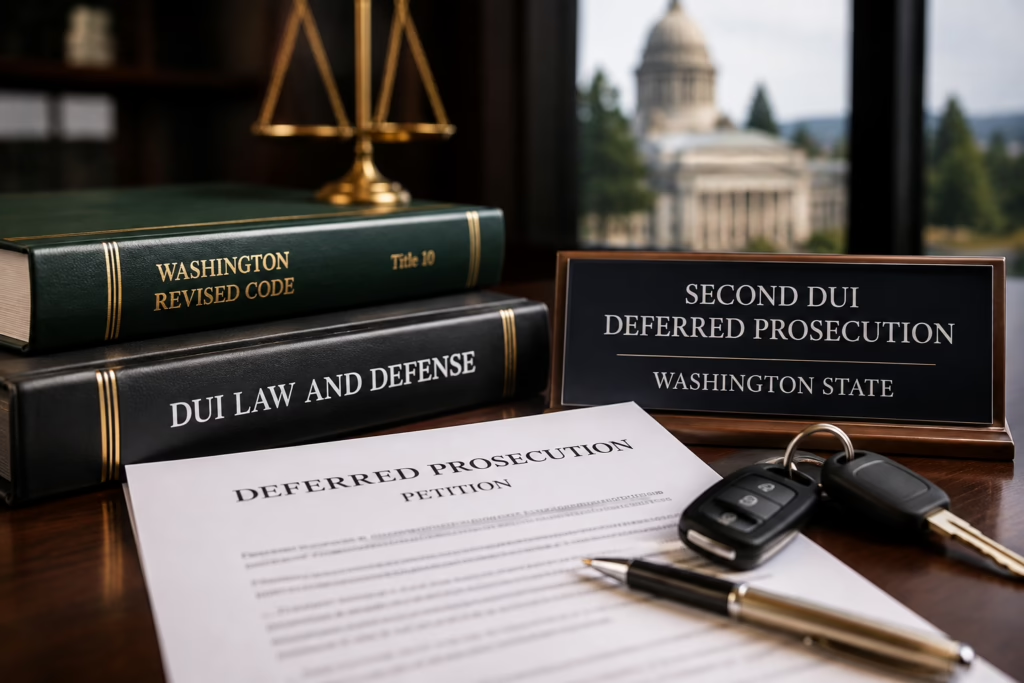
A second DUI deferred prosecution refers to the limited ability of a person who previously participated in deferred prosecution for a DUI or physical-control case to petition for deferred prosecution again.
Under current RCW 10.05.010, a person who participated in deferred prosecution for his or her first violation of Washington’s DUI statute, RCW 46.61.502, or physical-control statute, RCW 46.61.504, may petition for a second deferred prosecution for the person’s next DUI or physical-control violation if the person has no other convictions that meet the statutory definition of a “prior offense.”
That is a significant exception to the older idea that deferred prosecution could never be used more than once.
But it is also a narrow exception.
Who May Qualify for a Second DUI Deferred Prosecution?
The sequence of prior cases matters.
The statute is written to allow a second petition when a person:
- Participated in deferred prosecution for the person’s first DUI or physical-control violation;
- Is now facing the person’s next DUI or physical-control violation; and
- Has no other convictions that qualify as a “prior offense” under Washington’s DUI sentencing statute.
The statutory definition of a “prior offense” is found in RCW 46.61.5055.
One particularly important point is that the person’s first deferred prosecution is not treated as a prior offense for the purpose of determining whether the second deferred prosecution may be granted. RCW 10.05.010 expressly addresses that issue.
Why the Order of the Cases Matters
Consider the difference between these two situations.
A person receives deferred prosecution on the person’s first DUI and years later is charged with a second DUI, with no other qualifying prior convictions. That person may potentially fall within the second-petition provision.
By contrast, a person who did not participate in deferred prosecution for the first DUI may still potentially petition for deferred prosecution on a later qualifying case, but RCW 10.05.010 states that such a person is not eligible for deferred prosecution more than once.
That distinction is why a complete review of the person’s criminal and driving history is important before assuming that a second petition is available.
Can You Be in Two Deferred Prosecutions at the Same Time?
Generally, no.
RCW 10.05.010 provides that a person may petition for a second deferred prosecution while still under the first court’s jurisdiction. However, the first deferred prosecution must be revoked before the second deferred prosecution is entered.
The statute also generally prohibits a person from being on two deferred prosecutions at the same time.
There is a narrow exception involving separate offenses committed within seven days of one another that are consolidated into a single deferred-prosecution program. Separate offenses committed more than seven days apart may not be consolidated in that manner.
Does a Second Petition Automatically Mean the Court Will Grant It?
No.
Being statutorily eligible to petition does not mean the court must grant deferred prosecution.
A petitioner still has to satisfy the broader requirements of Chapter 10.05 RCW.
Under RCW 10.05.020, a petitioner generally must allege under oath that the charged conduct resulted from or was caused by a qualifying substance use disorder, mental health disorder, domestic-violence behavior problem, or other qualifying condition, that treatment is necessary, and that without treatment the probability of future recurrence is great.
The court must also make specific statutory findings before entering the deferred-prosecution order.
A Second DUI Deferred Prosecution Still Requires Major Waivers
The availability of a second petition should not be confused with a simple opportunity to avoid a DUI conviction.
Deferred prosecution involves substantial legal waivers.
Under RCW 10.05.020, the petitioner must acknowledge and waive important rights, including the right to testify, the right to a speedy trial, the right to call witnesses, the right to present defense evidence, and the right to a jury trial.
The petitioner must also stipulate to the admissibility and sufficiency of the facts contained in the written police report.
That matters because if the deferred prosecution is later revoked, those stipulated facts can be used to support a finding of guilt.
For someone facing a second DUI or physical-control charge, that can be an especially important consideration. Before giving up the right to contest the State’s case, the evidence should be evaluated carefully.
What Treatment Is Required?
A second deferred prosecution is still subject to the treatment requirements that apply under Chapter 10.05 RCW.
For a substance use disorder or qualifying co-occurring mental health disorder, RCW 10.05.150 provides for a two-year deferred-prosecution treatment period.
Requirements may include:
- Total abstinence from alcohol and nonprescribed mind-altering drugs;
- Treatment through or approved by a state-approved behavioral health agency;
- Periodic random urinalysis or breath testing;
- Intensive outpatient or residential treatment when required;
- Ongoing outpatient counseling; and
- Participation in qualifying substance-use recovery-support meetings.
The exact program depends on the diagnosis and approved treatment plan.
How Long Before the DUI Charge Is Dismissed?
Treatment completion does not mean the DUI case is dismissed immediately.
Under RCW 10.05.120, for the standard form of deferred prosecution under RCW 10.05.020(1), dismissal cannot occur before five years have passed from entry of the deferred-prosecution order. The person must also prove successful completion of treatment and compliance with the court’s post-treatment conditions.
That means deferred prosecution remains a major long-term commitment even when a second petition is legally available.
Should You Seek a Second Deferred Prosecution or Fight the DUI?
Eligibility does not automatically answer the more important question: whether deferred prosecution is the best strategy.
A person facing another DUI should still evaluate the strength of the State’s evidence.
Potential DUI defenses may involve:
- An unlawful traffic stop;
- Lack of probable cause;
- Problems with breath or blood testing;
- Problems with field sobriety testing;
- Constitutional violations;
- Weak evidence of impairment;
- Evidentiary problems; or
- Defenses specific to a physical-control charge.
If the State’s case has significant weaknesses, conventional DUI defense may produce a better result without requiring the extensive waivers associated with deferred prosecution.
On the other hand, where the person genuinely qualifies for treatment and the prosecution’s evidence is strong, a second deferred prosecution may be an important option to evaluate.
Why the “Once in a Lifetime” Explanation Can Be Misleading
Older discussions of Washington DUI law often describe deferred prosecution as a one-time opportunity.
That statement is now too broad.
Current RCW 10.05.010 expressly creates limited circumstances in which a person may petition for a second deferred prosecution for DUI or physical control.
The more accurate explanation is:
Washington deferred prosecution is generally limited, but current law provides a narrow second-petition opportunity for certain people who used deferred prosecution for their first DUI or physical-control violation and meet the remaining statutory requirements.
Whether someone fits that exception depends on the complete history of prior offenses.
Learn More About Washington DUI Deferred Prosecution
The second-petition rule is only one part of Washington’s deferred-prosecution law.
For a broader explanation of the program—including initial eligibility, required admissions and waivers, treatment, court supervision, revocation, and dismissal—read our Washington DUI Deferred Prosecution guide.
That page provides a more complete overview for anyone deciding whether deferred prosecution should be considered as an alternative to defending or resolving a DUI charge through the ordinary criminal process.
Talk With a Washington DUI Attorney About a Second Deferred Prosecution
Whether a second deferred prosecution is available can depend on details that are easy to overlook, including which case was the person’s first DUI or physical-control violation, whether deferred prosecution was used in that case, and whether other convictions qualify as prior offenses under Washington law.
Even when a person is eligible to petition, the decision should be made only after considering the evidence in the current DUI case, the required treatment, the waiver of trial rights, and the consequences of failing to complete the program.
Contact Blanford Law today at ken@blanfordlaw.com or 253-720-9304 for guidance on your legal matter.
Additional Resources
Washington DUI Deferred Prosecution
A comprehensive guide to deferred-prosecution eligibility, treatment, waivers, supervision, dismissal, and revocation in Washington.
Washington DUI Laws | Penalties, Process & Defenses
Learn how Washington DUI charges are prosecuted and review common penalties, license consequences, and defense issues.
DUI & Alcohol Offenses
Blanford Law’s primary DUI practice page provides an overview of DUI and alcohol-related charges and the importance of early defense review.