
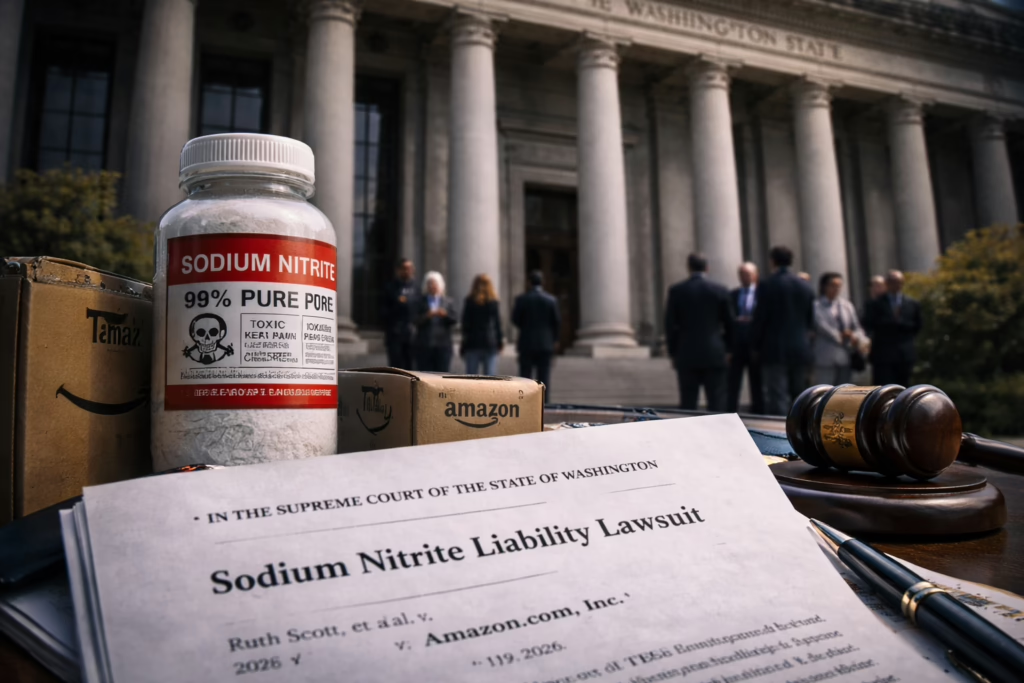
In a landmark decision addressing sodium nitrite liability Washington, the Washington Supreme Court held that families of four individuals who died after ingesting sodium nitrite purchased through Amazon may proceed with negligence claims under the Washington Product Liability Act (WPLA).
In Scott v. Amazon.com, Inc., No. 103730-9 (Wash. Feb. 19, 2026), the Court rejected the argument that suicide is automatically a superseding cause that bars product liability claims. Instead, the Court held that foreseeability and proximate cause must be analyzed based on the specific facts alleged — allowing the plaintiffs’ claims to survive dismissal at the pleading stage.
This decision significantly impacts online retailer liability and how Washington courts analyze intentional self-harm in product liability cases.
Background of the Case
The estates of four individuals brought wrongful death claims after each decedent purchased high-purity sodium nitrite through Amazon’s online marketplace and later ingested it.
Sodium nitrite has legitimate uses in laboratories and food preservation. However, in concentrated form, it is highly toxic and can cause rapid death when consumed in sufficient quantities.
The plaintiffs alleged that:
- Amazon sold high-purity sodium nitrite without meaningful warnings or safeguards.
- Amazon’s website algorithms recommended related products allegedly associated with self-harm.
- Amazon knew or should have known that sodium nitrite was being used in suicides.
- The company failed to implement reasonable safety measures despite awareness of the risk.
Amazon moved to dismiss the lawsuits under CR 12(b)(6), arguing that suicide is a superseding cause as a matter of law, eliminating proximate cause under Washington tort principles.
The Washington Supreme Court disagreed.
Sodium Nitrite Liability Washington: The Supreme Court’s Legal Analysis
The central issue was whether suicide automatically breaks the chain of causation in a negligence claim under the WPLA.
1. Suicide Is Not Automatically a Superseding Cause
Amazon relied on older Washington cases suggesting that suicide can be a superseding cause unless the defendant caused an irresistible impulse or diminished mental capacity.
The Supreme Court clarified that those principles do not operate as an automatic bar in every case. Instead, courts must analyze:
- Foreseeability of harm
- The defendant’s knowledge of risk
- Whether the defendant’s conduct contributed to the harm
Because the plaintiffs alleged that Amazon knew sodium nitrite was being used in suicides and continued selling and promoting the product without safeguards, the Court held that suicide was not dispositive at the motion-to-dismiss stage.
In other words, proximate cause cannot be resolved categorically — it depends on the pleaded facts.
2. Negligence Under the Washington Product Liability Act
Under RCW 7.72.040(1)(a), a product seller may be liable if a claimant’s harm was proximately caused by the seller’s negligence.
The Court emphasized that:
- Product sellers owe a duty of reasonable care to avoid foreseeable risks of harm.
- The WPLA incorporates traditional negligence principles.
- At the CR 12(b)(6) stage, courts must assume the truth of plaintiffs’ allegations.
Because plaintiffs plausibly alleged that Amazon failed to act reasonably in light of known risks, the Court held the complaints stated viable negligence claims.
The ruling does not determine liability — it allows the case to proceed to discovery and further factual development.
Implications for Online Retailers
The sodium nitrite liability Washington decision signals several important developments:
Foreseeability Matters
If a seller is aware that a product is being used in a dangerous manner, courts may require reasonable preventive measures — even where misuse is intentional.
E-Commerce Platforms Are Not Automatically Shielded
Large online marketplaces can face liability under Washington law when they directly sell products and allegedly fail to address foreseeable risks.
Suicide Does Not Automatically Defeat Causation
The Court declined to adopt a bright-line rule immunizing sellers whenever intentional self-harm occurs. Instead, proximate cause remains a fact-specific inquiry.
This represents a meaningful clarification in Washington tort law.
What This Means for Washington Tort Law
The Supreme Court’s ruling narrows the application of the “suicide as superseding cause” doctrine in product liability cases. While prior decisions remain relevant, courts must evaluate:
- Knowledge of harm
- Risk foreseeability
- Seller conduct
- Alleged failure to implement safeguards
By reversing dismissal, the Court reinforced that negligence claims involving dangerous consumer products should not be resolved categorically at the pleading stage when plaintiffs allege specific knowledge and foreseeability.
Conclusion
The Washington Supreme Court’s decision in Scott v. Amazon reshapes how courts analyze sodium nitrite liability Washington and clarifies that intentional self-harm does not automatically eliminate negligence claims under the WPLA.
As litigation proceeds, the case may further define the obligations of online sellers when marketing potentially lethal products.
If you have questions about product liability, wrongful death claims, or negligence under Washington law:
Contact Blanford Law today at ken@blanfordlaw.com or 253-720-9304 for guidance on your legal matter.
Additional Resources
1. Washington Product Liability Act Explained
Overview of negligence claims under RCW 7.72 and seller liability standards.
https://www.blanfordlaw.com/washington-product-liability-act/
2. Proximate Cause in Washington Tort Law
Explains foreseeability and superseding cause principles.
https://www.blanfordlaw.com/proximate-cause-washington/
3. CR 12(b)(6) Motions in Washington
Discusses dismissal standards and pleading requirements.
https://www.blanfordlaw.com/cr-12b6-washington/
4. Wrongful Death Claims in Washington
Overview of statutory wrongful death actions and damages.
https://www.blanfordlaw.com/wrongful-death-washington/
5. Superseding Cause Doctrine in Washington
Explains how courts determine when intervening acts break causation.
https://www.blanfordlaw.com/superseding-cause-washington/