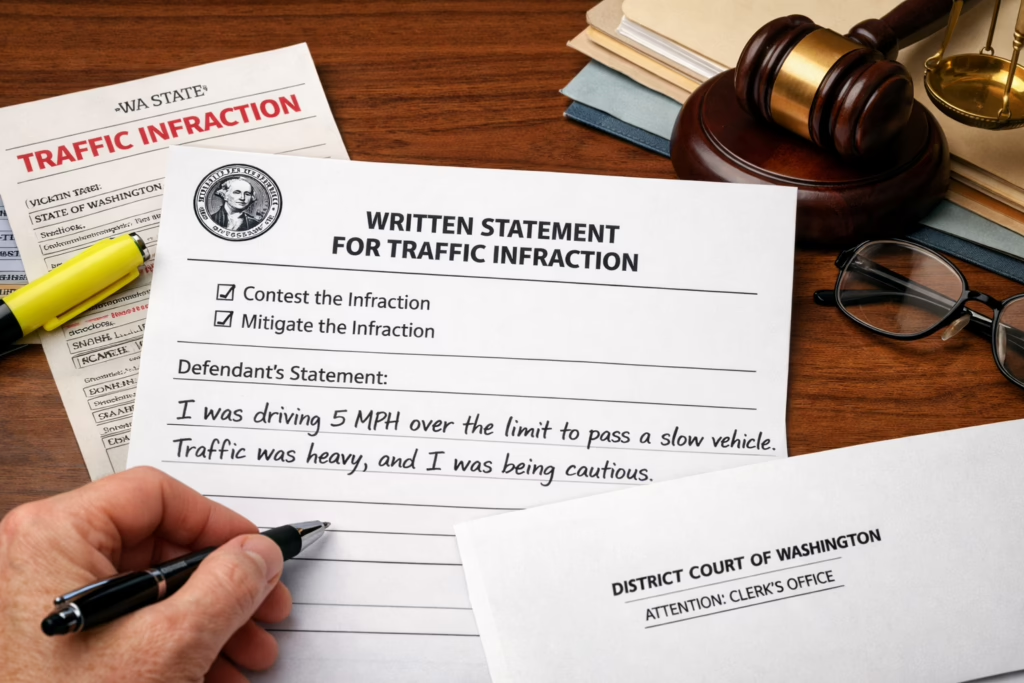
If you received a traffic ticket in Washington State, you may be able to resolve it with a traffic infraction written statement — no court appearance required. Under IRLJ 3.5, Washington courts must give every defendant the option to contest or mitigate their infraction entirely on paper, letting a judge review your side of the story in chambers.
Here is what you need to know about how that process works.
What Is IRLJ 3.5 and How Does It Apply to Your Traffic Infraction Written Statement?
IRLJ stands for Infraction Rules for Courts of Limited Jurisdiction — the procedural rules that govern how traffic infractions are handled in Washington’s district and municipal courts. Rule 3.5 specifically covers hearings decided on written statements rather than in-person appearances.
The rule was originally adopted in 1981 and has been amended several times, most recently in July 2024. It applies to two types of hearings:
- Contested hearings — where you argue that you did not commit the infraction
- Mitigation hearings — where you admit the infraction but ask the court to reduce the penalty
Both can be handled entirely through a traffic infraction written statement, without you ever setting foot in a courtroom.
The Written Statement Form: What It Must Include
Under IRLJ 3.5(1), every court must create and maintain its own form for defendants to use. That form must be available on the court’s website and provided to you upon request.
The form is required to include:
- A blank space for your traffic infraction written statement, either contesting the infraction or explaining mitigating circumstances
- Notice that you may attest you do not currently have the ability to pay the infraction in full
- Information on how to submit evidence of inability to pay, how to set up a payment plan, and a warning that failure to pay may result in collection action — including wage garnishment
- For a contested hearing: an agreement that if the court finds you committed the infraction, you will pay any penalty authorized by law
- For a mitigation hearing: a promise to pay the penalty assessed, which the court may reduce at its discretion
- A signature block consistent with GR 13, with notice that you may sign in any manner consistent with GR 30 — which includes electronic signatures in many circumstances
How a Contested Traffic Infraction Written Statement Hearing Works
If you believe you did not commit the infraction, you may request a contested hearing by written statement.
Under IRLJ 3.5(2), the court will review the citing officer’s report along with any statement or documents you submit. That review happens in chambers — no one appears in person. The court has 120 days from the date you filed your response to conduct the examination.
The legal standard is whether the government has proved by a preponderance of the evidence that you committed the infraction. That means more likely than not. It is a lower standard than a criminal case, but it is still a standard the state must meet — and a well-written, specific traffic infraction written statement that contradicts or undermines the officer’s account can genuinely affect the outcome.
How a Mitigation Traffic Infraction Written Statement Hearing Works
A mitigation hearing is not about innocence. You are telling the court: yes, this may have happened, but here are the circumstances — please reduce the penalty.
Under IRLJ 3.5(3), mitigation hearings based on a written statement are also held in chambers and must occur within 120 days of your filing. The court has discretion to reduce the fine based on what you submit.
Common grounds for mitigation include financial hardship, a clean driving record, or an honest explanation of what happened. The more specific and credible your traffic infraction written statement, the better your chances.
Notice of Decision and the No-Appeal Rule
Once the court reviews your submission, IRLJ 3.5(4) requires it to notify you in writing of its decision, including any penalty imposed.
Here is the part most people do not know: under IRLJ 3.5(5), there is no appeal from a decision made on written statements. If you use this process and the court rules against you, that is final. You cannot take it to a higher court.
This is a critical limitation. For high-stakes infractions — ones that could affect your license, your insurance rates, or your CDL — an in-person hearing and legal representation may be the smarter choice. An attorney can help you evaluate whether a traffic infraction written statement is the right path or whether you should appear in court.
Key Deadlines Under IRLJ 3.5
Timing is everything with a traffic infraction written statement in Washington State:
- File your response to the notice of infraction within the deadline on your ticket — typically 15 days from the infraction date
- The court has 120 days from your filing to conduct the written statement hearing in chambers
- Written notice of the decision will be mailed to you after the court rules
Missing the initial response deadline can result in a default finding against you and potential license suspension. Do not wait.
Should You Contest, Mitigate, or Appear in Person?
IRLJ 3.5 gives you a real option to address a traffic infraction written statement without taking time off work or sitting in a courtroom. But it is not always the right move.
A contested written statement works best when you have clear, specific facts on your side and your written account meaningfully contradicts the officer’s report. A mitigation written statement makes sense when you have a clean record or genuine financial hardship to document.
Because there is no appeal from a written statement decision, anything high-stakes — a commercial license, an insurance-sensitive violation, a case with complex facts — may warrant an in-person hearing with an attorney.
For a full breakdown of which infractions count as moving violations and which do not, see our guide here.
Contact Blanford Law
We are no-nonsense, relentless, fair, and honest. We are great listeners instead of fast talkers, and that is just who we are. More than 20 years ago, Ken began practicing law with a deeply-held belief that every person has the right to the best legal representation available. He built his law firm on that belief. Another belief he strongly adheres to is that clients deserve respect, with no assumptions or preconceived notions.
If you received a traffic infraction and are not sure whether a written statement or an in-person hearing is your best option, contact us today. We can help.
Tacoma: 253-720-9304
Roslyn: 509-260-1290
Email: info@blanfordlaw.com
Contact us anytime for your urgent legal needs.
Review our client resources here
Areas of Practice: DUI & Alcohol Offenses, Criminal Defense, Domestic Violence, Personal Injury, and Traffic Infractions. We serve Tacoma, Roslyn, and surrounding areas of Washington State.