Introduction
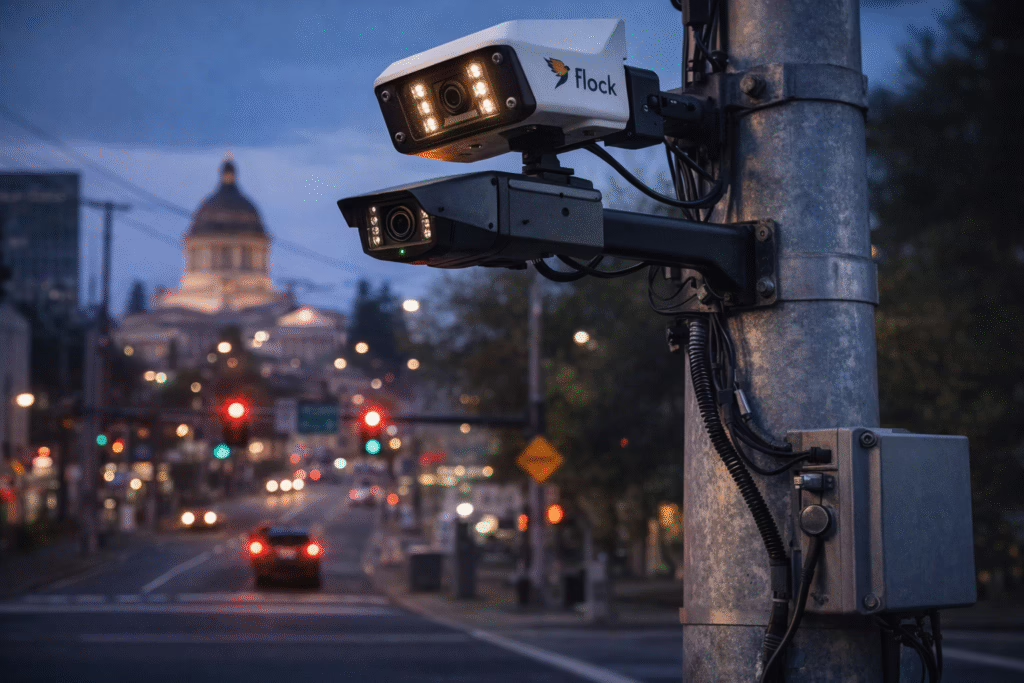
The Washington State Senate has passed a bill to regulate automatic license plate reader (ALPR) cameras, including those sold under brands such as Flock. The legislation, which advanced on a 40–9 vote, now moves to the House of Representatives for further consideration. If enacted, the bill would be the first statewide law governing how ALPR systems are used, how data is stored and shared, and who may access that data. The proposal reflects growing concerns about privacy, law enforcement access, and data sharing with federal agencies.
What Are ALPR Cameras?
Automatic License Plate Reader (ALPR) cameras are surveillance devices that capture images of vehicle license plates and associated data. They are widely used by:
- Law enforcement agencies for crime and traffic investigations
- Parking enforcement agencies
- Toll agencies
- Transportation departments
ALPR systems can record license plate numbers, timestamps, and GPS coordinates as vehicles pass within range. While useful for locating stolen cars and identifying suspects, that capability also raises privacy and civil liberties questions when data is stored long-term or accessed by outside agencies.
Why Washington Needs a Statewide Law
Currently, Washington has no statewide regulatory framework governing:
- How ALPR data may be collected
- How long data can be retained
- Who may access license plate data
- How data may be shared between agencies
As a result, individual counties, cities, and Tribal governments have entered into their own contracts — often with private vendors like Flock Safety — without uniform rules about privacy protections.
Research by the University of Washington found that:
- At least eight local law enforcement agencies enabled sharing of ALPR data with U.S. Border Patrol.
- Data access occurred even without formal data-sharing agreements with at least 10 additional agencies.
- In some cases, ICE, Border Patrol, and out-of-state law enforcement accessed ALPR data.
- More than 80 cities, six counties, and three Tribal governments in Washington had contracts with ALPR providers as of 2025.
These findings have raised concern among privacy advocates and legislators alike, spurring the push for clear statewide rules.
Key Features of the Proposed Bill
The legislation sponsored by Sen. Yasmin Trudeau (D-Tacoma) is intended to strike a balance between privacy protections and public safety utility of ALPR technology. According to sponsors, the measure is not aimed at banning the tools, but at establishing guardrails for responsible use.
Key provisions include:
1. Limits on Federal Access
The bill would restrict federal agencies — including ICE and U.S. Border Patrol — from directly accessing ALPR data collected by Washington agencies. This addresses concerns about data sharing beyond local law enforcement without clear oversight.
2. Data Retention and Deletion Requirements
Agencies using ALPR systems would be required to delete raw data, including images of vehicles and license plates, after a specified retention period. This aims to prevent indefinite storage of sensitive location and vehicle data.
3. Clear Rules for Data Sharing
The legislation would establish transparent policies for how ALPR data may be shared between agencies and set boundaries around such sharing to protect civil liberties.
Sen. Trudeau stated, “This is not about restricting law enforcement tools. This is about putting in place reasonable rules around how the data is used and accessed.”
Legislative Outlook
The bill passed the State Senate on a Wednesday afternoon by a 40–9 margin, signaling bipartisan recognition of the need for ALPR regulation. The legislation now moves to the Washington House of Representatives, where lawmakers are expected to begin consideration after February 17.
If the House approves the bill and it is signed by the governor, Washington would become one of the first states to enact comprehensive, statewide rules governing ALPR technology.
Implications for Law Enforcement and Privacy
For Law Enforcement
- The bill would preserve the use of ALPR systems as investigative tools.
- Agencies would need to adopt new data retention policies and compliance procedures.
- Data sharing with federal agencies would be more tightly controlled.
For Individual Privacy
- Privacy advocates argue that automatic, long-term tracking of vehicles without limits poses significant civil liberties concerns.
- Data deletion requirements could reduce unnecessary surveillance.
- Limits on federal access address fears of broad law enforcement or immigration enforcement use.
The bill reflects a growing national conversation about how to balance the utility of surveillance technologies with robust privacy protections.
Conclusion
The advancing Washington ALPR bill marks an important step toward modernizing privacy and surveillance law in the state. As automatic license plate reader cameras become more widespread, lawmakers are seeking to ensure that powerful data-collection tools are used responsibly, transparently, and in ways that respect individual rights.
With bipartisan support in the Senate and growing public scrutiny over data access, this legislation could set a precedent for other states grappling with similar issues.
Call to Action
If you’re concerned about how law enforcement surveillance technology affects your privacy or legal rights, or if you’re facing any legal issues involving law enforcement data use, contact Blanford Law for trusted guidance.
Email: ken@blanfordlaw.com
Phone: 253-720-9304
Additional Resources
- ER 705 – Expert Opinion Testimony in Washington Courts
An explanation of how ER 705 allows experts to give opinions without first disclosing underlying facts, and how those opinions may be challenged.
https://blanfordlaw.com/er-705-expert-opinion/ - Williams v. City of Spokane: Limits on Class Actions Challenging Traffic Camera Fines
An analysis of how Washington courts restrict the use of class action lawsuits to challenge automated traffic camera penalties.
https://blanfordlaw.com/williams-v-city-of-spokane-the-limits-of-class-action-suits-to-challenge-traffic-camera-fines/ - Automatic Exoneration of Bail Bonds: Insights from State v. French
A case review explaining when bail bonds may be automatically exonerated under Washington law and the limits of that doctrine.
https://blanfordlaw.com/examining-automatic-exoneration-of-bail-bonds-insights-from-state-v-french-88-wn-app-586-wash-ct-app-1997/ - Washington Proposes Lowering the BAC Limit to 0.05%
A detailed discussion of proposed legislation to reduce Washington’s DUI per se BAC limit and its potential impact on drivers.
https://blanfordlaw.com/washington-state-proposes-lowering-bac-limit-to-05-for-enhanced-road-safety/ - Washington RPC 3.3 – Candor Toward the Tribunal
An overview of attorneys’ ethical duties of honesty and disclosure to the court under Washington’s Rules of Professional Conduct.
https://blanfordlaw.com/washington-rpc-3-3-candor-tribunal/