
Understanding Washington Bail Rights After Arrest
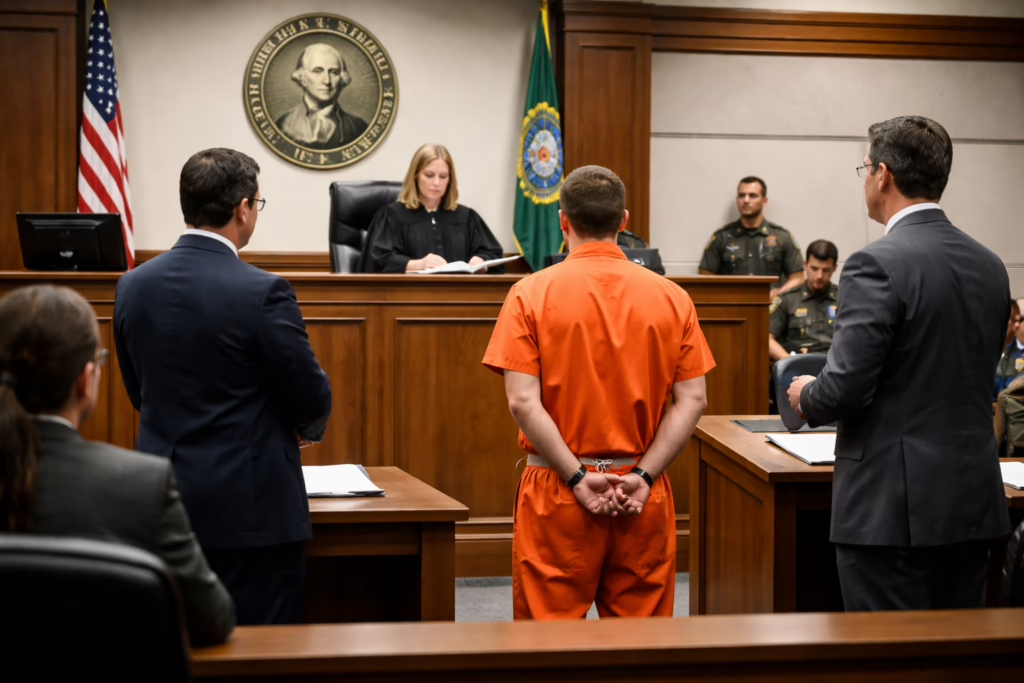
In Washington State, the right to bail is protected under Article I, Section 20 of the state constitution. However, many people misunderstand when that right actually applies. The Washington Supreme Court clarified this issue in Westerman v. Cary, a landmark case that continues to shape pretrial detention practices today.
This case addressed whether individuals arrested for domestic violence offenses could be held without bail until their first court appearance—and whether that practice violated constitutional rights.
Key Holding in Westerman v. Cary
When Do Washington Bail Rights After Arrest Attach?
The central issue in Westerman v. Cary was whether the constitutional right to bail begins immediately upon arrest or later in the criminal process.
The Washington Supreme Court held:
- The right to bail does not attach immediately upon arrest
- Instead, it attaches at the time of a judicial determination, typically at the first court appearance (preliminary appearance)
- This appearance must occur within 48 hours of arrest (excluding weekends/holidays in some circumstances)
This means law enforcement may temporarily detain an individual without bail, so long as a prompt judicial review follows.
Why the Court Allowed Temporary Detention Without Bail
Judicial Determination Is Essential
The Court emphasized that bail has historically been a judicial function, not an administrative one. Before bail is set:
- A judge must evaluate the individual circumstances
- Probable cause must be confirmed
- Conditions of release must be considered
The Court rejected the argument that bail must be immediately available through preset schedules, noting that individualized review better protects both defendants and public safety.
Constitutional Challenges Addressed
1. Right to Bail (Washington Constitution)
The Court ruled that holding someone briefly without bail does not violate Article I, Section 20, as long as a prompt hearing occurs.
2. Due Process
Temporary detention is constitutional if:
- It serves a legitimate government interest (e.g., safety, court appearance)
- It is limited in duration
- It includes timely judicial oversight
3. Equal Protection
The Court upheld different treatment for domestic violence arrestees, finding:
- The classification was reasonable
- It addressed legitimate public safety concerns
- It applied equally within the defined group
Practical Impact on Washington Criminal Cases
What This Means for Defendants
If you are arrested in Washington:
- You may not be released immediately on bail
- You are entitled to a prompt court appearance (usually within 48 hours)
- A judge—not jail staff—will decide:
- Bail amount (if any)
- Conditions of release
- Whether release is appropriate
What This Means for Courts and Law Enforcement
Courts can:
- Require mandatory first appearances before bail is set
- Avoid reliance on automatic bail schedules
- Prioritize individualized determinations
Why Westerman v. Cary Still Matters
This case remains highly relevant because it balances:
- Individual liberty rights
- Judicial oversight
- Public safety concerns
It also confirms that Washington provides stronger bail protections than federal law, while still allowing limited pre-hearing detention.
Call to Action
If you or a loved one is facing criminal charges and have questions about bail or pretrial detention, experienced legal guidance is critical.
Contact Blanford Law today at ken@blanfordlaw.com or 253-720-9304 for guidance on your legal matter.
Additional Resources
- Unlawful Detention and Evidence in Washington
Learn how unlawful detention can impact criminal cases and whether evidence obtained may be suppressed. - Home Detention Conditions in Washington State
Explore how courts use home detention as an alternative to jail and what conditions may apply. - Bail Appearance Bond vs. Performance Bond in Washington
Understand the key differences between appearance bonds and performance bonds in Washington criminal cases. - Washington Bail for Felonies Explained
A breakdown of how bail is determined in felony cases and what factors judges consider. - Deadly Weapon Enhancement in Washington
Learn how sentencing enhancements work when a deadly weapon is involved in a criminal offense.