
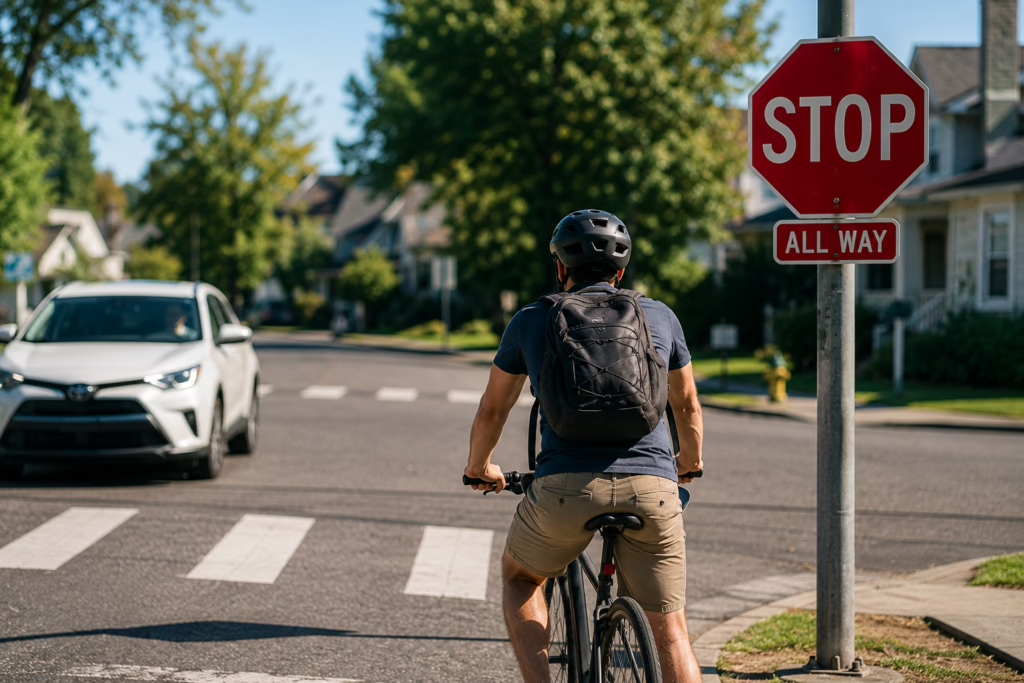
Washington’s bicycle stop sign law is different from the rule that applies to most motorists. In many situations, a person riding a bicycle does not have to come to a complete stop at a stop sign. Instead, Washington law allows bicyclists to treat most stop signs like yield signs, provided they slow appropriately and yield when necessary.
The rule is sometimes called a “stop-as-yield” law or an “Idaho stop” law. Recent public-interest coverage has brought renewed attention to how the law works and what it means when a bicycle and motor vehicle collide at an intersection. The Tacoma News Tribune highlighted Washington’s stop-as-yield rule on August 10, 2026, noting its role in intersection safety.
For people involved in bicycle accidents, the rule matters for another reason: a driver cannot necessarily establish that a cyclist was at fault simply by saying, “The bicyclist did not stop.”
How Does the Washington Bicycle Stop Sign Law Work?
Under RCW 46.61.190, a bicyclist approaching most stop signs has two choices. The cyclist may make the same complete stop required of other vehicles, or the cyclist may comply with the requirements that apply to a yield sign.
That second option is what creates Washington’s stop-as-yield rule.
When treating the stop sign as a yield sign, the cyclist must slow to a speed that is reasonable for existing conditions. If safety requires a complete stop, the cyclist must stop. The cyclist must also yield the right of way to traffic already in the intersection or approaching closely enough to create an immediate hazard.
In practical terms, Washington law does not give cyclists permission to fly through stop signs without looking. It allows them to continue through an intersection without fully stopping when traffic and safety conditions permit.
Are There Exceptions to the Stop-as-Yield Rule?
Yes.
RCW 46.61.190 specifically excludes certain situations from the ordinary bicycle stop-as-yield rule. A bicyclist approaching a stop sign at a highway-grade railroad crossing must comply with the rules governing railroad crossings. A bicycle rider must also comply with the stop requirements associated with a school bus displaying the required stop signal.
Those exceptions are important because the general rule should not be interpreted to mean that every stop indication can be treated as a yield.
What Does “Yield” Mean for a Bicyclist?
Yielding is more than simply slowing down.
Under Washington law, a person approaching a yield sign must reduce speed to a reasonable level and stop if necessary for safety. The person must then yield to vehicles already in the intersection or approaching closely enough to constitute an immediate hazard.
For a bicyclist, that can mean considering factors such as:
- The speed and distance of approaching vehicles
- Whether another vehicle has already entered the intersection
- Visibility around parked cars, landscaping, or buildings
- Weather and roadway conditions
- Pedestrians using or entering a crosswalk
- Whether there is enough time to enter and clear the intersection safely
A cyclist who enters an intersection without yielding when required may still be found at fault for a collision. The stop-as-yield law changes the requirement to make a complete stop; it does not eliminate the duty to exercise reasonable care.
Why the Washington Bicycle Stop Sign Law Matters After an Accident
Intersection bicycle crashes frequently produce disputes over who had the right of way.
A motorist may tell police or an insurance adjuster that the cyclist “ran the stop sign.” That statement may sound damaging, but it does not answer the legal question under Washington law.
If the cyclist slowed appropriately, determined that no immediate hazard was present, and entered the intersection in compliance with the yield requirements of RCW 46.61.190, the fact that the bicycle never came to a complete stop may be perfectly consistent with Washington law.
The more important questions may be whether the cyclist properly yielded and whether the motorist was driving safely and attentively.
Those distinctions can become significant in an insurance claim or personal injury lawsuit.
Can a Bicyclist Still Be Partially at Fault?
Yes. Washington follows a comparative-fault system.
Under RCW 4.22.005, fault attributable to an injured person generally reduces the amount of compensatory damages in proportion to that person’s share of fault. It does not automatically prevent recovery.
For example, suppose a jury determined that a motorist was 80 percent responsible for a bicycle collision and the cyclist was 20 percent responsible. The cyclist’s recoverable compensatory damages would generally be reduced by 20 percent.
This is why statements such as “the cyclist did not stop” should not end the analysis.
Even if a bicyclist made a mistake, investigators and insurers still must examine the motorist’s conduct. A driver may also have been speeding, distracted, failing to keep a proper lookout, failing to yield, or otherwise contributing to the collision.
Drivers Still Have Duties Toward Bicyclists
Washington law recognizes bicyclists and several other roadway users as vulnerable users of a public way.
RCW 46.61.190 itself provides for an additional fine when a motorist violates the right-of-way requirements of that statute with respect to a vehicle that qualifies as a vulnerable user of a public way.
Separate Washington law also establishes enhanced consequences for certain negligent driving offenses that cause substantial or great bodily harm to a vulnerable roadway user. Under RCW 46.61.526, negligent driving that proximately causes qualifying bodily harm to a vulnerable user can result in significant monetary penalties and a driver’s-license suspension, subject to the procedures and alternatives contained in the statute.
These laws do not automatically establish civil liability after every bicycle accident. They do, however, underscore that Washington law imposes meaningful responsibilities on motorists when sharing the road with bicyclists and other vulnerable users.
Evidence Can Determine Who Had the Right of Way
Bicycle intersection cases often turn on evidence collected soon after the crash.
Useful evidence may include traffic-camera video, residential or business surveillance footage, dash-camera recordings, photographs of the intersection, skid marks, debris locations, bicycle and vehicle damage, witness statements, police reports, and cell-phone records when distracted driving is suspected.
The physical layout of the intersection can also matter.
Sight distances, vegetation, parked vehicles, lane markings, lighting, traffic-control devices, road construction, and the location of the stop line may help explain what each person could reasonably see before entering the intersection.
An attorney investigating a bicycle accident may also evaluate exactly where the bicycle and motor vehicle were located in the moments before impact, which direction each party was traveling, and whether either person had sufficient time to avoid the collision.
Does a Cyclist Have the Right of Way Just Because of the Stop-as-Yield Law?
No.
The stop-as-yield rule does not give bicyclists unconditional priority at intersections.
A cyclist who encounters traffic that constitutes an immediate hazard must yield. If necessary for safety, the cyclist must stop.
At the same time, a motorist cannot assume that a bicycle approaching a stop sign is legally required to place a foot on the ground or come to a complete halt before proceeding.
The rights and responsibilities of both parties must be evaluated under the actual traffic conditions and applicable rules of the road.
What If an Insurance Company Blames the Cyclist for Not Stopping?
Insurance companies often investigate fault quickly after a collision, sometimes relying heavily on the initial police report or statements made at the scene.
If an adjuster argues that a bicyclist caused the crash simply because the cyclist rolled through a stop sign, RCW 46.61.190 may be highly relevant. Washington law expressly permits a bicyclist to comply with yield-sign requirements at most stop signs.
That does not automatically mean the cyclist was fault-free. It does mean the analysis should focus on what actually happened at the intersection rather than applying the ordinary motor-vehicle stop requirement to a bicyclist.
Because Washington uses comparative fault, the percentage of responsibility attributed to each party can directly affect the amount of compensation available for medical bills, lost income, pain and suffering, property damage, and other losses.
Injured in a Washington Bicycle Accident?
A bicycle crash can result in serious injuries, particularly when a cyclist is struck by a passenger vehicle, commercial truck, or SUV. Disputes about stop signs, right of way, visibility, and comparative fault can make these claims especially complicated.
If you were injured in a bicycle accident in Tacoma, Seattle, Olympia, Oak Harbor, Ellensburg, or elsewhere in Washington, it can be helpful to have the intersection evidence and applicable traffic laws reviewed before accepting an insurance company’s version of what happened.
Contact Blanford Law today at ken@blanfordlaw.com or 253-720-9304 for guidance on your legal matter.
Additional Resources
Washington Failure to Yield Accident
Learn how failure-to-yield violations can contribute to Washington traffic crashes and affect questions of negligence and liability.
RCW 46.61.750: Washington Bicycle Rules
Review key Washington laws governing how bicyclists may use roadways and the rights and responsibilities that apply while riding.
RCW 46.61.770: Bicycle Law
Understand Washington rules concerning bicycle roadway positioning, lane use, and other requirements that can matter after a bicycle collision.
Oak Harbor Motorcycle Accident
See how right-of-way, visibility, and driver awareness can become important issues in crashes involving vulnerable roadway users.
RCW 46.61.790: Intoxicated Bicyclists
Learn how Washington law addresses bicyclists who are impaired by alcohol or drugs and how those rules differ from standard DUI laws.