
Overview of State v. Thompson
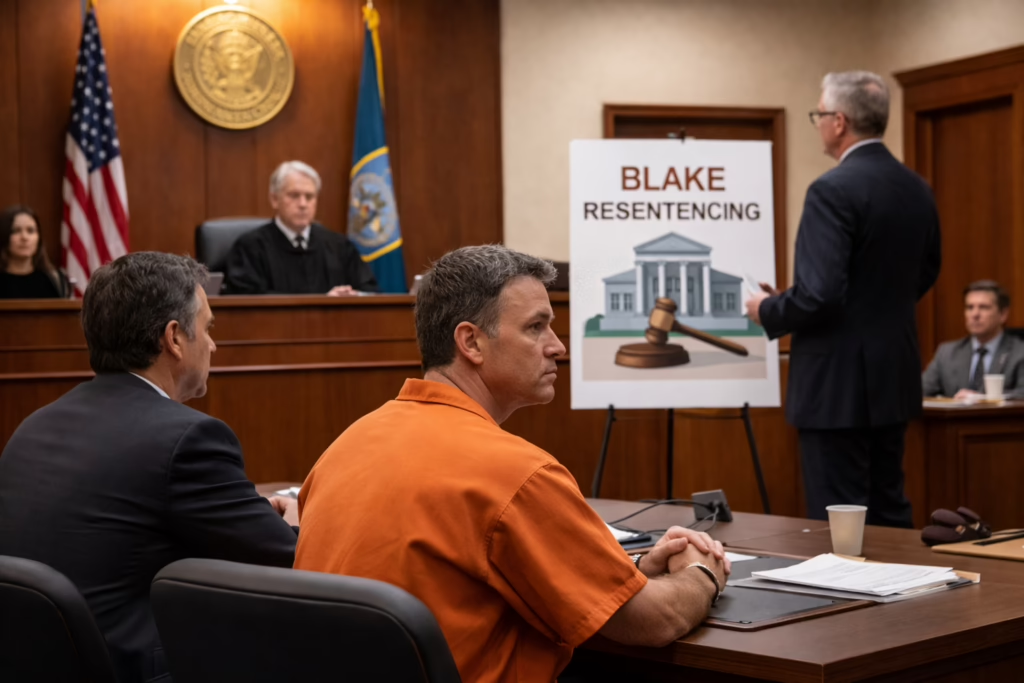
In State v. Thompson, the Washington Court of Appeals (Division II) addressed multiple challenges arising from a Blake resentencing, including jurisdiction, double jeopardy, offender score calculations, and sentencing discretion. The court ultimately affirmed the new judgment and sentence.
Brenton Thompson was originally convicted of first-degree murder and first-degree assault. His sentence included prior drug convictions that were later invalidated under State v. Blake, 197 Wn.2d 170 (2021). After his drug possession conviction was vacated, Thompson was resentenced.
On appeal, he raised several arguments challenging the legality of that resentencing.
Washington Blake Resentencing Appeals Explained
What Is a Blake Resentencing?
After State v. Blake, Washington courts have been required to:
- Vacate unconstitutional drug possession convictions
- Recalculate offender scores
- Conduct resentencing where necessary
These proceedings are often referred to as Blake resentencing hearings.
Key Issues in State v. Thompson
1. Jurisdiction to Resentence
Thompson argued that the trial court lacked jurisdiction to resentence him because his prior judgment was allegedly invalid.
The Court of Appeals rejected this argument, explaining:
- Washington superior courts have broad jurisdiction over felony cases
- Jurisdiction depends on authority over the person and subject matter—not sentencing errors
Importantly:
A change in offender score under Blake does not eliminate the court’s authority to resentence.
2. Double Jeopardy Claim
Thompson argued that resentencing him without formally vacating the prior judgment violated double jeopardy.
The court disagreed, relying on recent Washington Supreme Court precedent. It held that:
- A full resentencing hearing effectively replaces the prior judgment
- The earlier judgment is considered “impliedly vacated”
Because the trial court conducted a full resentencing and entered a new judgment, no constitutional violation occurred.
3. Offender Score Calculation
A major issue involved whether two prior 1995 convictions should count in Thompson’s offender score.
Thompson argued those convictions were invalid because they were connected to a now-invalid drug possession conviction.
The court rejected this argument, explaining:
- Prior convictions are presumed valid unless facially unconstitutional
- A conviction is only invalid if the defect appears on the face of the record
The court emphasized:
Not every connection to a Blake-invalid conviction invalidates later convictions.
As a result, the trial court properly included those convictions in the offender score.
4. Standard Range Sentence
Thompson also challenged the trial court’s decision to impose a standard range sentence, arguing that:
- The court did not properly consider his youth
- The court ignored rehabilitation efforts
- The court limited additional testimony
The Court of Appeals rejected these claims, noting:
- Trial courts have broad discretion at sentencing
- A standard range sentence is generally not appealable
- The court did consider mitigating factors, including:
- Thompson’s age (24 at the time of the crime)
- His rehabilitation while incarcerated
The record showed that the judge actively considered mitigation but ultimately concluded the seriousness of the crime justified the sentence.
5. Claims Outside the Record
Thompson raised additional claims related to:
- Jury unanimity
- Alleged instructional errors
- Due process violations
The court declined to consider these arguments because they relied on facts outside the appellate record. Such claims must be raised in a personal restraint petition (PRP) instead.
This Is an Unpublished Opinion
Important Limitation Under Washington Law
The State v. Thompson decision is explicitly designated as an unpublished opinion.
Under Washington law:
- It is filed under RCW 2.06.040
https://app.leg.wa.gov/rcw/default.aspx?cite=2.06.040 - It may be cited under RAP 10.4(h)
https://www.courts.wa.gov/court_rules/?fa=court_rules.display&group=app&set=RAP&ruleid=app10.4
What This Means
- The opinion is not binding precedent
- Courts are not required to follow it
- It may be cited only for persuasive value
Unpublished opinions like Thompson are still useful for understanding how courts are handling ongoing Blake-related resentencing issues across Washington.
Why State v. Thompson Matters
This case provides important guidance on Washington Blake resentencing appeals, particularly:
- Courts retain jurisdiction to resentence after Blake
- Resentencing does not violate double jeopardy when properly conducted
- Prior convictions remain valid unless facially unconstitutional
- Sentencing courts have wide discretion, even after Blake
For defendants seeking relief, this case highlights that while Blake offers meaningful opportunities for resentencing, not every argument will succeed on appeal.
Contact Blanford Law Today
If you or a loved one may qualify for resentencing or are considering an appeal, experienced legal guidance is critical.
Contact Blanford Law today at ken@blanfordlaw.com or 253-720-9304 for guidance on your legal matter.
Additional Resources
- Post-Conviction Relief in Washington – Learn how to challenge convictions and sentences after trial.
https://www.blanfordlaw.com/post-conviction-relief-in-washington/ - Washington Sentencing Appeals – Overview of appealing criminal sentences in Washington courts.
https://www.blanfordlaw.com/washington-sentencing-appeals/ - Understanding Offender Scores in Washington – How criminal history affects sentencing.
https://www.blanfordlaw.com/offender-score-washington/ - Record Expungement in Washington [USED] – A guide to clearing your criminal record.
https://www.blanfordlaw.com/record-expungement-in-washington/ - Understanding Your Right to Remain Silent [USED] – Learn your constitutional rights.
https://www.blanfordlaw.com/understanding-your-right-to-remain-silent/