
In a recent published decision from Division II of the Washington Court of Appeals (D2 No. 59459-5-II), the court issued an important ruling clarifying the limits of Washington community custody conditions imposed at sentencing. The opinion serves as a reminder that while trial courts have discretion to craft conditions intended to promote rehabilitation and protect public safety, that discretion is not unlimited.
For individuals facing felony sentencing — and for attorneys handling criminal cases — this case underscores the importance of carefully reviewing every condition attached to community custody.
The Role of Community Custody in Washington Sentencing
Under Washington’s Sentencing Reform Act (RCW 9.94A), many felony sentences include a term of community custody following incarceration. Community custody functions similarly to probation or parole and places individuals under Department of Corrections supervision.
Courts may impose:
- Mandatory conditions required by statute
- Crime-related prohibitions
- Certain discretionary rehabilitative conditions
However, the statutory framework limits what courts may impose. Not every condition that seems reasonable is legally permissible.
The appellate court’s decision focuses squarely on these limitations.
How the Court Evaluated the Challenged Conditions
In this case, the defendant challenged specific community custody conditions imposed at sentencing. The Court of Appeals analyzed whether those conditions complied with statutory requirements and constitutional protections.
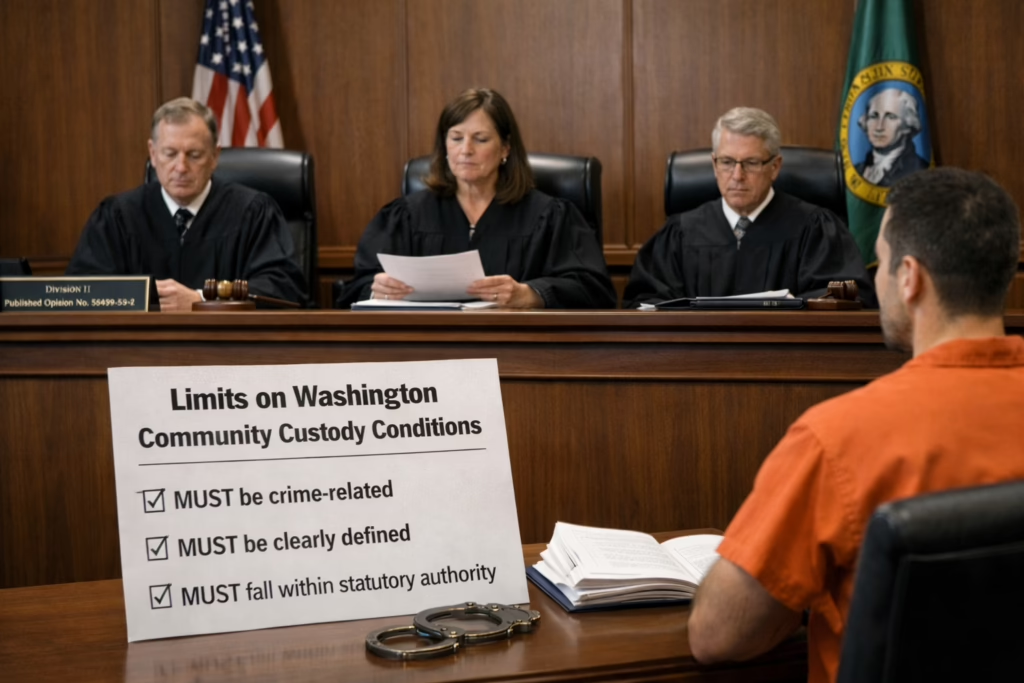
The ruling provides valuable clarification on three major principles governing Washington community custody conditions.
1. Conditions Must Be Crime-Related
Washington law requires that discretionary prohibitions be “crime-related.” This means there must be a direct relationship between the condition imposed and the offense of conviction.
The Court of Appeals emphasized that a sentencing judge may not impose conditions simply because they might be helpful in a general sense. Instead, there must be a clear nexus between the restriction and the defendant’s underlying criminal conduct.
If the record does not establish that connection, the condition exceeds statutory authority and must be stricken.
This reinforces a key rule: sentencing courts cannot impose broad lifestyle restrictions without grounding them in the facts of the case.
2. Community Custody Conditions Cannot Be Unconstitutionally Vague
The court also addressed constitutional concerns. A community custody condition is unconstitutionally vague if it:
- Fails to give ordinary people fair notice of what conduct is prohibited, or
- Allows arbitrary or discriminatory enforcement.
Individuals on community custody must be able to understand what behavior will result in sanctions. If a condition is unclear or overly broad, it creates a serious due process problem.
Washington appellate courts consistently strike or require modification of vague conditions, and this opinion continues that trend. The decision reinforces that clarity is not optional — it is constitutionally required.
3. Courts Must Stay Within Legislative Authority
Perhaps most importantly, the opinion reiterates that sentencing authority comes from statute. Courts may not create new categories of restrictions that the Legislature has not authorized.
Even well-intentioned conditions designed to promote rehabilitation must fall within RCW 9.94A. When they do not, appellate courts will vacate or modify them.
This separation of powers principle ensures that sentencing policy remains grounded in legislative direction rather than judicial expansion.
Why This Decision Matters for Washington Defendants
Community custody can last months or years. Violations may result in additional jail time, sanctions, or further legal complications. Because these conditions carry serious consequences, they must be lawful and clearly defined.
This case is significant because it reinforces that:
- Washington community custody conditions must be crime-related
- Conditions must provide clear notice
- Sentencing courts cannot exceed statutory authority
For defendants, this means improper conditions can and should be challenged. For defense attorneys, it highlights the importance of preserving objections at sentencing and reviewing judgment and sentence documents carefully.
Protecting Your Rights at Sentencing
Sentencing does not end when the prison term is announced. The fine print of community custody conditions can shape nearly every aspect of a person’s daily life after release.
If you are facing sentencing — or believe your community custody conditions are overly broad, vague, or unlawful — legal review may be critical. Appellate courts regularly correct improper sentencing provisions, but timing and proper procedure matter.
Contact Blanford Law today at ken@blanfordlaw.com or 253-720-9304 for guidance on your legal matter.
Additional Resources
1. Courtroom Restraints at Sentencing in Washington
Explains when physical restraints may be used during sentencing and the constitutional limits courts must follow.
https://blanfordlaw.com/courtroom-restraints-at-sentencing-washington/
2. Washington RPC 3.7 – Lawyer as Witness Rule
A breakdown of Rule of Professional Conduct 3.7 and when an attorney may be prohibited from acting as both advocate and witness.
https://blanfordlaw.com/washington-rpc-3-7/
3. Washington RPC 3.6 – Trial Publicity
Discusses ethical limits on public statements by attorneys involved in criminal cases.
https://blanfordlaw.com/washington-rpc-3-6/
4. Washington RPC 3.5 – Impartiality and Decorum of the Tribunal
Explains professional conduct rules governing attorney behavior toward judges, jurors, and court personnel.
https://blanfordlaw.com/washington-rpc-3-5/
5. Washington RPC 3.4 – Fairness to Opposing Party and Counsel
Outlines ethical obligations related to evidence, discovery, and fairness in criminal and civil proceedings.
https://blanfordlaw.com/washington-rpc-3-4/