
Overview of State v. Kane
In State v. Kane, Division One of the Washington Court of Appeals addressed whether a trial court must order a renewed competency evaluation when a defendant behaves erratically during trial. The case also examined juror issues and sufficiency of the evidence.
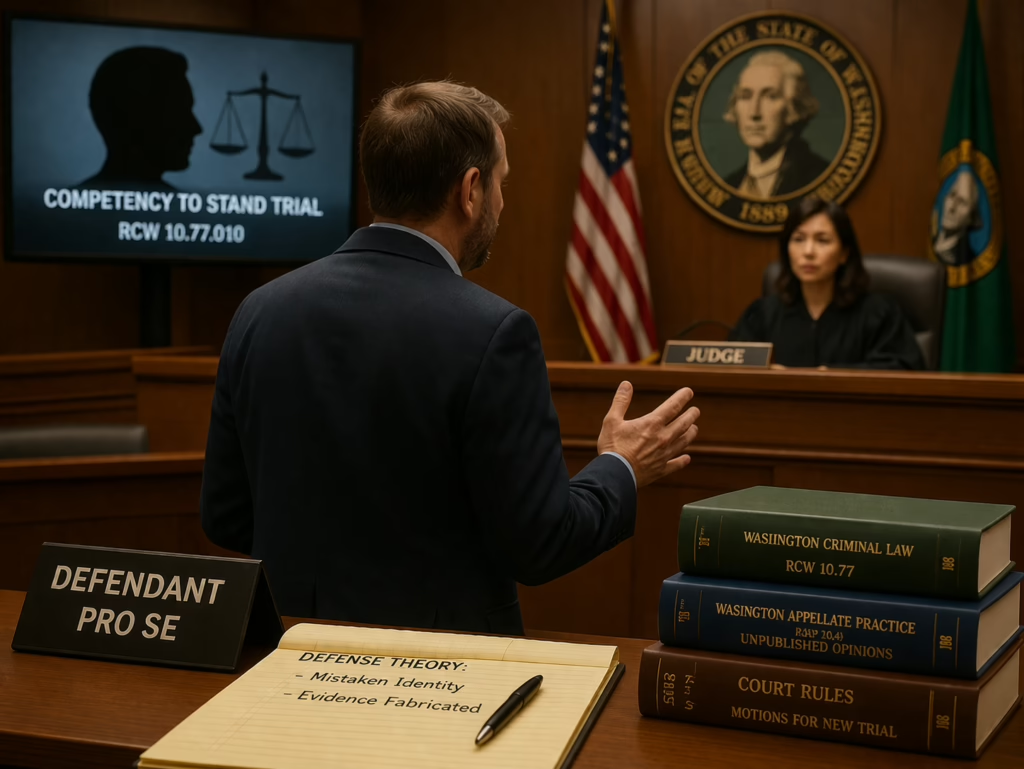
Sean Kane was charged with multiple domestic violence-related offenses involving alleged contact with his estranged wife in violation of a protection order. Initially found incompetent, Kane later underwent competency restoration and was deemed competent to stand trial. He chose to represent himself.
On appeal, Kane raised three primary arguments:
- The trial court should have ordered a new competency evaluation
- The court failed to adequately investigate juror concerns
- The evidence was insufficient for one conviction
The Court of Appeals reversed one conviction (interfering with domestic violence reporting) but otherwise affirmed.
Washington Competency to Stand Trial
Legal Standard for Competency
Under Washington law, a defendant is incompetent if they lack the capacity to:
- Understand the nature of the proceedings, or
- Assist in their defense
This rule is grounded in RCW 10.77.010 and related statutes. Courts must order a competency evaluation when there is a “genuine doubt” as to competency.
The decision whether to order an evaluation is reviewed for abuse of discretion, meaning appellate courts give significant deference to the trial judge.
Applying the Law in State v. Kane
Kane displayed unusual and sometimes erratic behavior throughout trial, including:
- Asking confusing and tangential questions during jury selection
- Referencing conspiracies, artificial intelligence, and unrelated topics
- Exhibiting paranoid or grandiose thinking
Despite this, the Court of Appeals emphasized a key principle:
Unusual or eccentric behavior does not automatically mean a defendant is incompetent.
The trial court conducted a detailed colloquy with Kane and found that he:
- Understood the charges against him
- Knew the role of the prosecutor and jury
- Understood possible outcomes
- Could articulate a defense theory
The appellate court agreed that Kane’s behavior, while concerning, did not show a significant change in mental condition after he had already been restored to competency.
As the court explained, competency focuses on functional ability, not personality or communication style.
Self-Representation and Competency
Kane’s decision to represent himself complicated the case. Washington law allows defendants to proceed pro se even if doing so is unwise.
The court noted:
- Poor legal strategy does not equal incompetence
- Lack of legal knowledge is not grounds for a competency finding
- Defendants are entitled to make mistakes in their defense
Kane presented a consistent theory: that the allegations were fabricated and that he was not responsible for the conduct. He cross-examined witnesses and challenged evidence, demonstrating functional participation in his defense.
Post-Verdict Competency Argument
After trial, Kane argued he had been incompetent during trial and requested a retrospective competency hearing.
The court treated this as a motion for a new trial under CrR 7.5, which requires filing within 10 days of the verdict.
Kane filed months later. The court held:
- The motion was untimely, and
- Even if considered, it lacked sufficient merit
This highlights the importance of procedural deadlines in criminal cases.
Juror Issue Not Preserved
A juror raised concerns about deliberations, including the behavior of the presiding juror.
Kane requested a mistrial but did not specifically request further investigation or object to the court’s handling of the issue.
On appeal, the court refused to review the issue because:
- It was not properly preserved at trial
- Kane failed to show a manifest constitutional error
This reinforces a critical rule: issues must be clearly raised at trial to be reviewed on appeal.
Insufficient Evidence: Reversal of One Charge
The court reversed Kane’s conviction for interfering with domestic violence reporting.
The jury instructions required proof that Kane prevented a specific individual—named in the instructions—from calling 911.
However:
- The alleged victim was never clearly identified by name during testimony
- The State failed to connect the named individual in the instruction to the evidence
Because this element was not proven, the conviction could not stand.
This Is an Unpublished Opinion
What That Means Under Washington Law
The decision in State v. Kane is expressly labeled:
“UNPUBLISHED OPINION”
Under Washington law:
- Unpublished opinions are filed under RCW 2.06.040
- They may be cited under RAP 10.4(h)
- They are not binding precedent
Practical Impact
This means:
- Courts are not required to follow this case
- It can still be cited for persuasive value
- It is useful for understanding how courts apply competency standards in real cases
Unpublished opinions often provide insight into how appellate courts handle fact-specific issues like competency and self-representation.
Why State v. Kane Matters
This case highlights several important legal takeaways:
- Competency depends on ability to function, not behavior alone
- Courts give broad discretion to trial judges on competency decisions
- Defendants can represent themselves—even poorly—if competent
- Procedural missteps can prevent appellate review
- The State must prove every element of a crime, including identity
For defendants and attorneys alike, Kane underscores the importance of both mental competency standards and trial procedure.
Contact Blanford Law Today
If you or a loved one is facing criminal charges or competency-related issues, experienced legal guidance is essential.
Contact Blanford Law today at ken@blanfordlaw.com or 253-720-9304 for guidance on your legal matter.
Additional Resources
- Washington Criminal Appeals Process – Learn how appellate courts review trial court decisions.
https://www.blanfordlaw.com/washington-criminal-appeals/ - Understanding Domestic Violence Charges in Washington – Overview of DV charges and defenses.
https://www.blanfordlaw.com/domestic-violence-charges-washington/ - Post-Conviction Relief in Washington – Options for challenging convictions after trial.
https://www.blanfordlaw.com/post-conviction-relief-in-washington/ - Record Expungement in Washington [USED] – How to clear eligible criminal records.
https://www.blanfordlaw.com/record-expungement-in-washington/ - Understanding Your Right to Remain Silent [USED] – Know your constitutional rights during police encounters.
https://www.blanfordlaw.com/understanding-your-right-to-remain-silent/