
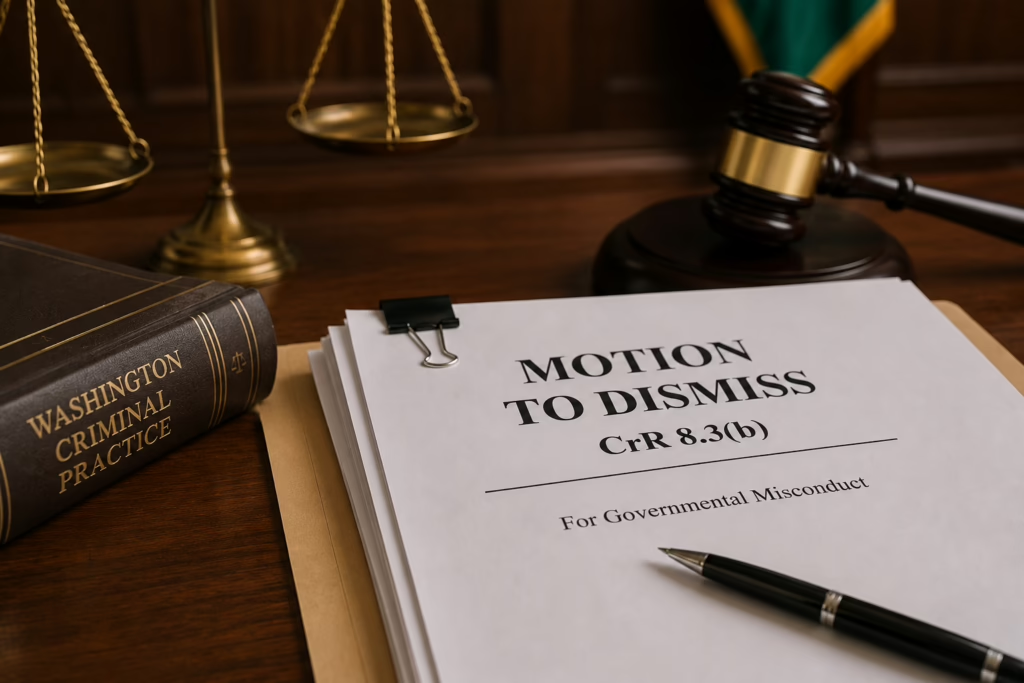
A recent Washington Court of Appeals decision highlights how difficult it can be to obtain dismissal of criminal charges based on alleged governmental misconduct under CrR 8.3(b).
In State v. Comer, the defendant argued the trial court improperly denied dismissal after prosecutors sought trial continuances and later amended the charging information shortly before trial. The Court of Appeals rejected those arguments and affirmed the convictions.
The opinion provides important guidance regarding motions to dismiss, preservation of appellate issues, trial continuances, and late amendments to criminal charges.
What Is a Motion to Dismiss Under CrR 8.3(b)?
Under Washington Criminal Rule 8.3(b), a court may dismiss criminal charges due to governmental misconduct when the defendant’s rights have been prejudiced.
Courts generally require proof of:
- Governmental misconduct or mismanagement
- Actual prejudice affecting the defendant’s right to a fair trial
Dismissal under CrR 8.3(b) is considered an extraordinary remedy and is not granted lightly.
Washington courts often reserve dismissal for situations involving serious prosecutorial mismanagement or violations that materially impair the defense.
Background of the Case
According to the opinion, Christopher Comer was charged after an incident involving his former girlfriend in August 2023. Prosecutors alleged Comer threatened the victim with a firearm, assaulted her, and later discharged the weapon.
The State initially charged:
- Assault in the second degree
- Assault in the fourth degree
After several continuances, prosecutors later moved to amend the information to add:
- Unlawful possession of a firearm in the first degree
The amendment occurred approximately two weeks before trial.
The jury ultimately convicted Comer of second-degree assault and unlawful possession of a firearm.
The Motion to Dismiss Issue on Appeal
On appeal, Comer argued the trial court should have dismissed the case under CrR 8.3(b) due to governmental mismanagement.
His arguments focused primarily on:
- Trial continuances
- Prosecutorial reassignment delays
- The late amendment adding the firearm charge
However, the Court of Appeals rejected the argument for several procedural reasons.
Why the Court Rejected the Motion to Dismiss Argument
The appellate court explained that Comer never actually filed a formal motion to dismiss under CrR 8.3(b).
According to the opinion:
- The record contained no formal CrR 8.3(b) motion
- Defense counsel never requested dismissal as a remedy
- The record lacked any order denying such a motion
- The defendant failed to properly preserve the issue for appeal
The Court of Appeals emphasized that appellate courts generally will not review arguments raised for the first time on appeal unless narrow exceptions apply.
Because the defendant failed to preserve the issue below and failed to properly address RAP 2.5(a), the court declined review.
Trial Continuances Alone Were Not Enough
The defendant also challenged the continuance granted after the assigned prosecutor left the prosecutor’s office.
The Court of Appeals noted:
- The continuance remained within CrR 3.3 time-for-trial limits
- The defendant did not allege a speedy trial violation
- The defense failed to show actual prejudice
Without proof that the continuance harmed the defense, the court found no basis for reversal.
The Court Also Upheld Amendment of the Charges
The appellate court separately analyzed whether the State improperly amended the charging information shortly before trial.
Washington Allows Pretrial Amendments
Under CrR 2.1(d), prosecutors may amend criminal informations before verdict if the defendant’s substantial rights are not prejudiced.
The court explained that prejudice usually involves whether the defendant lacked adequate time to prepare a defense.
Why the Amendment Was Allowed
The Court of Appeals concluded the amendment was permissible because:
- The firearm allegations already appeared in the original affidavit
- The amendment occurred two weeks before trial
- Only one additional charge was added
- Defense counsel did not request another continuance
- The defense did not show surprise or inability to prepare
The court distinguished the case from State v. Michielli, where prosecutors added multiple new charges only days before trial and forced the defendant to waive speedy trial rights.
Because Comer failed to establish actual prejudice, the amendment remained valid.
Why This Case Matters
This decision highlights several important principles in Washington criminal procedure.
Motions Must Be Properly Preserved
Appellate courts generally will not review arguments never formally raised in the trial court.
CrR 8.3(b) Dismissals Are Difficult to Obtain
General claims of governmental mismanagement are usually insufficient without proof of prejudice.
Continuances Do Not Automatically Create Error
Defendants must show actual harm to the defense.
Late Amendments May Still Be Allowed
Courts often permit amendments when the underlying facts were already known and the defense still has adequate time to prepare.
Understanding Unpublished Opinions in Washington
It is important to understand that State v. Comer is an unpublished Washington Court of Appeals opinion.
Under Washington court rules, unpublished opinions generally are not binding precedent. Courts are not required to follow unpublished opinions in the same way they follow published appellate decisions.
However, unpublished opinions still provide useful insight into:
- Criminal motion practice
- CrR 8.3(b) dismissal standards
- Preservation of appellate issues
- Amendment of criminal charges
- Washington criminal procedure
Attorneys often review unpublished opinions to better understand how appellate courts are handling procedural disputes in criminal cases.
For readers interested in reviewing the court’s reasoning directly, the full unpublished opinion is available through the Washington Courts website: https://www.courts.wa.gov/opinions/pdf/406440_unp.pdf
Contact Blanford Law Today
If you are facing criminal charges involving motions to dismiss, amended charges, or alleged prosecutorial misconduct in Washington State, experienced legal representation is critical.
Contact Blanford Law today at ken@blanfordlaw.com or 253-720-9304 for guidance on your legal matter.
Additional Resources
State v. Teems and Washington Speedy Trial Rights
Learn how Washington courts analyze speedy trial violations and procedural delays in criminal prosecutions.
https://blanfordlaw.com/state-v-teems-speedy-trial/
Roslyn Noise Ordinance Violations
This article explains how noise ordinance violations are enforced under local Washington municipal law.
https://blanfordlaw.com/roslyn-noise-ordinance/
State v. Knapstad in Washington Criminal Law
Review how defendants may seek dismissal of criminal charges before trial under a Knapstad motion.
https://blanfordlaw.com/state-v-knapstad-washington/
SeaTac Off-the-Record Continuances
Learn about procedural concerns involving off-the-record continuances and Washington criminal court practices.
https://blanfordlaw.com/seatac-off-the-record-continuances/
Downing Continuance Ruling Explained
This resource examines how Washington courts evaluate continuance requests and claims of prejudice in criminal cases.
https://blanfordlaw.com/downing-continuance-ruling/