
Overview of State v. Jaynes
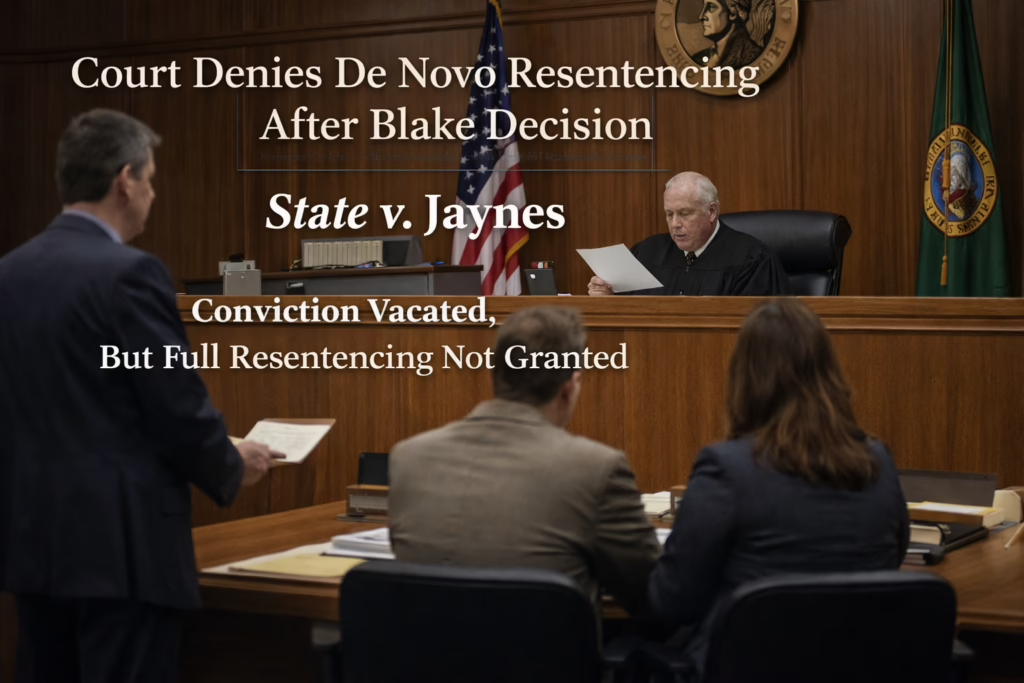
In State v. Jaynes, Division II of the Washington Court of Appeals addressed whether a defendant is entitled to Washington de novo resentencing after a conviction is vacated under State v. Blake. The court held that a full resentencing hearing is not always required—particularly when the change does not affect the overall sentence.
Jaynes was convicted in 2007 of multiple felony offenses, including first-degree assault, firearm-related charges, and unlawful possession of a controlled substance. His total sentence was 579 months, driven largely by serious violent offenses and firearm enhancements.
Following State v. Blake, 197 Wn.2d 170 (2021), which struck down Washington’s strict liability drug possession statute as unconstitutional, Jaynes moved to vacate his possession conviction and requested a full resentencing.
The trial court granted partial relief by removing the invalid conviction and its related firearm enhancement, but denied a full resentencing. The Court of Appeals affirmed.
Washington De Novo Resentencing After Blake
When Resentencing Is Typically Required
Under Washington law, courts may grant relief from a final judgment under CrR 7.8(b) when a conviction or sentence is invalid.
👉 https://www.courts.wa.gov/court_rules/?fa=court_rules.display&group=cr&set=CrR&ruleid=crr7.8
Additionally, post-conviction motions are generally subject to a one-year time limit under RCW 10.73.090, unless an exception applies.
👉 https://app.leg.wa.gov/rcw/default.aspx?cite=10.73.090
One key exception is when a judgment is facially invalid, such as when it includes a conviction invalidated by Blake.
In many cases, Washington courts require a full de novo resentencing, meaning the court reevaluates the entire sentence from scratch.
When Full Resentencing Is Not Required
The Jaynes decision reinforces a critical limitation:
A court may correct a judgment without full resentencing when the error is not material to the overall sentence.
Relying on recent Washington Supreme Court cases such as State v. Kelly and State v. Vasquez, the Court of Appeals emphasized:
- If the offender score remains high enough to produce the same sentencing range
- And the invalid conviction does not affect the total confinement time
Then a full resentencing is unnecessary.
Court’s Analysis in Jaynes
The court identified three decisive factors:
1. Partial Correction, Not Full Vacation
The trial court vacated only the invalid drug conviction and removed its 18-month firearm enhancement. It did not vacate the entire judgment and sentence.
2. No Appellate Mandate
There was no appellate order requiring a full resentencing hearing.
3. No Change to Sentencing Range
Even after the correction:
- Jaynes’s offender score remained 9+
- His sentencing range for first-degree assault stayed the same
- His base sentence remained 333 months
Because the Blake error had no practical impact, the court held that a full resentencing was not required.
Citing Unpublished Opinions in Washington
Governing Rule: RAP 10.4(h)
The Jaynes opinion is unpublished, which affects how it can be used in future cases.
Washington Rule of Appellate Procedure RAP 10.4(h) governs citation of unpublished opinions:
👉 https://www.courts.wa.gov/court_rules/?fa=court_rules.display&group=app&set=RAP&ruleid=app10.4
Key Rules for Citation
- Unpublished opinions may be cited as nonbinding authority
- They are not precedential and do not bind courts
- A party citing one should provide a copy or hyperlink to the opinion
Additionally, unpublished opinions are filed for public record under RCW 2.06.040:
👉 https://app.leg.wa.gov/rcw/default.aspx?cite=2.06.040
Practical Limitations
Attorneys should understand the limitations:
- Courts are free to disregard unpublished opinions
- They carry persuasive value only
- They are most useful when:
- No published authority addresses the issue, or
- The case is factually similar
In Jaynes, the unpublished designation signals that while the reasoning is informative, it does not establish binding law.
Why Jaynes Matters for Washington Defendants
The key takeaway from State v. Jaynes is practical:
Vacating a conviction does not automatically entitle a defendant to full resentencing.
If the sentencing structure—particularly the offender score and standard range—remains unchanged, courts may simply correct the judgment.
For individuals seeking relief after Blake, this distinction can determine whether a motion results in a minor correction or a full resentencing hearing.
Contact Blanford Law Today
If you or a loved one may be affected by a prior conviction or sentencing issue, legal guidance is essential.
Contact Blanford Law today at ken@blanfordlaw.com or 253-720-9304 for guidance on your legal matter.
Additional Resources
- Post-Conviction Relief in Washington – Learn about legal options for challenging convictions after sentencing.
https://www.blanfordlaw.com/post-conviction-relief-in-washington/ - Understanding Firearm Enhancements – Details on how firearm enhancements can significantly increase prison time.
https://www.blanfordlaw.com/understanding-firearm-enhancements/ - Washington Sentencing Appeals – Overview of appealing criminal sentences in Washington courts.
https://www.blanfordlaw.com/washington-sentencing-appeals/ - Record Expungement in Washington [USED] – A guide to clearing your criminal record.
https://www.blanfordlaw.com/record-expungement-in-washington/ - Understanding Your Right to Remain Silent [USED] – Learn your rights during police encounters.
https://www.blanfordlaw.com/understanding-your-right-to-remain-silent/