
A new Washington drug patch ruling strengthens the privacy rights of people accused of DUI who are awaiting trial. In Bailey-Cobb v. Snohomish County District Court, consolidated with Toombs v. Snohomish County District Court, Division One of the Washington Court of Appeals held that requiring two DUI defendants to wear transdermal drug-monitoring patches as conditions of pretrial release violated article I, section 7 of the Washington State Constitution.
The decision is significant because the defendants had been charged with DUI but had not been convicted. The Court of Appeals emphasized that pretrial defendants do not automatically lose the privacy protections enjoyed by other Washington residents simply because criminal charges are pending.
Washington Drug Patch Ruling Protects Pretrial Privacy
The consolidated appeal involved Simone Bailey-Cobb and Andrew Toombs, who were separately arrested in Snohomish County on allegations of driving under the influence.
At Bailey-Cobb’s arraignment, the court imposed several conditions of release, including a requirement that she wear a drug-monitoring patch. The court cited her criminal history and concerns about public safety.
Toombs was also required to wear a drug-monitoring patch as a condition of release. The district court described the patch as a less restrictive alternative to detention or higher bail.
Both defendants challenged the monitoring requirement through habeas corpus petitions. The lower court denied their petitions, concluding that Washington law and court rules provided authority for the monitoring.
The Court of Appeals disagreed.
What Is a Transdermal Drug-Monitoring Patch?
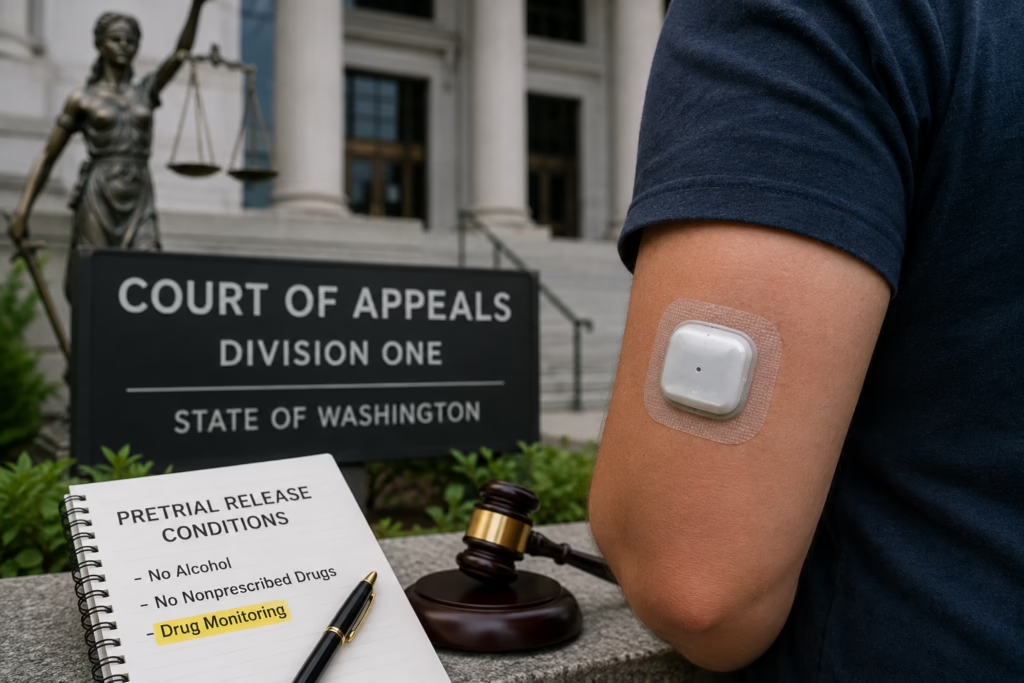
The patches at issue are worn directly on the skin and collect sweat that can be tested for drugs.
That might sound less intrusive than a blood draw or urine test, but the Court of Appeals found the privacy implications were substantial.
According to the opinion, participation in the monitoring program required the defendants to provide personal information to a third-party monitoring company. That information could include a Social Security number, employment information, and medical records.
The patch could also detect drugs beyond substances the court had specifically prohibited. The court noted that the monitoring could collect evidence concerning prescription drugs and other substances that were not necessarily connected to unlawful conduct.
The defendants were also required to return periodically to have the patches replaced.
Article I, Section 7 Provides Strong Washington Privacy Protection
Article I, section 7 of the Washington Constitution states that no person may be disturbed in their private affairs without authority of law.
Washington courts have long recognized that this provision can provide broader privacy protection than the Fourth Amendment to the United States Constitution.
The Court of Appeals relied heavily on an important distinction between pretrial defendants and people who have already been convicted.
People serving probation or community custody may have reduced expectations of privacy because of their criminal convictions and supervision status. Bailey-Cobb and Toombs, however, were awaiting trial.
They had not been convicted.
Washington precedent recognizes that people charged with crimes but not yet convicted do not automatically have diminished privacy rights.
That distinction was central to the court’s decision.
Why RCW 10.21.045 Did Not Authorize These Drug Patches
RCW 10.21.045 allows Washington courts imposing pretrial release conditions to prohibit a defendant from consuming intoxicating liquor or nonprescribed drugs and to require testing when the court determines that such a condition is necessary to protect the public from harm.
The State argued that this statute, together with CrRLJ 3.2, supplied the required authority of law for the drug-monitoring patches.
But the Court of Appeals concluded that those provisions did not constitutionally justify the particular searches imposed on Bailey-Cobb and Toombs.
The distinction is important.
The decision does not say that courts lack authority to prohibit alcohol or drug use as a release condition. Nor does it eliminate every form of substance testing that might be lawfully ordered in a criminal case.
Instead, the court held that the transdermal patch requirements imposed on these pretrial defendants were not supported by sufficient constitutional authority under the circumstances presented.
The Drug Patches Were Not Narrowly Tailored
The State also argued that protecting the public from impaired driving was a compelling governmental interest.
The Court of Appeals did not dispute the importance of public safety.
The problem was the method chosen to accomplish that goal.
Even if a balancing test applied, the court concluded that the monitoring patches were not narrowly tailored because they could reveal significantly more private information than was necessary to enforce the release conditions.
The court pointed out that the patch could collect evidence of substances that were prescribed or otherwise not prohibited. In addition, the monitoring program required defendants to disclose substantial personal information to the private company administering the program.
The court also noted a practical limitation: the patch did not test for alcohol, even though alcohol consumption was prohibited by the defendants’ release conditions.
In other words, the monitoring system intruded significantly into private affairs while not even monitoring every substance prohibited by the court orders.
The Court Rejected the State’s “Special Needs” Argument
The State also relied on the federal “special needs” doctrine.
Under that doctrine, certain searches may sometimes be permitted without the usual warrant or probable-cause requirements when the government has a special purpose beyond ordinary law enforcement.
But Washington’s constitution provides its own protection of private affairs.
The Court of Appeals noted that the Washington Supreme Court has repeatedly declined to broadly apply the federal special-needs exception to pretrial defendants under article I, section 7.
Even assuming such an exception could apply, the Court of Appeals concluded that the State had not shown that its public-safety interest outweighed the defendants’ privacy interests.
The opinion describes the monitoring as highly invasive and capable of exposing personal information beyond what was necessary to determine compliance with the release conditions.
What Did the Court Ultimately Order?
The Court of Appeals reversed the lower court rulings.
It directed the trial court to amend Bailey-Cobb’s and Toombs’s release orders and remove the drug-monitoring patch requirements.
The decision is important, but it should not be interpreted as eliminating judicial authority to impose reasonable pretrial conditions.
Washington law continues to permit courts to consider public safety when setting release conditions. RCW 10.21.050, for example, directs courts to consider factors such as the nature of the charge, criminal history, history relating to drug or alcohol abuse, and the danger that release may pose to another person or the community.
Courts may also prohibit alcohol or nonprescribed drug consumption and impose other lawful conditions of release.
What this decision reinforces is that the government’s choice of monitoring method must still comply with the Washington Constitution.
Does the Decision Prohibit All Pretrial Drug Testing?
No.
The Court of Appeals addressed the specific transdermal monitoring program imposed in these two cases and the constitutional arguments the State relied upon to defend it.
The court did not hold that every possible drug test imposed before trial is automatically unconstitutional.
Different circumstances could involve consent, a warrant, another recognized authority of law, a different testing method, or facts not presented in these cases.
That makes the exact wording of a release order—and the method used to enforce it—important.
Why This Case Matters to Washington DUI Defendants
Release conditions can have a significant impact on someone charged with DUI before the case is ever resolved.
A court may impose restrictions involving alcohol, drugs, driving, ignition interlock devices, travel, treatment, or other conduct. Violating those conditions can lead to additional hearings and potentially more restrictive release requirements.
But being charged with a crime is not the same as being convicted.
The Bailey-Cobb and Toombs decision reinforces the principle that Washington defendants awaiting trial continue to have substantial constitutional privacy rights.
When a release condition requires continuous bodily monitoring or disclosure of sensitive personal information, constitutional limits still apply.
Questions About DUI Release Conditions in Washington?
A DUI arrest can result in court-ordered conditions that affect driving, alcohol use, testing, treatment, and everyday life. If a release condition appears unusually intrusive or you do not understand what the court has ordered, it is important to review the exact language of the order and the authority supporting it.
Contact Blanford Law today at ken@blanfordlaw.com or 253-720-9304 for guidance on your legal matter.
Additional Resources
DUI vs Physical Control in Washington: Key Differences Explained
Learn how Washington distinguishes DUI from physical control and why the difference can matter when evaluating charges and possible defenses.
https://blanfordlaw.com/dui-vs-physical-control-washington/
Mandatory Minimum Sentences for DUI in Washington State
Review Washington DUI sentencing requirements, including potential jail, fines, license consequences, and other mandatory penalties.
https://blanfordlaw.com/mandatory-minimum-sentences-dui-washington/
Washington Bail Recognizance Law Under RCW 10.19.040
Learn how Washington law addresses release on recognizance and other issues that can arise while a criminal case is pending.
https://blanfordlaw.com/washington-bail-recognizance-law/
State v. Keller Breath Test: Washington Supreme Court Ruling
Learn about another Washington case involving DUI evidence, testing, and the constitutional rules that can affect criminal investigations.
https://blanfordlaw.com/state-v-keller-breath-test/
How to Get Discovery DUI | Washington Criminal Defense
Learn what discovery may contain in a Washington DUI case and why police reports, testing records, video, and other evidence can matter.
https://blanfordlaw.com/how-to-get-discovery-dui/