
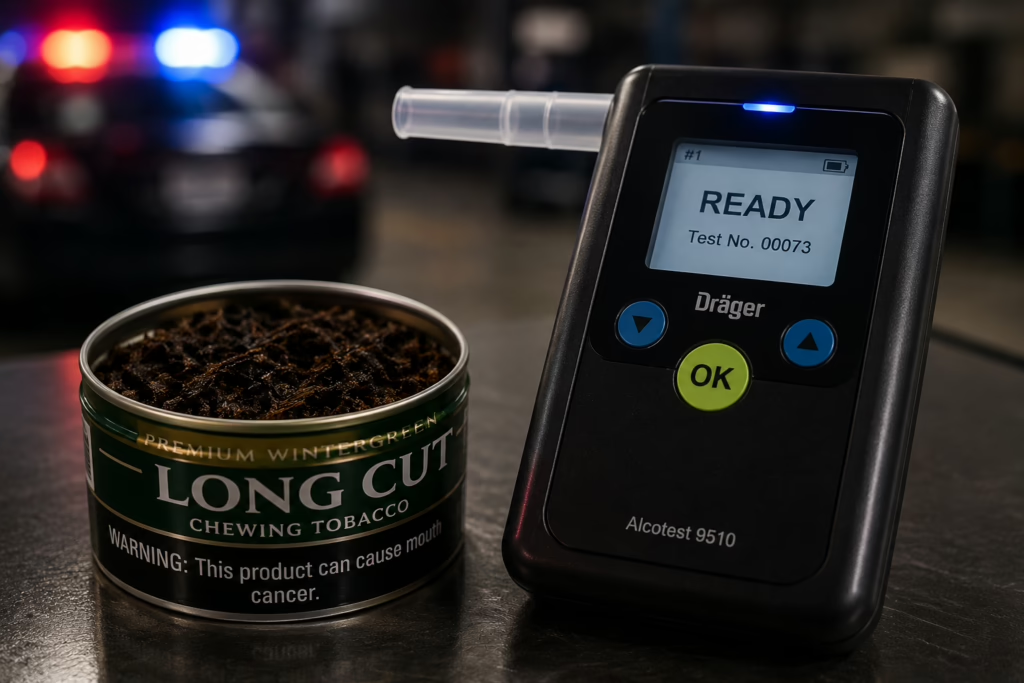
A Washington DUI breath test can become a major piece of evidence in a DUI or vehicular-homicide prosecution. But what happens when the person being tested recently had chewing tobacco in their mouth—and tiny strands of tobacco remain between their teeth when the test begins?
On August 13, 2026, the Washington Supreme Court addressed that unusual question in State v. Sliger, No. 103563-2. The court affirmed admission of the defendant’s Draeger breath-test results even though an officer had observed small tobacco strands in his teeth. The decision is important for anyone challenging BAC evidence because it draws attention to a practical distinction between an obvious foreign substance—such as a lump of chewing tobacco—and small residual material whose effect on the reliability of the test may require additional evidence.
What Happened in State v. Sliger?
John Henry Sliger was involved in a 2020 collision with a dirt bike, and the rider later died. At the scene, an officer learned that Sliger had been drinking and saw chewing tobacco in his mouth. Before a portable breath test, the officer instructed him to spit out the tobacco.
After Sliger was arrested and taken to jail, he agreed to a Draeger breath test. When asked whether he had any foreign substances in his mouth, Sliger said no. But the officer also visually examined his mouth and documented “tiny tobacco strands” stuck between his teeth. The strands were not removed before the breath test was administered.
Sliger later moved to suppress the Draeger results, arguing that the remaining tobacco violated Washington’s foundational requirements for admissibility of breath-test evidence. The trial court denied suppression, and the Court of Appeals affirmed. The Washington Supreme Court then accepted review and ultimately affirmed the result.
Washington DUI Breath Test Rules and the 15-Minute Observation Period
Washington law requires the State to establish specific foundational facts before breath-test evidence may be admitted.
Under the current version of RCW 46.61.506, the prosecution must produce prima facie evidence that, among other requirements, the person being tested did not vomit or eat, drink, or smoke for at least 15 minutes before the test and did not have a disqualifying foreign substance in the mouth at the beginning of the observation period. A 2026 amendment renumbered the relevant subsection but did not materially change the foreign-substance issue addressed in Sliger.
WAC 448-16-040 further provides that the presence of a foreign substance may be determined either by examining the person’s mouth or by obtaining the person’s denial that a foreign substance is present. The regulation also provides procedures when the instrument detects interference or records an invalid sample.
These rules matter because the 15-minute observation period is not simply a formality. Breath-test admissibility rules are designed to help ensure that the reported alcohol concentration is sufficiently reliable to be considered by a judge or jury.
Did the Supreme Court Say Chewing Tobacco Never Invalidates a Breath Test?
No.
That is the most important practical point from Sliger. The decision should not be read to mean that chewing tobacco is irrelevant to every breath test or that an officer may ignore an obvious amount of tobacco in a person’s mouth.
The lead opinion distinguished between a substantial amount of foreign material and tiny residual strands. The State’s breath-test expert testified that he would have concerns if a person still had a lump of chewing tobacco in the mouth, but not the small strands or flecks described in Sliger’s case. Based on that expert testimony, the lead opinion concluded that the State had produced sufficient prima facie evidence supporting admission of the test.
In other words, the practical question became not merely, “Was there technically something in the mouth?” but also, “Was the substance present in an amount or condition that could affect the reliability of the breath test?”
That distinction could become central in future motions seeking suppression of BAC evidence.
Why the Court’s Split Matters for Future Breath-Test Challenges
Sliger was not a unanimous decision, and lawyers should be careful about describing its reasoning too broadly.
Four justices signed Justice Madsen’s lead opinion. Justice González concurred in the result but used different reasoning. Four justices dissented. The five-justice majority therefore agreed that Sliger’s breath-test result should remain admissible, but they did not all agree on why.
The lead opinion relied on expert testimony that the tiny tobacco strands would not affect the validity of the test. Justice González would have gone further, reasoning that the State did not need expert testimony because Sliger’s denial that he had a foreign substance in his mouth could support an inference that no more than a de minimis quantity remained.
The dissent took the opposite approach. It emphasized that Washington State Patrol training treated chewing tobacco as a foreign substance and argued that the statutory requirement should have been applied strictly when the officer actually observed tobacco remaining in Sliger’s mouth.
For defense lawyers, that fractured reasoning is significant. Sliger unquestionably makes suppression harder where only tiny residual material is present, but it does not create a simple rule that every trace amount of tobacco is automatically harmless.
Obvious Contaminant vs. Small Residual Substance
The most useful way to understand Sliger is through two categories.
An Obvious Foreign Substance
A sizeable lump of chewing tobacco, gum, food, liquid, or another clearly identifiable material in the mouth presents a much stronger suppression issue. The lead opinion specifically relied on testimony distinguishing a substantial lump of chewing tobacco from tiny strands remaining between the teeth.
Where an officer sees an obvious substance and proceeds without removing it or restarting the observation period, the defense may have a substantial argument that the State failed to establish the statutory foundation for admission.
Tiny Residual Material
Small strands, flecks, or debris present a more complicated problem after Sliger.
The lead opinion suggests that when the substance is minimal and its effect on the breath test is disputed, technical testimony about whether the material could actually affect the reliability of the Draeger result may become important. The concurrence, however, would allow admission on a somewhat broader theory where the evidence supports only a de minimis amount.
That means future breath-test litigation may increasingly focus on details such as:
- What exactly was in the person’s mouth?
- How much material was present?
- Where was it located?
- Did the officer actually see it?
- Was the mouth rinsed?
- Was the 15-minute period restarted?
- What did the officer write in the DUI report?
- Did the Draeger machine register interference or an invalid sample?
- Can an expert explain whether the substance could have affected the reported BAC?
These are fact-intensive questions. A small notation in a police report—such as “tobacco strands,” “gum,” “food debris,” or “foreign substance”—may become important when evaluating whether breath-test evidence can be challenged.
Does a Problem With the Observation Period Automatically Suppress BAC Evidence?
Not necessarily.
Washington law requires the State to establish the statutory foundation for admitting a breath test, but Sliger demonstrates that courts may look closely at the nature and potential effect of the substance involved. The State bears the prima facie burden at the admissibility stage, while the defense may still challenge the weight, accuracy, and reliability of the BAC evidence at trial.
The distinction between admissibility and weight matters. Even when a judge allows the breath-test number into evidence, the defense may still argue that testing procedures, instrument performance, officer observations, or other circumstances make the number less reliable than the prosecution claims.
The Washington Supreme Court previously addressed another technical challenge involving the Draeger Alcotest 9510 in State v. Keller. There, the court also emphasized the statutory foundation required for breath-test evidence while rejecting the particular suppression theory advanced in that case. Blanford Law’s discussion of Keller provides useful background for understanding how Washington courts analyze these technical challenges.
What Should a DUI Defense Lawyer Review After Sliger?
A meaningful challenge to a breath test generally requires more than looking at the final BAC number. The defense should examine the complete testing process, including the officer’s reports, breath-test ticket, observation-period documentation, body-camera footage when available, statements about substances in the mouth, and any inconsistencies between the officer’s contemporaneous notes and later testimony.
Sliger itself illustrates why those details matter. The officer documented tiny tobacco strands in one portion of the record while later reporting that no foreign substances were present. Those facts became central to the suppression litigation.
Where a substance was plainly visible, the issue may be primarily procedural. Where only a small residue remained, the case may turn more heavily on technical evidence about whether that residue could affect the Draeger’s reliability.
Challenging Breath-Test Evidence in a Washington DUI Case
A breath-test result over the legal limit can be powerful evidence, but it is not automatically immune from challenge. Washington law imposes foundational requirements precisely because breath testing must be performed under controlled conditions.
After State v. Sliger, defense counsel should distinguish carefully between a clear contaminant that should have been removed before testing and a small residual substance whose significance may depend on expert testimony, the officer’s observations, and the specific testing record.
No two DUI cases present exactly the same facts. A lawyer evaluating a breath-test challenge should review not only the BAC result but also whether the State can establish every required step leading to its admission.
Contact Blanford Law
If you are facing a DUI charge and have questions about a breath test, the 15-minute observation period, foreign substances in the mouth, or another potential challenge to BAC evidence, experienced legal review can help identify issues that may not be obvious from the test result alone.
Contact Blanford Law today at ken@blanfordlaw.com or 253-720-9304 for guidance on your legal matter.
Additional Resources
- State v. Keller Breath Test: Washington Supreme Court Ruling — Explains another Washington Supreme Court decision addressing the foundational requirements for Draeger breath-test evidence.
https://blanfordlaw.com/state-v-keller-breath-test/ - Washington DUI Laws | Penalties, Process & Defenses — Provides a broader overview of Washington DUI law, BAC evidence, license consequences, and common defense issues.
https://blanfordlaw.com/washington-dui-laws/ - Blood Alcohol Content BAC: DUI Myths and Facts in Washington — Reviews common misconceptions about BAC and how breath-test evidence may affect a Washington DUI case.
https://blanfordlaw.com/blood-alcohol-content-bac/ - Washington DUI Case: State v. Quaale — Discusses evidentiary limits in a Washington DUI prosecution and the importance of carefully scrutinizing opinion evidence.
https://blanfordlaw.com/state-v-quaale-dui-washington/ - What to Do When Pulled Over for a DUI in Washington — Explains practical issues surrounding DUI stops, arrest, implied consent, and post-arrest breath testing.
https://blanfordlaw.com/what-to-do-when-pulled-over-for-a-dui-in-washington/
Summary of Article: State v. Sliger clarifies that tiny residual strands of chewing tobacco do not automatically require suppression of a Washington breath test. The lead opinion relied on expert testimony that the residue would not affect reliability, while a concurrence would have allowed admission based on the defendant’s denial and the de minimis nature of the residue. The decision makes the distinction between an obvious contaminant and minor residual material especially important in future BAC challenges.
Yoast Compliance: ✅
Article URL: To be added after publishing.