
Overview of State v. Bailey
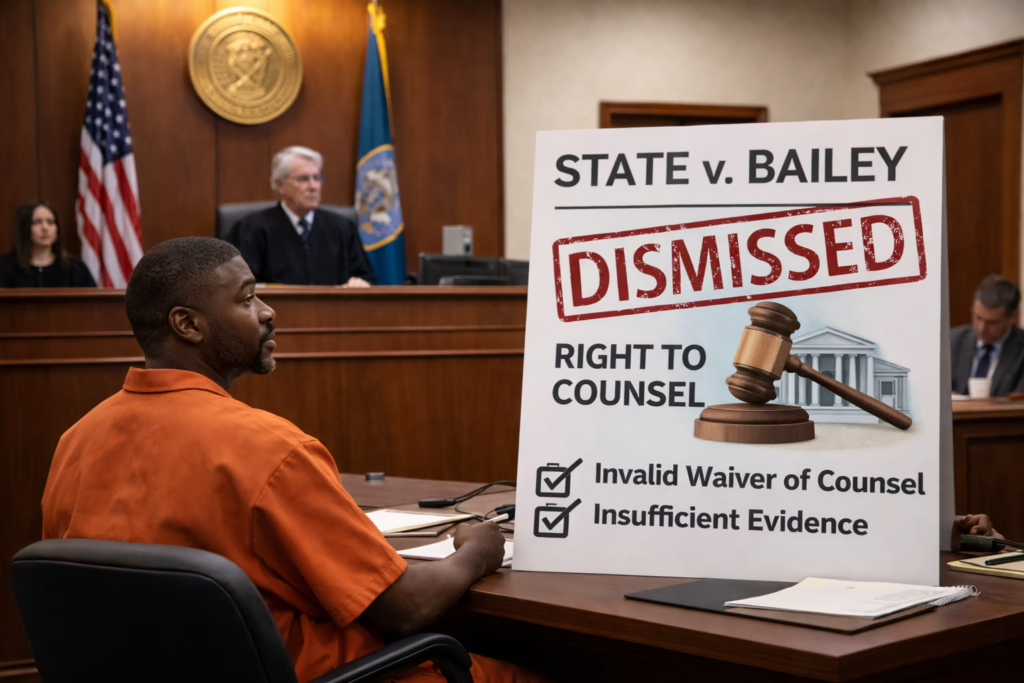
In State v. Bailey, the Washington Court of Appeals (Division II) addressed two critical issues: whether a defendant validly waived the right to counsel and whether sufficient evidence supported felony harassment convictions. The court ultimately reversed the convictions and dismissed the charges with prejudice.
Jared Bailey was charged with two counts of felony harassment against prosecutors after sending threatening emails. He represented himself at trial and was convicted. On appeal, both Bailey and the State agreed that his waiver of counsel was invalid.
The Court of Appeals went further, holding not only that Bailey’s constitutional rights were violated, but also that the evidence was insufficient, meaning the case could not be retried.
Washington Felony Harassment Right to Counsel
Constitutional Right to Counsel
Both the U.S. and Washington Constitutions guarantee a criminal defendant the right to counsel. However, a defendant may waive that right—but only if the waiver is:
- Knowing
- Intelligent
- Voluntary
Washington courts require a formal, on-the-record colloquy to ensure a defendant understands:
- The nature of the charges
- The potential penalties
- The risks of self-representation
Failure to Obtain a Valid Waiver
In Bailey, the trial court allowed the defendant to proceed without counsel but failed to conduct a proper colloquy.
The record showed:
- Bailey expressed confusion about legal representation
- He questioned whether attorneys were even licensed
- The court never fully explained the risks of self-representation
The Court of Appeals held:
There was no valid waiver of the right to counsel.
Because the right to counsel is fundamental, this error alone required reversal.
Insufficient Evidence for Felony Harassment
Legal Standard
Under RCW 9A.46.020, felony harassment requires proof that:
- The defendant made a threat
- The threat placed the victim in reasonable fear it would be carried out
Importantly, this includes both:
- Subjective fear (the victim was actually afraid), and
- Objective fear (a reasonable person would be afraid)
Why the Evidence Failed
Although Bailey’s emails contained threatening language, the court found the evidence insufficient to establish objective reasonable fear.
Key factors included:
- Bailey never attempted to carry out the threats
- He never appeared at the prosecutors’ office
- There was no evidence he had the ability to act on the threats
While the prosecutors testified they were afraid, the court emphasized:
The State must show that the fear was objectively reasonable—not just subjectively felt.
Because that element was not proven, the convictions could not stand.
Result: Dismissal With Prejudice
This case did not result in a new trial.
Instead, because the evidence was insufficient:
- Double jeopardy protections applied
- The State cannot retry Bailey
- The charges were dismissed with prejudice
This is a critical distinction—insufficient evidence ends the case permanently.
Additional Issue: Concerns About Trial Evidence
The court also noted concerns about the admission of a recorded interview:
- The video contained hearsay statements
- It may have violated confrontation rights
- It likely would have been excluded if properly challenged
This highlights a broader issue: self-represented defendants may fail to raise valid evidentiary objections, which can impact trial fairness.
This Is an Unpublished Opinion
Important Legal Note
The State v. Bailey decision is designated as an unpublished opinion.
Under Washington law:
- It is filed under RCW 2.06.040
https://app.leg.wa.gov/rcw/default.aspx?cite=2.06.040 - It may be cited under RAP 10.4(h)
https://www.courts.wa.gov/court_rules/?fa=court_rules.display&group=app&set=RAP&ruleid=app10.4
What This Means
- The case is not binding precedent
- Courts are not required to follow it
- It may be used as persuasive authority only
Even so, unpublished opinions like Bailey provide valuable insight into how Washington courts analyze constitutional rights and evidentiary sufficiency.
Why State v. Bailey Matters
This case reinforces several important principles in Washington criminal law:
- Courts must strictly ensure a valid waiver of counsel
- Self-representation requires careful judicial safeguards
- Threatening language alone is not enough—the State must prove reasonable fear
- Insufficient evidence results in permanent dismissal, not retrial
For defendants and attorneys, Bailey underscores the importance of both procedural protections and evidentiary standards in criminal prosecutions.
Contact Blanford Law Today
If you are facing criminal charges or believe your constitutional rights were violated, experienced legal guidance is essential.
Contact Blanford Law today at ken@blanfordlaw.com or 253-720-9304 for guidance on your legal matter.
Additional Resources
- Washington Criminal Appeals Process – Learn how appellate courts review criminal convictions.
https://www.blanfordlaw.com/washington-criminal-appeals/ - Understanding Your Right to Counsel – Overview of when and how counsel must be provided.
https://www.blanfordlaw.com/right-to-counsel-washington/ - Washington Harassment Laws Explained – Learn how harassment charges are defined and defended.
https://www.blanfordlaw.com/washington-harassment-laws/ - Record Expungement in Washington [USED] – A guide to clearing your criminal record.
https://www.blanfordlaw.com/record-expungement-in-washington/ - Understanding Your Right to Remain Silent [USED] – Learn your constitutional protections.
https://www.blanfordlaw.com/understanding-your-right-to-remain-silent/