
Overview of State v. Clark
In State v. Clark, the Washington Court of Appeals (Division II) addressed whether certain statements admitted at trial violated Washington hearsay evidence rules, and whether alleged sentencing errors required reversal. The court ultimately affirmed both Clark’s convictions and sentence.
Rachel Clark was convicted of multiple crimes related to unauthorized use of a friend’s credit card, including identity theft and theft offenses. At trial, the key issue was whether Clark had permission to use the card. Clark admitted to using the card but claimed she had consent.
On appeal, she raised three primary arguments:
- The trial court improperly admitted hearsay evidence
- Her due process rights were violated by appearing in a courtroom holding cell
- The trial court improperly calculated her offender score
The Court of Appeals rejected all three arguments.
Washington Hearsay Evidence Rules Explained
What Is Hearsay?
Under ER 801(c), hearsay is:
An out-of-court statement offered to prove the truth of the matter asserted.
Under ER 802, hearsay is generally inadmissible unless an exception applies.
👉 Washington Evidence Rules: https://www.courts.wa.gov/court_rules/?fa=court_rules.display&group=er&set=ER
Why the Court Found No Hearsay Violation
Clark challenged testimony and documents related to bank notifications showing:
- Changes to account information
- Unauthorized transactions
She argued these statements were used to prove fraud occurred.
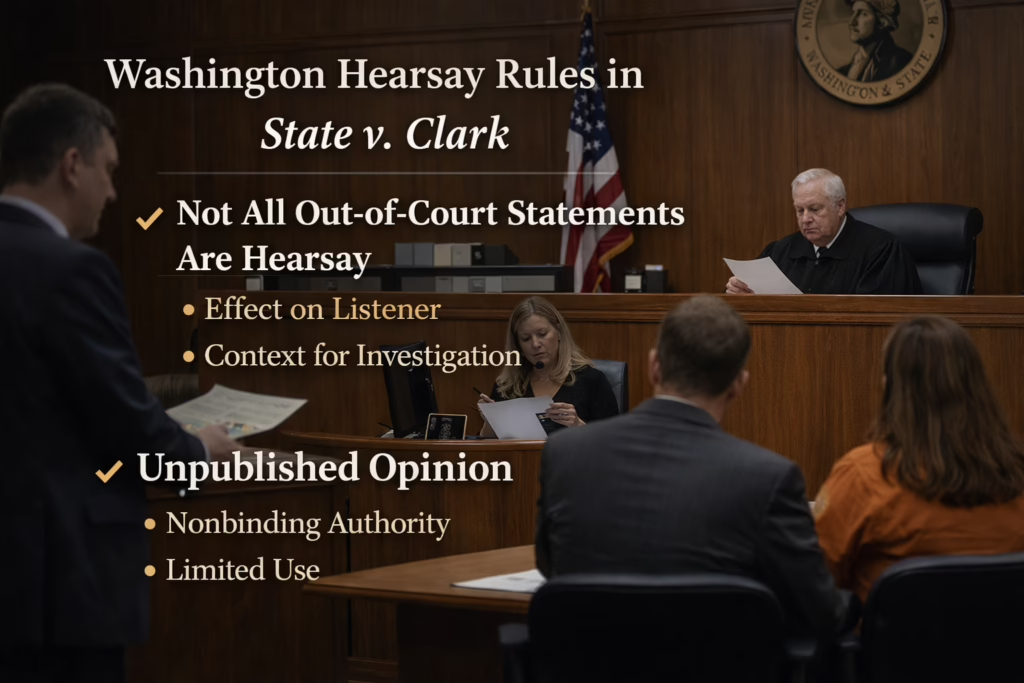
The court disagreed. Instead, it held the evidence was admitted for non-hearsay purposes, including:
1. Effect on the Listener
The statements explained why the victim became concerned and reported the issue.
2. Context for Police Investigation
They helped establish how law enforcement began investigating and identified Clark.
Washington courts recognize that statements offered for these purposes are not hearsay, because they are not introduced to prove the truth of the statements themselves.
Even If It Was Hearsay: Harmless Error
The court also held that even if admitting the statements had been error, it would have been harmless because:
- Clark admitted using the credit card
- Surveillance video showed her using it
- The case hinged on permission, not whether transactions occurred
Because of this overwhelming evidence, the statements had no meaningful impact on the verdict.
Other Key Legal Issues in Clark
Appearance in a Holding Cell
Clark argued her constitutional rights were violated by appearing in a courtroom holding cell without an individualized determination of necessity.
However, the court declined to review this claim under RAP 2.5(a) because:
- No objection was made at trial
- The alleged error was not “manifest” at the time
👉 RAP 2.5(a): https://www.courts.wa.gov/court_rules/?fa=court_rules.display&group=app&set=RAP&ruleid=app2.5
Offender Score Calculation
Clark also challenged how her offender score was calculated, arguing:
- A jury should determine prior convictions
- The State failed to prove her criminal history
The court rejected both arguments:
- Judges—not juries—may determine prior convictions under Washington law
- Clark agreed to the offender score, waiving the State’s burden of proof
This aligns with longstanding precedent that prior convictions are not subject to jury determination for sentencing purposes.
Citing Unpublished Opinions in Washington
Governing Rule: RAP 10.4(h)
The Clark opinion is unpublished, which affects how it can be used in future cases.
Under RAP 10.4(h):
👉 https://www.courts.wa.gov/court_rules/?fa=court_rules.display&group=app&set=RAP&ruleid=app10.4
- Unpublished opinions may be cited as nonbinding authority
- They are not binding precedent
- Parties citing them should provide access or a copy
Additionally, unpublished opinions are filed under:
👉 RCW 2.06.040: https://app.leg.wa.gov/rcw/default.aspx?cite=2.06.040
Practical Limitations on Use
Unpublished opinions like Clark:
- Do not control future cases
- Are used only for persuasive value
- Are most helpful when:
- No published authority exists, or
- The facts closely align
Attorneys should rely primarily on published case law but may use unpublished decisions to reinforce arguments or show trends in judicial reasoning.
Why State v. Clark Matters
This case reinforces two important principles in Washington criminal law:
- Not all out-of-court statements are hearsay—context matters
- Trial strategy matters—failure to object can waive important issues on appeal
It also highlights how courts evaluate whether alleged errors actually impacted the outcome of a trial.
Contact Blanford Law Today
If you are facing criminal charges or believe legal errors affected your case, experienced representation is critical.
Contact Blanford Law today at ken@blanfordlaw.com or 253-720-9304 for guidance on your legal matter.
Additional Resources
- Post-Conviction Relief in Washington – Learn how to challenge a conviction after trial.
https://www.blanfordlaw.com/post-conviction-relief-in-washington/ - Understanding Evidence Rules in Washington – Overview of how evidence is admitted in court.
https://www.blanfordlaw.com/understanding-evidence-rules/ - Washington Criminal Appeals Process – Learn how appeals work in Washington courts.
https://www.blanfordlaw.com/washington-criminal-appeals/ - Record Expungement in Washington [USED] – A guide to clearing your criminal record.
https://www.blanfordlaw.com/record-expungement-in-washington/ - Understanding Your Right to Remain Silent [USED] – Learn your rights during police questioning.
https://www.blanfordlaw.com/understanding-your-right-to-remain-silent/