
Washington Malicious Mischief Case Highlights Importance of Trial Objections
A recent Washington malicious mischief case out of Division II of the Court of Appeals offers a powerful reminder that even when the facts appear strong, procedural errors at trial can determine the outcome. In State v. Wells Palmer, the court upheld that sufficient evidence supported the conviction—but still reversed the case because of ineffective assistance of counsel tied to hearsay evidence.
The decision illustrates how evidentiary rules are not just technicalities—they can be the difference between a conviction and a new trial.
A Domestic Dispute Turns Destructive
The case arose from a long-term marriage that had deteriorated into separation and pending divorce. Although both parties had ownership interests in their home, a separation agreement gave the husband possession of the residence.
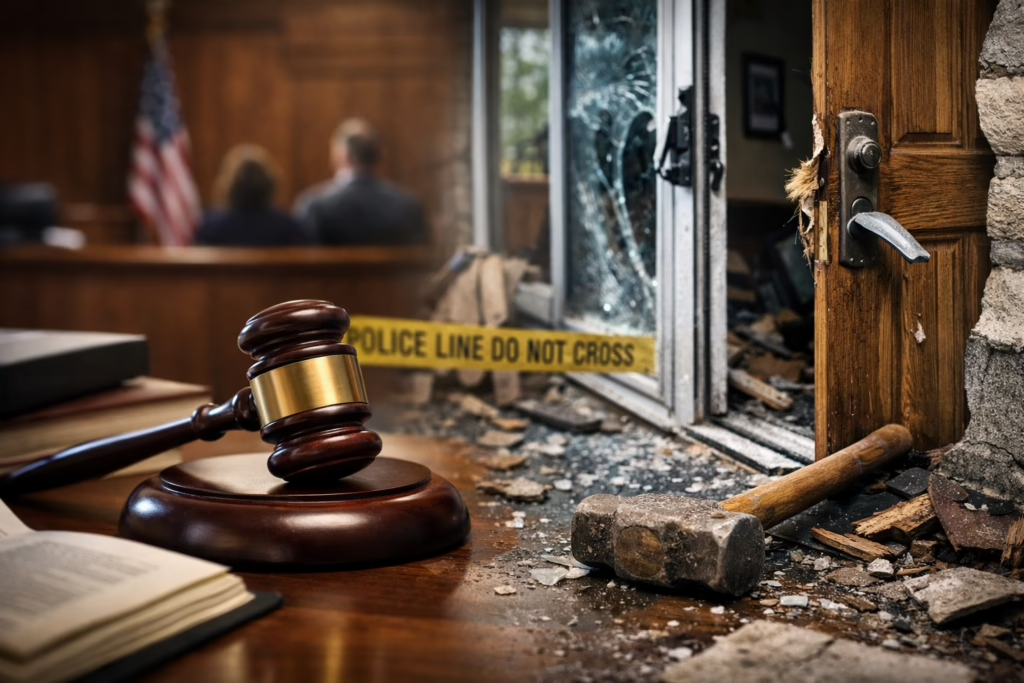
That arrangement set the stage for the incident. In May 2022, Wells Palmer returned to the property and demanded entry. When she was refused, the situation escalated quickly. Armed with a sledgehammer, she broke through doors and windows, ultimately forcing her way inside and causing extensive damage.
The destruction was significant—broken locks, shattered glass, and structural damage that required temporary repairs just to secure the home. A jury later acquitted her of burglary but convicted her of malicious mischief in the second degree, a felony tied to the amount of damage caused.
Why Ownership Did Not Prevent Criminal Liability
On appeal, Wells Palmer argued that she could not be guilty of damaging the “property of another” because she still had an ownership interest in the home. The Court of Appeals rejected that argument, relying on established Washington law.
Even when property is jointly owned, each party maintains a separate legal interest. That means one co-owner can still be held criminally liable for damaging shared property. The court emphasized that shared ownership does not grant a right to destroy property without consequence.
This principle is especially important in domestic situations, where property disputes often overlap with criminal conduct.
The Damage Amount—and Why It Mattered
The second key issue involved the amount of damage. Under Washington law, malicious mischief in the second degree requires proof that damage exceeded $750. At trial, the State relied on testimony that repair costs were approximately $9,500—well above the threshold.
On appeal, the court concluded that this evidence was sufficient. Washington courts give significant deference to juries, and even relatively simple testimony about repair costs can satisfy the State’s burden when viewed in the light most favorable to the prosecution.
But that was not the end of the analysis.
The Critical Error: Hearsay Evidence Goes Unchallenged
Although the evidence was sufficient, the conviction ultimately failed because of how that evidence was introduced.
The repair estimate—the linchpin for proving felony-level damage—was not based on firsthand testimony. Instead, it came from an out-of-court statement relayed through a witness. In other words, it was classic hearsay.
Under Washington’s evidence rules, hearsay is generally inadmissible unless an exception applies. Here, no exception justified its admission. Yet defense counsel did not object.
That failure proved decisive.
The Court of Appeals concluded that a proper objection likely would have been sustained. More importantly, the hearsay testimony was the only evidence establishing the amount of damage. Without it, the State may not have been able to prove the felony charge at all.
Because of that, the court found both deficient performance and prejudice—meeting the standard for ineffective assistance of counsel.
A Conviction Reversed Despite Strong Evidence
The result was striking but legally sound. Even though the jury had enough evidence to convict, the process used to reach that conviction was flawed. The court reversed the conviction and sent the case back for a new trial.
This outcome underscores a fundamental principle of criminal law: fairness in procedure is just as important as the underlying facts.
Unpublished Opinion—but Still Important
It is also worth noting that this is an unpublished opinion. Under Washington law, unpublished decisions are not binding precedent, meaning future courts are not required to follow them.
However, they can still be cited for persuasive value and often provide valuable insight into how appellate courts approach recurring legal issues. This case, in particular, offers a clear example of how courts evaluate hearsay, damage evidence, and ineffective assistance claims.
Why This Case Matters in Washington Law
At its core, this case is about more than property damage—it is about the integrity of the legal process. It reinforces several key lessons:
- Shared ownership does not shield a person from criminal liability
- The amount of damage is a critical element that must be properly proven
- Hearsay rules are strictly enforced when properly challenged
- Defense counsel’s performance can directly impact the outcome of a case
For anyone facing criminal charges, the case is a reminder that details matter—and that experienced legal representation is essential at every stage of the process.
Call to Action
If you are facing criminal charges or have questions about Washington evidence rules, it is critical to have knowledgeable legal representation.
Contact Blanford Law today at ken@blanfordlaw.com or 253-720-9304 for guidance on your legal matter.
Additional Resources
- Evidence Rule 608: Witness Credibility
Learn how ER 608 governs attacks and support of witness credibility in Washington courts.
https://blanfordlaw.com/evidence-rule-608-witness-credibility/ - Washington State Evidence Rule 404: Character Evidence in Legal Proceedings
This article explains when character evidence is admissible and key exceptions under ER 404.
https://blanfordlaw.com/exploring-washington-state-evidence-rule-404-character-evidence-in-legal-proceedings/ - Washington State Rule of Evidence 404: A Complex Rule with Important Exceptions
A deeper analysis of ER 404 and its practical application in criminal and civil cases.
https://blanfordlaw.com/washington-state-rule-of-evidence-404-a-complex-rule-with-important-exceptions/ - RCW 10.58.090 and State v. Gresham
Explore constitutional challenges related to evidentiary statutes in Washington.
https://blanfordlaw.com/rcw-10-58-090-unconstitutional-state-v-gresham/ - Suits Season 4 Crimes: Legal Accuracy Review
A look at how legal concepts are portrayed in media and how they compare to real law.
https://blanfordlaw.com/suits-season-4-crimes/