
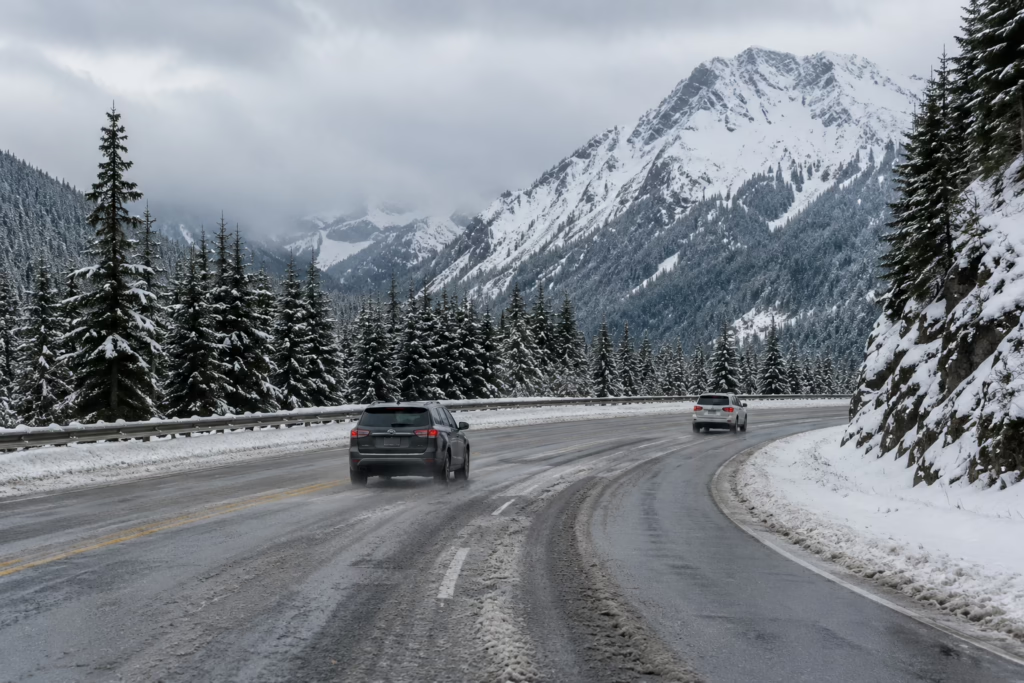
Driving through Washington’s Cascade Mountains during winter can be dangerous. Snow-covered highways, freezing temperatures, icy curves, and reduced visibility increase the risk of serious collisions. Washington mountain pass accidents can occur when drivers fail to prepare their vehicles, disregard traction requirements, or travel too fast for road conditions.
Major mountain routes, including Snoqualmie Pass on Interstate 90, Stevens Pass on US Highway 2, and White Pass on US Highway 12, are particularly vulnerable to rapidly changing winter weather.
While snow and ice can contribute to an accident, poor weather does not automatically excuse negligent driving. Washington motorists have a legal responsibility to operate their vehicles safely, even when road conditions are hazardous.
Understanding Washington’s winter driving laws, tire chain requirements, and personal injury liability rules can help drivers protect themselves and their legal rights.
Why Washington Mountain Pass Accidents Are Especially Dangerous
Mountain highways present driving challenges that differ from those encountered on ordinary city streets.
Steep grades, sharp curves, limited shoulders, and unpredictable weather can make controlling a vehicle difficult. Conditions can change dramatically over a short distance, especially when temperatures fluctuate around freezing.
Common hazards include:
- Black ice: Thin, nearly invisible ice that can cause drivers to lose traction unexpectedly.
- Snow-covered pavement: Accumulated snow can reduce braking effectiveness and make steering difficult.
- Reduced visibility: Heavy snowfall, blowing snow, and fog can make it difficult to see other vehicles.
- Steep downhill grades: Descending mountain roads requires additional stopping distance.
- Commercial truck traffic: Large trucks need more room to stop and may lose traction on icy grades.
- Sudden traffic backups: Collisions, disabled vehicles, and weather-related closures can create unexpected hazards.
A single vehicle sliding across an icy highway can trigger a multi-vehicle collision, particularly when surrounding drivers are following too closely.
Washington Winter Driving Laws: What Drivers Need to Know
Washington law requires drivers to exercise reasonable care under existing road and weather conditions.
Driving Too Fast for Snowy or Icy Conditions
Under RCW 46.61.400, motorists must drive at speeds that are reasonable and prudent, considering actual and potential hazards.
This means the posted speed limit is not necessarily a safe speed during winter weather.
For example, a driver traveling 50 mph in a 60 mph zone may still be driving negligently if ice, snow, or limited visibility makes that speed unsafe.
Drivers must reduce their speed when approaching curves, intersections, hill crests, and other hazardous areas.
A motorist who loses control because of excessive speed for the conditions may be held responsible if their negligence causes a collision.
Washington Tire Chain and Traction Requirements
The Washington State Department of Transportation (WSDOT) establishes traction and chain restrictions when hazardous conditions develop.
Depending on the weather, drivers may encounter several different requirements:
Traction Tires Advised
Drivers are encouraged to use approved traction tires. Oversize loads are prohibited.
Traction Tires Required
Vehicles must use approved traction tires or qualifying traction equipment. Certain heavier vehicles must install chains.
Tire Chains Required
Most vehicles must install chains or approved alternative traction devices. Qualifying all-wheel-drive and four-wheel-drive vehicles under 10,000 pounds may be exempt from installing chains if they satisfy the applicable conditions, including carrying chains.
Chains Required on All Vehicles
Every vehicle must install approved chains or qualifying alternative traction devices, including four-wheel-drive and all-wheel-drive vehicles.
Drivers who fail to install chains when required may face a $500 fine.
The Washington State Patrol provides detailed information about approved equipment and chain requirements.
Official resource: Washington State Patrol — Vehicle and Equipment Requirements
Are Studded Tires Required in Washington?
Washington does not generally require drivers to use studded tires.
Studded tires are ordinarily permitted between November 1 and March 31, although WSDOT may authorize extensions when conditions warrant.
Importantly, studded tires are not a substitute for chains when chain installation is required.
Drivers should verify that their tires meet Washington’s traction standards and carry appropriate equipment before crossing mountain passes.
Who Is Liable for a Winter Weather Car Accident in Washington?
Determining fault after a winter collision involves more than establishing that snow or ice was present.
The central question is whether one or more drivers failed to exercise reasonable care and whether that failure caused the accident.
Negligent Driving in Winter Conditions
A driver may be liable for injuries caused by conduct such as:
- Driving too fast for road conditions.
- Following another vehicle too closely.
- Failing to use required traction equipment.
- Making unsafe lane changes.
- Driving while distracted.
- Failing to maintain proper control on a steep grade.
- Operating a vehicle with unsafe or excessively worn tires.
For example, suppose a driver approaches stopped traffic on Snoqualmie Pass and cannot brake in time because they were traveling too fast for the icy roadway.
Even though the ice contributed to the collision, the driver may still be responsible for failing to adjust their speed and following distance.
However, sliding on ice does not automatically establish negligence. Liability depends on the driver’s actions and the surrounding circumstances.
What Happens When Both Drivers Are Partially at Fault?
Washington follows a pure comparative fault system under RCW 4.22.005.
An injured person may still recover compensation even if they share responsibility for the collision.
However, their recovery is generally reduced by their percentage of fault.
For example, if an injured driver has $100,000 in legally recoverable damages but is found 25% responsible, their recovery would generally be reduced to $75,000.
Insurance companies may dispute fault after winter collisions, making photographs, witness statements, road condition reports, and other evidence particularly important.
Common Injuries in Washington Mountain Pass Accidents
Winter driving collisions can cause serious injuries, particularly when they involve highway speeds, commercial vehicles, or multiple cars.
Potential injuries include:
- Whiplash and neck injuries.
- Concussions and traumatic brain injuries.
- Herniated discs and spinal injuries.
- Broken bones and fractures.
- Shoulder, knee, and other joint injuries.
- Internal injuries.
- Permanent disabilities.
Some injuries may not be immediately apparent following a collision.
Seeking appropriate medical evaluation and following treatment recommendations can protect your health and help establish a record of accident-related injuries.
What Should You Do After a Winter Car Accident?
Taking appropriate steps after a mountain pass collision can protect your safety and preserve evidence relevant to a potential personal injury claim.
1. Prioritize Safety and Call for Assistance
If possible, move your vehicle away from active traffic without creating additional danger.
Call 911 if anyone is injured or emergency assistance is needed.
Avoid standing on icy roadways or near moving traffic.
2. Document the Accident Scene
When safe, photograph vehicle damage, tire tracks, snow accumulation, road signs, and surrounding conditions.
Record the location, approximate time, and weather conditions.
Dashcam footage and witness contact information may also be valuable.
3. Obtain Medical Attention
Seek medical care for injuries and follow recommended treatment.
Keep copies of medical records, bills, prescriptions, and documentation of missed work.
4. Preserve Evidence of Road Conditions
WSDOT maintains mountain pass reports, traffic cameras, and travel information that may help establish conditions surrounding a collision.
Some information changes or becomes unavailable over time, so preserving relevant evidence promptly can be important.
5. Understand Your Rights Before Settling
Insurance companies may attempt to resolve claims before the full extent of an injury is known.
Before accepting a settlement, consider whether your medical expenses, future treatment needs, lost income, and other damages have been adequately evaluated.
Can You Recover Compensation After a Snow or Ice Accident?
If another driver’s negligence caused your injuries, Washington law may allow you to pursue compensation.
Depending on the circumstances, recoverable damages may include medical expenses, rehabilitation costs, lost wages, reduced earning capacity, pain and suffering, and other legally recognized losses.
Most Washington personal injury negligence claims are subject to a three-year statute of limitations under RCW 4.16.080.
However, exceptions may apply, and claims involving government entities may require additional procedures and earlier notice.
A legal evaluation can help determine which deadlines and requirements apply.
How to Prepare for Safe Winter Travel in Washington
Before traveling over Snoqualmie, Stevens, White, or other mountain passes, drivers should take precautions.
Check WSDOT Road Conditions Before Traveling
WSDOT provides official information about highway conditions, traction requirements, weather-related restrictions, and closures.
Travelers can review current road conditions through the department’s website.
Official resource: Washington State Department of Transportation — Travel Information
Prepare Your Vehicle for Winter
Before beginning a mountain trip:
- Inspect tire condition and tread depth.
- Carry properly sized chains or approved traction alternatives.
- Check brakes, windshield wipers, and exterior lights.
- Keep an emergency kit with blankets, water, food, and a flashlight.
- Allow additional travel time.
- Increase following distances.
- Avoid sudden acceleration, braking, and steering movements.
Four-wheel drive may improve traction when accelerating, but it does not eliminate the risk of skidding or reduce the stopping distance required on ice.
When severe winter weather makes travel unsafe, postponing a trip may be the safest decision.
Injured in a Washington Mountain Pass Accident? Contact Blanford Law
Winter weather can create dangerous driving conditions, but motorists remain responsible for operating their vehicles with reasonable care.
When another driver’s negligence contributes to a collision, injured individuals may have legal options for recovering compensation.
At Blanford Law, we understand that a serious motor vehicle accident can create physical, financial, and emotional challenges.
Whether your collision occurred on Snoqualmie Pass, Stevens Pass, White Pass, or another Washington roadway, understanding your rights is an important first step.
Contact Blanford Law today at ken@blanfordlaw.com or 253-720-9304 for guidance on your legal matter.
Additional Resources
Washington State Patrol — Vehicle and Equipment Requirements
Explains Washington’s traction tire standards, tire chain regulations, studded tire restrictions, and approved alternative traction devices.
Washington State Department of Transportation — Travel Information
Provides official travel alerts, highway conditions, mountain pass information, traffic cameras, and road closure updates.
Washington State Department of Transportation — Winter Driving Preparation
Offers winter travel preparation information, including vehicle readiness, tire chains, emergency supplies, and safe driving practices.
Five Blanford Law internal links—three related articles and two unused orphaned articles—will be added after reviewing the SEO Article Tracker.