
Understanding Washington Personal Restraint Petition Time Limits
A Washington personal restraint petition (PRP) is a post-conviction legal tool that allows individuals to challenge unlawful restraint, including improper sentencing. However, strict procedural rules apply—most notably, the one-year time bar under RCW 10.73.090(1).
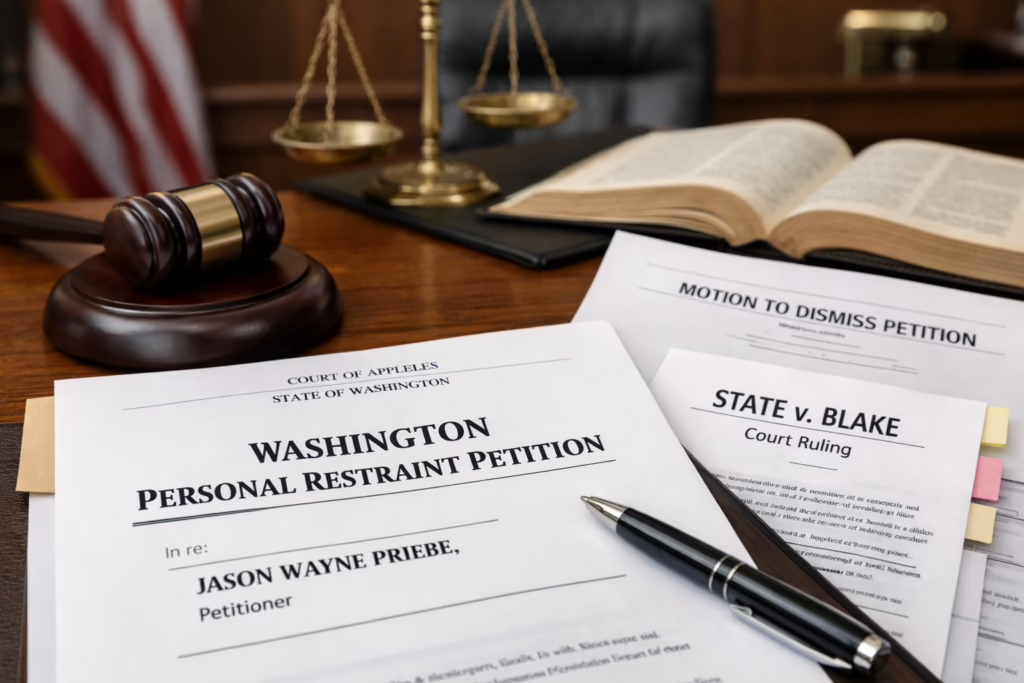
The recent unpublished decision in In re Personal Restraint of Priebe highlights how Washington courts are applying these time limits—even in the wake of significant legal changes like State v. Blake.
Case Overview: In re Personal Restraint of Priebe
Background and Procedural History
Jason Priebe was convicted in 2019 of multiple serious offenses, including burglary, firearm possession, and vehicle-related crimes. His offender score—used to calculate his sentencing range—was significantly increased due to prior drug possession convictions.
After the Washington Supreme Court’s decision in State v. Blake (2021), which invalidated Washington’s strict liability drug possession statute, Priebe sought resentencing. Initially, the Court of Appeals granted relief.
However, upon reconsideration, the court reversed course and dismissed his petition as time-barred.
Why the Petition Was Dismissed
The One-Year Time Bar Rule
Under RCW 10.73.090(1), a PRP must be filed within one year after the judgment becomes final unless an exception applies.
Priebe filed his petition outside that one-year window. Therefore, his claim could proceed only if:
- The judgment was facially invalid, or
- A statutory exception under RCW 10.73.100 applied
No Facial Invalidity Found
The key issue was whether Priebe’s sentence became invalid after removing the unconstitutional drug convictions from his offender score.
The court held:
- Even after removing the invalid convictions, Priebe’s offender score remained high enough that
- His standard sentencing range did not change
- Therefore, the sentence imposed was still legally authorized
Because of this, the judgment was not facially invalid, and the petition remained time-barred.
Impact of State v. Blake and Subsequent Case Law
Significant Change in Law—But Not Always Enough
While Blake represents a “significant change in the law,” it does not automatically reopen all past cases.
To bypass the time bar under RCW 10.73.100(6), a petitioner must show:
- A significant change in the law
- Material impact on their sentence or conviction
- Justification for retroactive application
In Priebe’s case, although Blake applied, it did not materially affect his sentencing range, which proved fatal to his claim.
Citation of Unpublished Opinions in Washington
Are Unpublished Opinions Binding?
The Priebe decision itself is an unpublished opinion, which raises an important procedural issue.
Under GR 14.1, unpublished opinions of the Washington Court of Appeals:
- Are not binding precedent
- May be cited as non-binding, persuasive authority
- Must be properly identified as unpublished
Practical Considerations for Attorneys
Even though unpublished opinions are not precedential, they can still be influential:
- They provide insight into how courts are currently applying the law
- They are often used to support arguments where published authority is limited
- Courts may find them persuasive, especially when factually similar
Interestingly, the Priebe court relied on a Washington Supreme Court order (not a full opinion) and emphasized that even departmental decisions can carry precedential weight.
This highlights a key nuance:
👉 Not all non-traditional decisions are non-precedential, but unpublished Court of Appeals opinions generally are.
Key Takeaways for Washington Defendants
- Filing deadlines for a Washington personal restraint petition are strictly enforced
- A change in law (like Blake) does not guarantee relief
- Sentencing errors must actually affect the standard range to overcome time bars
- Unpublished opinions can still guide legal strategy, even if not binding
Call to Action
If you believe your sentence or conviction may be impacted by changes in Washington law, it is critical to act quickly and understand your legal options.
Contact Blanford Law today at ken@blanfordlaw.com or 253-720-9304 for guidance on your legal matter.
Additional Resources
Internal Resources
IRLJ 5.1 Appeals in Washington
A detailed guide explaining how to appeal infractions under Washington’s Infraction Rules for Courts of Limited Jurisdiction.
URL: https://blanfordlaw.com/irlj-5-1-appeals-washington/
Understanding Washington Sentencing Reform Act
Explains how offender scores and sentencing ranges are calculated under Washington law.
URL: https://www.blanfordlaw.com/washington-sentencing-reform-act
What Is a Personal Restraint Petition in Washington?
An overview of how PRPs work, including deadlines and procedural requirements.
URL: https://www.blanfordlaw.com/personal-restraint-petition-washington