
Overview of Beenen v. Lewis County
In Beenen v. Lewis County, the Washington Court of Appeals (Division II) addressed whether a county airport could be held liable for injuries sustained during a skydiving accident operated by a tenant. The court affirmed summary judgment in favor of the County, holding that it owed no duty under Washington premises liability law.
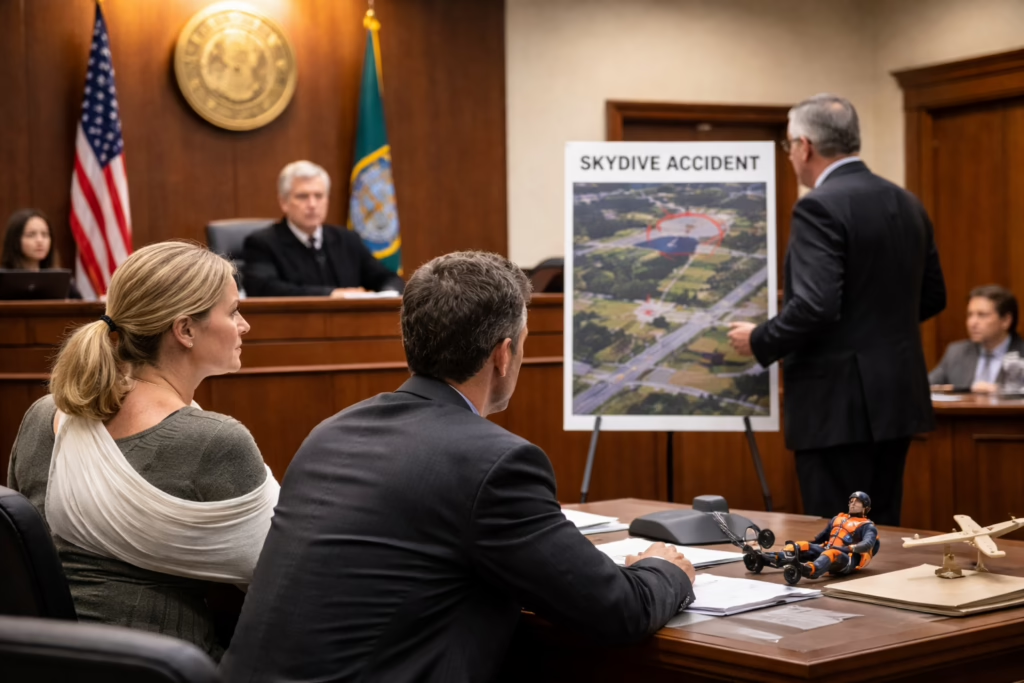
Jamie Beenen was seriously injured during a skydiving jump operated by Skydive Toledo, a private company operating out of a leased airport hangar. She argued that Lewis County, which owned the airport, should be liable because it allowed dangerous skydiving operations to occur on its property.
The court disagreed, concluding that the County did not possess or control the relevant premises and therefore had no legal duty.
Washington Premises Liability Landlords: Key Legal Principles
Duty Depends on Possession and Control
To succeed on a negligence claim in Washington, a plaintiff must prove that the defendant owed a duty of care. In premises liability cases, that duty depends on whether the defendant is a “possessor of land.”
Washington courts define a possessor as someone who:
- Occupies the land, and
- Has the ability to control it and reduce risks
When a landlord leases property to a tenant, possession and control typically transfer to the tenant, not the landlord.
General Rule: Landlords Are Not Liable for Tenant Activities
The court emphasized a well-established rule:
A landlord generally is not liable for dangerous conditions or activities created by a tenant after possession is transferred.
This includes:
- Business operations conducted by the tenant
- Unsafe practices arising from the tenant’s use of the property
- Risks associated with the tenant’s independent activities
Even if the landlord knows about the dangerous activity, that knowledge alone does not create liability.
Why the County Was Not Liable
1. No Control Over the Leased Hangar
The County leased hangar space to a tenant (Josephine Air), which allowed Skydive Toledo to operate there. The lease:
- Gave the tenant the right to exclusive use
- Required the tenant to maintain the premises
- Limited the County’s role to inspection and general oversight
The court held that these types of lease provisions do not establish control.
As a result, the County was not legally responsible for:
- Skydiving instruction
- Training practices
- Safety procedures
2. No Liability for Tenant’s Business Operations
Beenen argued that the County should be liable because it allowed a dangerous activity—skydiving—to occur.
The court rejected this argument, explaining:
Landlord liability does not extend to how a tenant operates its business, even if that business is inherently risky.
Here, the alleged negligence involved:
- Inadequate training
- Use of a trainee instructor
- Failure of radio communication
All of these were part of the tenant’s operations—not the condition of the land.
3. Injury Did Not Occur on County Property
A critical fact was that Beenen was injured on adjacent private property, not on the airport itself.
Washington law requires that:
The dangerous condition or activity must occur on the defendant’s land to create premises liability.
Because the injury occurred off airport property, this further undermined the claim against the County.
4. Common Areas Did Not Cause the Injury
Although the County controlled common areas like runways and taxiways, the court found:
- These areas were not dangerous
- They did not contribute to the injury
Therefore, no duty arose from the County’s control of those spaces.
5. No Affirmative Negligence by the County
Beenen also argued that the County assumed a duty by:
- Discussing safety concerns with the skydiving operator
- Being aware of prior incidents
However, the court held that:
- Simply discussing safety does not create liability
- The County did not actively participate in the skydiving operation
Without affirmative negligent conduct, there is no exception to landlord nonliability.
This Is an Unpublished Opinion
What That Means Under Washington Law
The Beenen decision is explicitly designated as an unpublished opinion.
Under Washington law:
- It is filed for public record under RCW 2.06.040
https://app.leg.wa.gov/rcw/default.aspx?cite=2.06.040 - It may be cited under RAP 10.4(h)
https://www.courts.wa.gov/court_rules/?fa=court_rules.display&group=app&set=RAP&ruleid=app10.4
Key Limitations
- It is not binding precedent
- Courts are not required to follow it
- It may be used only as persuasive authority
Attorneys may cite unpublished opinions like Beenen to illustrate how courts apply landlord liability principles, but they should rely on published cases whenever possible.
Why This Case Matters
Beenen v. Lewis County reinforces several important principles in Washington law:
- Control—not ownership—determines liability
- Landlords are generally not responsible for tenant business activities
- Liability requires a connection to conditions on the land itself
- Courts will not expand premises liability to cover independent third-party operations
For property owners, this case provides reassurance that leasing property does not automatically expose them to liability for tenant conduct. For plaintiffs, it highlights the importance of identifying who actually controlled the risk.
Contact Blanford Law Today
If you have been injured or are facing a complex liability issue, experienced legal guidance is essential.
Contact Blanford Law today at ken@blanfordlaw.com or 253-720-9304 for guidance on your legal matter.
Additional Resources
- Premises Liability in Washington – Learn how liability is determined for property owners.
https://www.blanfordlaw.com/premises-liability-washington/ - Personal Injury Claims in Washington – Overview of how injury claims are evaluated.
https://www.blanfordlaw.com/personal-injury-claims-washington/ - Washington Negligence Law Explained – Key elements required to prove negligence.
https://www.blanfordlaw.com/washington-negligence-law/ - Record Expungement in Washington [USED] – A guide to clearing your criminal record.
https://www.blanfordlaw.com/record-expungement-in-washington/ - Understanding Your Right to Remain Silent [USED] – Learn your rights during police encounters.
https://www.blanfordlaw.com/understanding-your-right-to-remain-silent/