
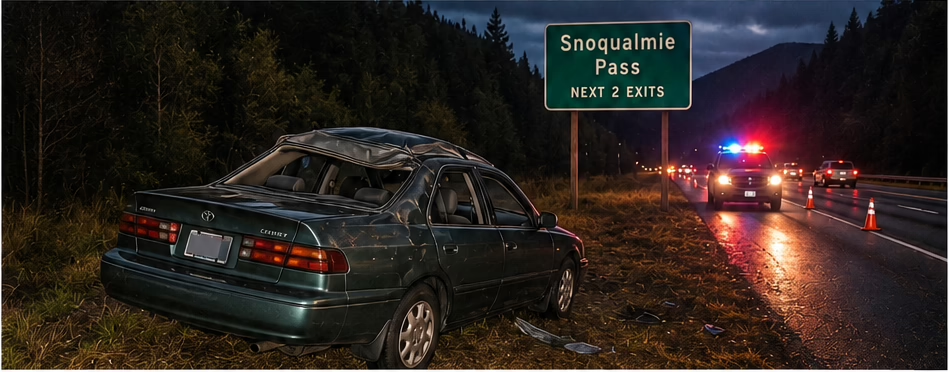
A Washington rollover crash on Interstate 90 east of Snoqualmie Summit reportedly killed a 19-year-old Wapato woman and injured a juvenile passenger in the early morning hours of August 27. According to the Washington State Patrol information provided about the collision, investigators listed driver fatigue as the cause and indicated that drugs and alcohol were not involved.
The fatal crash highlights both the dangers of fatigued driving and important legal questions that can arise when a passenger is killed or injured in a single-vehicle collision in Washington.
What Happened in the I-90 Rollover Near Snoqualmie Pass?
According to the State Patrol information provided, the crash occurred at approximately 1:26 a.m. near milepost 63 on eastbound Interstate 90, roughly 11 miles east of Snoqualmie Summit. That stretch of I-90 is in the vicinity of Cabin Creek and east of the summit area. Other transportation sources also place milepost 63 approximately 10 to 11 miles east of Snoqualmie Pass.
A 1997 Toyota Camry reportedly left the roadway and rolled.
The passenger who died was identified as Aby A. Arroyo Chaparro, 19, of Wapato. She was reportedly pronounced dead at the scene. The State Patrol information states that she was not wearing a seat belt.
The driver, Juan P. Barajas Acevedo, 19, of Yakima, was not reported injured but was transported to Kittitas Valley Hospital as a precaution. State Patrol reported that he was wearing a seat belt. Charges were listed as pending.
A second passenger, identified only as a juvenile, was injured and transported to Kittitas Valley Hospital. According to the report, that passenger was wearing a seat belt.
State Patrol reportedly identified fatigue as the cause of the collision and stated that drugs and alcohol were not factors. The Camry was totaled.
Because charges were reported as pending, no conclusion should be drawn at this stage about criminal responsibility. Likewise, a police investigation can be important evidence in a civil case, but it does not by itself determine civil liability.
How Driver Fatigue Can Lead to a Washington Rollover Crash
Fatigue can significantly impair a driver’s ability to operate a vehicle safely. A tired driver may have slower reactions, difficulty maintaining a lane, reduced awareness of changing road conditions, or even brief episodes of falling asleep.
Those risks can become especially serious during overnight travel. When a vehicle leaves the roadway at highway speed, the combination of uneven terrain, shoulders, embankments, or sudden steering corrections can contribute to a rollover.
Under Washington negligence law, drivers generally have a duty to operate their vehicles with reasonable care under the circumstances. If evidence ultimately shows that a driver continued driving despite being too fatigued to do so safely, that evidence may become relevant to determining whether the driver breached that duty.
However, every case depends on its particular facts. Investigators and attorneys may examine issues such as how long the driver had been awake, the length of the trip, witness statements, vehicle data, roadway evidence, phone records when legally obtainable, and the State Patrol’s reconstruction or collision report.
A Passenger May Have a Claim Against a Negligent Driver
Passengers generally are not responsible for controlling how a vehicle is driven. When a driver negligently causes a crash, an injured passenger may potentially pursue compensation from the responsible driver’s automobile liability insurance.
Possible damages in an injury claim can include medical expenses, lost wages, pain and suffering, and other losses attributable to the collision.
The injured juvenile passenger in this crash may therefore have potential civil rights depending on the full circumstances and available insurance coverage. Because the passenger is a minor, additional procedural considerations may also apply to the handling and resolution of any claim.
Wrongful Death Rights After a Fatal Washington Crash
Washington law permits a wrongful death action when a person’s death results from another person’s wrongful act, neglect, or default. Under RCW 4.20.010, the decedent’s personal representative may bring the action for economic and noneconomic damages suffered by qualifying beneficiaries.
The beneficiaries identified by RCW 4.20.020 include a surviving spouse, state registered domestic partner, children, and stepchildren. If none of those beneficiaries exist, the decedent’s parents or siblings may qualify.
Recoverable losses depend on the facts of the individual case and the relationship between the deceased person and the beneficiaries. A wrongful death case may involve financial losses as well as noneconomic losses associated with the death.
For a family dealing with the death of a young adult, establishing the appropriate beneficiaries, opening or working through an estate, preserving evidence, and identifying available insurance can all be important early steps.
Washington Wrongful Death Deadlines Matter
Wrongful death claims in Washington are generally subject to a three-year limitations period under RCW 4.16.080(2), as Washington courts have recognized.
That does not mean families should wait three years before seeking legal advice. Important evidence can disappear much sooner. Vehicles may be destroyed, electronic data may be overwritten, witnesses may become difficult to locate, and insurance issues may need to be addressed promptly.
What Does the Reported Lack of Seat Belt Use Mean?
The State Patrol information states that Arroyo Chaparro was not wearing a seat belt. Although that fact may be relevant to understanding the physical circumstances of the collision, Washington has an important rule governing how seat-belt nonuse may be treated in a civil case.
RCW 46.61.688 requires most occupants age 16 or older to wear a properly adjusted and securely fastened safety belt. But the statute also specifically provides that failure to comply does not constitute negligence and may not be admitted as evidence of negligence in a civil action.
That distinction is particularly important in a wrongful death case. A family should not assume that a passenger’s failure to wear a seat belt automatically prevents a claim or makes the passenger legally responsible for the crash.
The central liability question ordinarily concerns what caused the collision and whether another person’s negligent conduct contributed to the death or injury.
Insurance Issues After a Single-Vehicle Crash
Even when only one vehicle is involved, several forms of insurance coverage may need to be investigated.
The driver’s bodily injury liability coverage may potentially apply to passenger claims if the driver is found legally responsible. Depending on the policies and circumstances, other available insurance could also become relevant.
Families should avoid assuming that the limits initially disclosed by one insurer represent all available coverage. An attorney can investigate the applicable policies, ownership of the vehicle, household insurance, and other potential sources of recovery.
It is also important to be cautious about giving recorded statements or signing broad releases before understanding the nature and value of a claim.
Preserving Evidence After a Fatal Rollover
Evidence preservation can be especially important in a serious rollover. Useful evidence may include the Washington State Patrol collision report, scene photographs, vehicle photographs, event data recorder information if available, medical records, witness statements, roadway evidence, and insurance documents.
The fact that State Patrol reportedly attributed this collision to fatigue may become significant, but a civil investigation should still independently evaluate how and why the car left the roadway.
A finding that charges are pending also should not be confused with proof that a crime occurred. Criminal proceedings and civil claims use different legal standards and serve different purposes.
You can obtain a copy of the collision report by requesting records directly from the Washington State Patrol.
Speak With a Washington Injury Attorney
A fatal collision can leave a family facing legal, financial, and practical questions while also dealing with an extraordinary personal loss. When a passenger dies or is seriously injured, understanding insurance coverage and Washington wrongful death law can help families make informed decisions about what to do next.
Contact Blanford Law today at ken@blanfordlaw.com or 253-720-9304 for guidance on your legal matter.
Additional Resources
- How Long Will Someone Stay in Pierce County Jail? — Learn what can affect the length of a Pierce County Jail stay, including charges, bail, warrants, court orders, and release procedures. Read the article
- Seattle Motorcycle Hit-and-Run: What Families Should Know After a Fatal Queen Anne Crash — Learn about Washington wrongful death claims, insurance issues, evidence preservation, and legal options after a fatal motorcycle hit-and-run. Read the article
- Pierce County First Appearance and Bail Explained — Understand what happens at a first court appearance in Pierce County and how judges address bail and other conditions of release. Read the article
- How Do I Get Someone Out of Pierce County Jail? — Learn about bail, release conditions, court hearings, and practical steps families can take when someone is being held in Pierce County Jail. Read the article
- Arrested for DUI and Booked Into Pierce County Jail? What Happens Next in Washington State — Find out what may happen after a DUI arrest in Pierce County, including booking, court appearances, release issues, and the early stages of a Washington DUI case. Read the article