
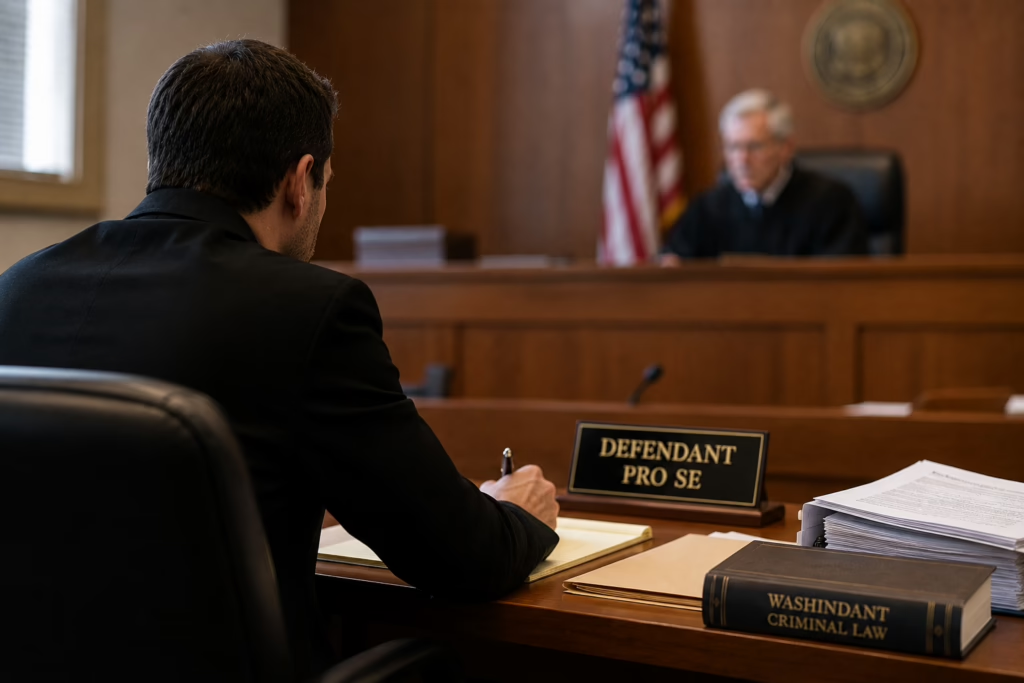
A recent Washington Court of Appeals decision highlights the risks and constitutional protections involved when a criminal defendant chooses self-representation instead of appointed counsel.
In State v. McDowell, the Court of Appeals addressed whether a trial court properly allowed a defendant to represent himself during a serious felony trial involving kidnapping, assault, firearm allegations, and domestic violence charges. The appellate court ultimately concluded that the defendant knowingly and intelligently waived his right to counsel.
The case provides important insight into how Washington courts evaluate requests for self-representation, what makes a waiver of counsel valid, and why trial courts carefully question defendants before allowing them to proceed without an attorney.
The Constitutional Right to Self-Representation
Under both the Washington Constitution and the Sixth Amendment to the United States Constitution, criminal defendants have the right to assistance of counsel.
However, defendants also possess the constitutional right to reject counsel and represent themselves.
Washington courts recognize that self-representation is a fundamental constitutional right, even when exercising that right may seriously harm the defendant’s case.
Because self-representation creates substantial risks, trial courts must carefully determine whether a defendant truly understands the consequences of waiving legal counsel.
Background of the Case
According to the opinion, William McDowell faced multiple felony charges arising from allegations involving his former romantic partner. Prosecutors alleged McDowell assaulted the victim, threatened to kill her, restrained her with a firearm, and later drove away in her vehicle.
The State charged McDowell with several offenses, including:
- First degree kidnapping
- First degree burglary
- Second degree assault
- Felony harassment
- Unlawful possession of a firearm
- Taking a motor vehicle without permission
The charges also included firearm sentencing enhancements that substantially increased potential prison exposure.
Before trial, McDowell rejected a plea offer and sought to represent himself.
The Trial Court’s Self-Representation Inquiry
Washington courts cannot simply allow self-representation because a defendant asks for it.
Instead, judges must conduct a detailed colloquy to determine whether the defendant:
- Understands the charges
- Understands the possible penalties
- Understands courtroom procedure
- Understands the risks of self-representation
- Is knowingly and voluntarily waiving counsel
In McDowell, the trial court repeatedly questioned the defendant about his decision.
The judge specifically discussed:
- The seriousness of the charges
- Possible life imprisonment
- Firearm sentencing enhancements
- Rules of evidence
- Criminal procedure requirements
The court also warned McDowell that he would likely be better defended by a trained attorney.
Despite those warnings, McDowell repeatedly confirmed that he still wanted to represent himself.
Why the Defendant Claimed the Waiver Was Invalid
On appeal, McDowell argued the trial court should never have allowed self-representation.
He claimed:
- His request was not truly unequivocal
- He mainly wanted substitute counsel
- He did not fully understand the sentencing consequences
- His waiver of counsel was not knowing and intelligent
The Court of Appeals rejected those arguments.
The Court Found the Request Was Unequivocal
One major issue involved whether McDowell clearly requested self-representation.
Washington courts closely examine whether defendants are truly choosing self-representation or merely expressing frustration with appointed counsel.
The Court of Appeals noted that McDowell repeatedly told the trial court he wanted to represent himself.
The opinion emphasized several important facts:
- McDowell renewed the request multiple times
- He specifically requested additional preparation time for self-representation
- He explained why he believed he could better handle his defense
- He did not merely make a passing complaint about counsel
Although McDowell initially discussed dissatisfaction with his attorney, the appellate court concluded his later requests clearly demonstrated a genuine desire to proceed pro se.
The Court Also Found the Waiver Was Knowing and Intelligent
The appellate court also rejected McDowell’s claim that he misunderstood the risks of self-representation.
The opinion explained that the trial court discussed:
- The charges filed against him
- Potential sentencing exposure
- Maximum possible penalties
- Firearm enhancements
- Courtroom procedural rules
The Court of Appeals also noted:
- McDowell had prior experience with legal proceedings
- He stated he studied legal materials in the law library
- He previously represented himself in a federal appeal
- He had received a plea offer outlining sentencing exposure
Even though some sentencing discussions during the hearing were imperfect, the appellate court concluded the overall record demonstrated a valid waiver of counsel.
Why Self-Representation Is Extremely Risky
Cases like McDowell illustrate why self-representation can be dangerous in serious felony prosecutions.
Criminal trials involve complicated:
- Rules of evidence
- Jury selection procedures
- Objection requirements
- Sentencing rules
- Constitutional issues
- Trial strategy decisions
Even highly intelligent defendants often struggle to effectively represent themselves against experienced prosecutors.
Judges may warn defendants about these risks, but courts generally cannot force representation on a competent defendant who knowingly waives counsel.
Washington Courts Strongly Presume Against Waiver
Although defendants possess the right to self-representation, Washington courts apply every reasonable presumption against waiver of counsel.
Trial courts must ensure the waiver is:
- Clear
- Unequivocal
- Voluntary
- Intelligent
- Timely
If the record does not adequately demonstrate a knowing waiver, convictions may later be reversed on appeal.
Understanding Unpublished Opinions in Washington
It is important to understand that State v. McDowell is an unpublished Washington Court of Appeals opinion.
Under Washington court rules, unpublished opinions generally are not binding precedent. Courts are not required to follow unpublished decisions the same way they follow published appellate opinions.
However, unpublished opinions still provide valuable insight into:
- Self-representation disputes
- Waiver of counsel standards
- Criminal procedure
- Appellate review of constitutional rights
- Trial court discretion
Attorneys frequently review unpublished opinions to better understand how Washington appellate courts are analyzing similar legal issues.
For readers interested in reviewing the court’s reasoning directly, the full unpublished opinion in State v. McDowell is available through the Washington Courts website: https://www.courts.wa.gov/opinions/pdf/D2%2059223-1-II%20Unpublished%20Opinion.pdf
Contact Blanford Law Today
If you are facing serious criminal charges in Washington State, decisions involving self-representation, plea negotiations, or waiver of counsel can dramatically affect the outcome of your case.
Contact Blanford Law today at ken@blanfordlaw.com or 253-720-9304 for guidance on your legal matter.
Additional Resources
Washington ER 502 Attorney-Client Privilege
Learn how Washington courts protect confidential communications between attorneys and clients under ER 502.
https://blanfordlaw.com/washington-er-502-attorney-client-privilege/
Right to Counsel Violations in Washington
This article explains when criminal defendants may challenge convictions based on violations of the constitutional right to counsel.
https://blanfordlaw.com/right-to-counsel-violation/
Right to Counsel in Washington: State v. Charlton
Review how Washington courts analyzed waiver of counsel and self-representation issues in State v. Charlton.
https://blanfordlaw.com/right-to-counsel-washington-charlton/
Why Unpublished Opinions Cannot Be Cited in Washington State Courts
Learn why unpublished Washington appellate opinions generally are not binding precedent and how attorneys still use them for legal guidance.
https://blanfordlaw.com/why-unpublished-opinions-cannot-be-cited-in-washington-state-courts/