
In State v. Favro, Division II of the Washington Court of Appeals addressed a critical issue in criminal sentencing: when may a court require a defendant to appear from a holding cell or otherwise restrained at sentencing?
Although the court affirmed Favro’s convictions for criminal impersonation and possession of a controlled substance with intent to deliver, it reversed and remanded for resentencing because the trial court failed to conduct an individualized inquiry before requiring Favro to appear from a holding cell.
This decision reinforces an important constitutional principle: Washington sentencing restraints require case-specific justification.
Background of the Case
Law enforcement stopped Dylon Lee Favro in Cowlitz County after a report involving a vehicle. During the encounter, Favro identified himself using his brother’s name, leading to a criminal impersonation charge. Officers later discovered blue pills marked “M 30” — commonly associated with fentanyl — along with cash and drug-related evidence.
Favro was charged with:
- First degree criminal impersonation
- Possession of a controlled substance with intent to deliver
A jury convicted him on both counts.
On appeal, Favro challenged multiple aspects of his trial, including:
- The sufficiency of the charging document
- Admission of expert testimony
- Alleged judicial comment on the evidence
- Admission of his statements to police
- The procedure used at sentencing
Most of his claims failed. One did not.
The Key Issue: Washington Sentencing Restraints Require Individualized Inquiry
Constitutional Framework
Under both the United States and Washington Constitutions, a defendant has the right to appear at trial and sentencing free from unnecessary restraints. Visible restraints can undermine the presumption of innocence and dignity of judicial proceedings.
Washington courts have repeatedly held that restraints may not be imposed as a routine practice. Instead, the trial court must conduct an individualized inquiry on the record, considering specific safety or security concerns.
What Happened in Favro’s Sentencing
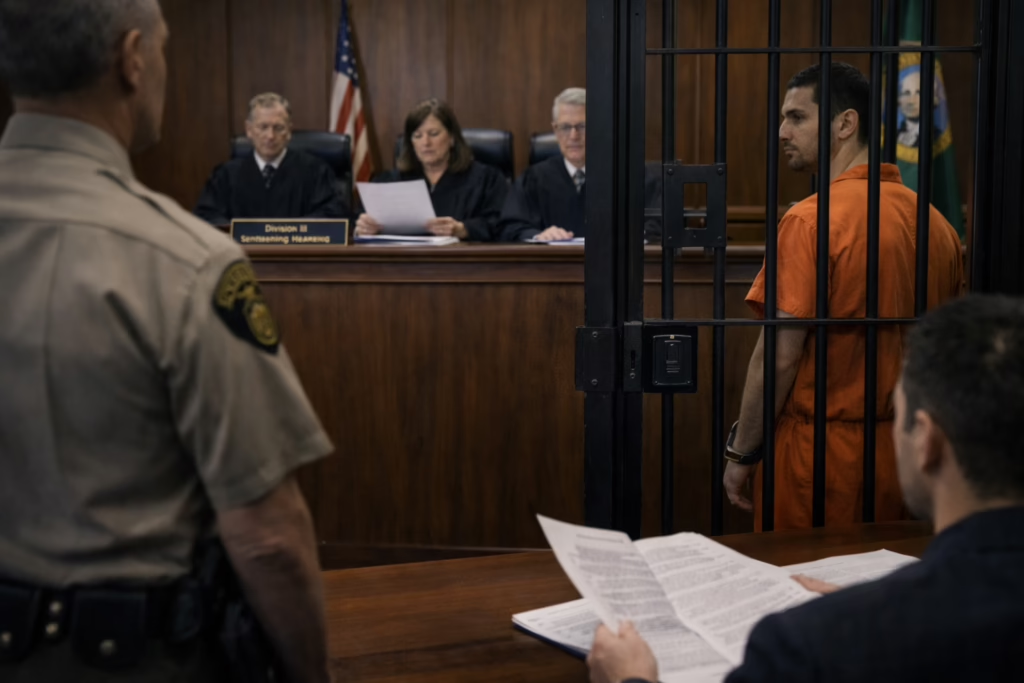
At sentencing, Favro was brought before the court from a holding cell without the trial court conducting an individualized inquiry into whether such security measures were necessary.
The Court of Appeals held that this was error.
Importantly, the court did not disturb the underlying convictions. Instead, it reversed only the sentencing portion and remanded for a new sentencing hearing that complies with constitutional requirements.
This distinction matters: procedural sentencing errors can result in reversal even when the trial itself was otherwise valid.
Other Issues Addressed by the Court
Although the sentencing issue drove the remand, the Court of Appeals also addressed several other arguments.
Sufficiency of the Charging Document
Favro argued that the information failed to properly specify the controlled substance. The court rejected this claim, finding that the charging document adequately set forth the essential elements required under Washington law.
Expert Testimony on Drug Distribution
The defense challenged testimony from law enforcement regarding drug packaging and distribution indicators. The appellate court held that the testimony was permissible expert opinion designed to assist the jury and did not improperly comment on guilt.
Statements to Police and CrR 3.5
Favro argued the trial court erred in handling the admissibility of his statements. The appellate court determined that the procedures followed were sufficient and did not warrant reversal.
These rulings demonstrate the deferential standards appellate courts apply when reviewing preserved and unpreserved trial objections.
Why Washington Sentencing Restraints Matter
Sentencing may feel like the final procedural step in a criminal case, but constitutional protections do not end once a verdict is returned.
Improper restraints can:
- Undermine the dignity of the proceeding
- Affect judicial perception
- Raise due process concerns
- Require resentencing
Washington appellate courts have made clear that trial courts must articulate specific, case-based reasons before imposing physical restraints or similar security measures.
Routine or automatic practices are not enough.
A Note on Publication Status
State v. Favro was issued as an unpublished opinion. Under GR 14.1, unpublished Court of Appeals opinions lack precedential value and generally may not be cited as binding authority.
However, unpublished decisions still reflect how Washington courts apply established legal principles to real cases. The constitutional rule requiring individualized inquiry for restraints is grounded in published precedent — and that binding authority remains controlling.
Protecting Your Rights at Sentencing and on Appeal
Appeals often succeed not because of dramatic trial errors, but because of procedural safeguards that were overlooked.
If you or a loved one faces sentencing — or believe a constitutional error occurred during trial or sentencing — experienced appellate review is essential.
Contact Blanford Law today at ken@blanfordlaw.com or 253-720-9304 for guidance on your legal matter.
Additional Resources
1. Courtroom Restraints at Sentencing in Washington
Explains constitutional limits on physical restraints and required judicial findings.
https://blanfordlaw.com/courtroom-restraints-at-sentencing-washington/
2. Appealing a Criminal Conviction in Washington
Overview of the appellate process and standards of review.
https://www.blanfordlaw.com/criminal-appeals-washington/
3. What Is Possession with Intent to Deliver in Washington?
Breakdown of the elements and common defense issues.
https://www.blanfordlaw.com/possession-with-intent-washington/
4. Washington CrR 3.5 Hearings Explained
Discusses admissibility of statements and Miranda considerations.
https://www.blanfordlaw.com/crr-3-5-hearings/
5. Manifest Constitutional Error in Washington Appeals
Explains when unpreserved errors may still be reviewed.
https://www.blanfordlaw.com/manifest-constitutional-error/