
Washington courts frequently decide whether a lawsuit should be dismissed before trial through summary judgment motions. A recent Washington Court of Appeals decision shows how difficult it can be to obtain summary judgment when factual disputes exist.
In Lerum v. City of Seattle, the Court of Appeals reversed a trial court’s dismissal of negligence claims involving a police pursuit and freeway collision. The appellate court concluded that genuine issues of material fact existed regarding whether police officers engaged in a pursuit and whether their conduct contributed to the crash.
The case is an important example of how Washington courts analyze summary judgment motions, causation disputes, expert testimony, and admissible evidence.
What Is Summary Judgment in Washington?
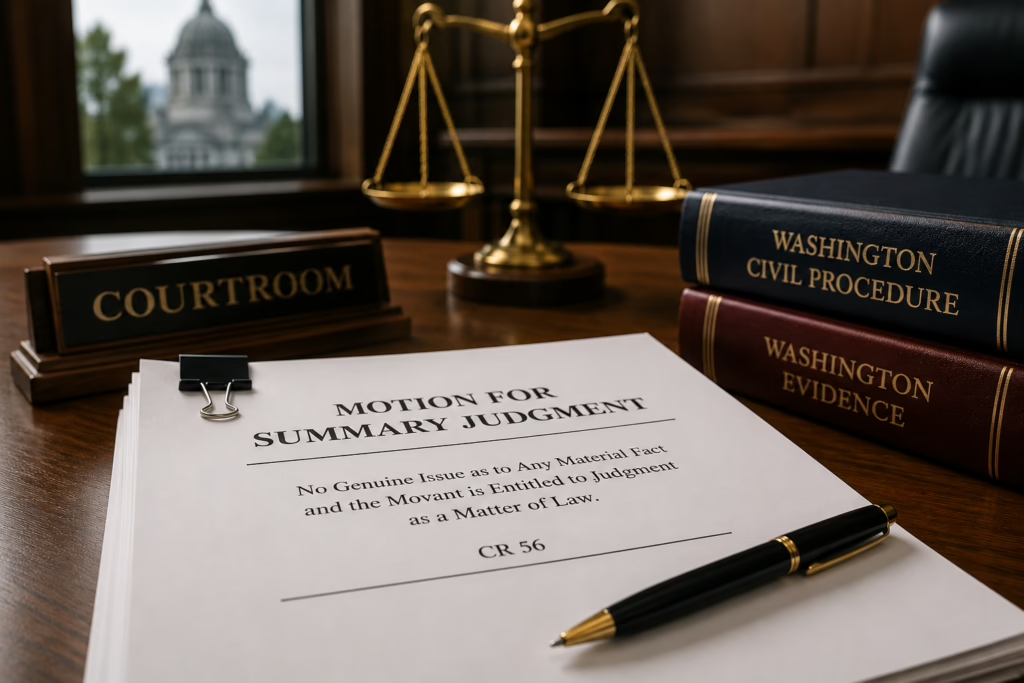
A summary judgment motion asks the court to dismiss claims before trial because no genuine dispute of material fact exists.
Under CR 56, a Washington court may grant summary judgment only if:
- No genuine issue of material fact exists
- The moving party is entitled to judgment as a matter of law
- Reasonable minds could not differ on the outcome
Courts must view the evidence in the light most favorable to the nonmoving party.
Because summary judgment prevents a case from reaching a jury, Washington appellate courts closely review whether factual disputes actually exist.
Background of the Washington Summary Judgment Case
The lawsuit arose from a 2019 freeway collision involving a stolen SUV traveling on the shoulder of Interstate 5 at extremely high speeds.
According to the opinion, Seattle Police Department Officer Gary Davenport and Bellevue Police Department Officer Robert Welty were traveling on motorcycles when the SUV passed them on the freeway shoulder. Both officers moved onto the shoulder and activated emergency lights while following the SUV.
Seconds later, the SUV crashed into another vehicle occupied by Robin Lerum and her daughter, causing serious injuries.
Lerum sued the City of Seattle and the City of Bellevue, alleging negligent pursuit, failure to follow police policies, and failure to exercise due regard for public safety.
The trial court granted summary judgment dismissing the claims. The Court of Appeals reversed.
Why the Court Reversed Summary Judgment
The appellate court focused heavily on factual disputes involving police conduct and causation.
Disputed Facts About Police Pursuit
The cities argued no pursuit occurred because the officers claimed they were merely investigating the situation and not actively chasing the vehicle.
However, the appellate court noted several disputed facts, including:
- Both officers moved onto the freeway shoulder
- Emergency lights were activated
- The SUV driver may have seen the officers
- Police policies defined pursuits broadly
- Expert testimony suggested the officers engaged in a de facto pursuit
The court emphasized that officer intent alone does not resolve whether a pursuit occurred. Instead, the total conduct and surrounding circumstances must be evaluated by a jury.
Because reasonable minds could differ, summary judgment was improper.
Expert Testimony Played a Major Role
One of the most important parts of the opinion involved expert testimony.
The plaintiff presented:
- A law enforcement practices expert
- An accident reconstruction expert
The experts concluded:
- The SUV driver likely saw the officers
- The officers’ actions may have contributed to evasive driving
- The conduct violated law enforcement policies
- The officers effectively engaged in a pursuit
The cities argued the opinions were speculative and relied on inadmissible evidence.
The Court of Appeals disagreed and concluded sufficient admissible evidence supported the experts’ opinions to create factual disputes for trial.
Summary Judgment and Circumstantial Evidence
The opinion also highlights an important legal principle in Washington summary judgment cases: circumstantial evidence can defeat dismissal.
The appellate court explained that factual disputes do not require direct evidence if reasonable inferences can be drawn from the surrounding facts.
The court noted:
- The officers activated emergency lights
- The roadway allowed visibility between the vehicles
- Several seconds elapsed before the collision
- Expert testimony supported the inference that the SUV occupants saw police
That evidence was enough to allow a jury to decide the issue.
Proximate Cause Issues Prevented Dismissal
The trial court originally ruled that the officers’ conduct was not the proximate cause of the collision.
The appellate court disagreed.
Under Washington law, proximate cause usually presents a jury question unless the connection between conduct and injury is purely speculative.
The Court of Appeals concluded competing expert opinions created factual disputes regarding:
- Whether the SUV driver reacted to police presence
- Whether the officers’ conduct contributed to evasive driving
- Whether the collision would have occurred absent the officers’ actions
Because conflicting evidence existed, the case could not be resolved on summary judgment.
Why This Decision Matters
This case demonstrates several important principles in Washington civil litigation:
Courts Rarely Resolve Credibility Questions on Summary Judgment
Judges generally cannot weigh competing evidence or decide witness credibility during summary judgment proceedings.
Expert Testimony Can Create Trial Issues
Well-supported expert opinions frequently create factual disputes that prevent dismissal.
Circumstantial Evidence Still Matters
A plaintiff does not always need direct proof if reasonable inferences support the claim.
Police Liability Cases Often Involve Fact-Intensive Analysis
Negligence claims involving police conduct frequently depend on disputed facts surrounding officer actions, departmental policies, and causation.
Understanding Unpublished Opinions in Washington
It is important to understand that Lerum v. City of Seattle is an unpublished Washington Court of Appeals opinion.
Under Washington court rules, unpublished opinions generally are not binding precedent. Courts are not required to follow unpublished decisions the same way they must follow published appellate opinions.
However, unpublished opinions may still provide useful insight into:
- How appellate courts analyze summary judgment
- Police pursuit liability claims
- Expert witness disputes
- Circumstantial evidence issues
- Washington negligence law
Attorneys often review unpublished opinions to better understand how courts are approaching similar factual and procedural issues.
For readers interested in reviewing the court’s reasoning directly, the full unpublished opinion is available through the Washington Courts website.
Contact Blanford Law Today
If you are involved in a Washington civil lawsuit involving summary judgment issues, negligence claims, police liability, or appellate litigation, experienced legal representation matters.
Contact Blanford Law today at ken@blanfordlaw.com or 253-720-9304 for guidance on your legal matter.
Additional Resources
McCormick v. Lake Washington School District: Case Analysis
This article analyzes a Washington appellate decision involving liability, negligence claims, and legal standards in civil litigation.
https://blanfordlaw.com/mccormick-v-lake-washington-school-district-a-case-analysis/
Mad Max Crimes and Washington Law
Learn how reckless driving, dangerous conduct, and criminal vehicle-related behavior may lead to serious charges in Washington State.
https://blanfordlaw.com/mad-max-crimes-wa-law/
Stay of Forfeiture Judgment in Washington
This resource explains how parties may seek a stay of enforcement after a forfeiture judgment in Washington courts.
https://blanfordlaw.com/stay-of-forfeiture-judgment-washington/
Fresh Pursuit Doctrine Limits in Washington
Review the legal limits of the fresh pursuit doctrine and how Washington courts evaluate police authority across jurisdictions.
https://blanfordlaw.com/fresh-pursuit-doctrine-limits/
City of Tacoma v. Durham: The Limits of Fresh Pursuit
This article examines how Washington courts interpreted the boundaries of fresh pursuit authority in City of Tacoma v. Durham.
https://blanfordlaw.com/city-of-tacoma-v-durham-the-limits-of-fresh-pursuit/