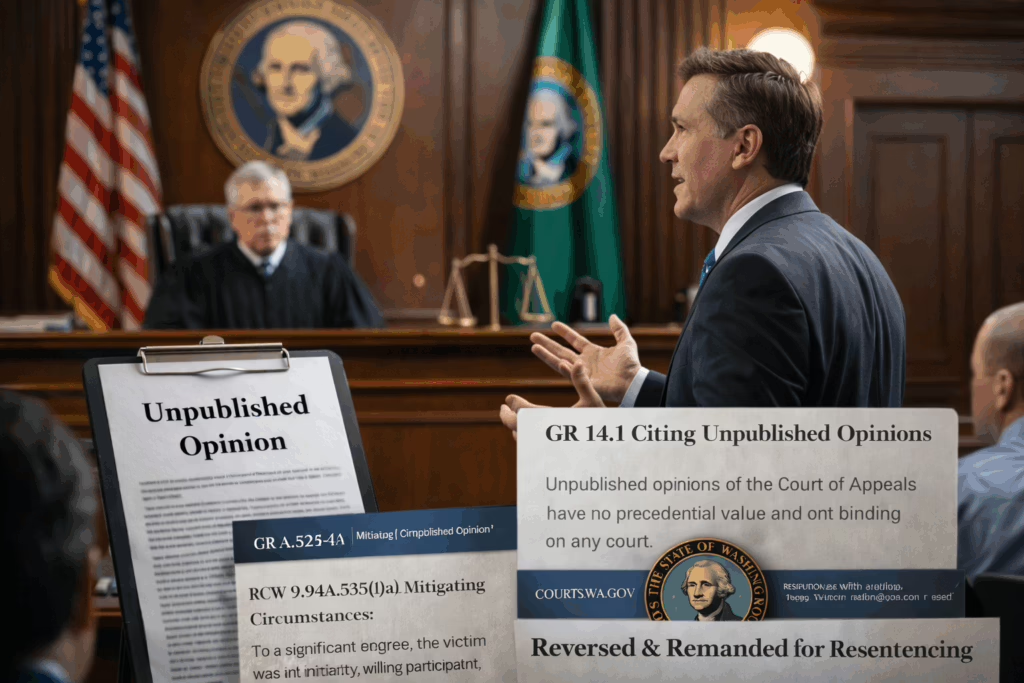
In State v. Alyssa Richelle Keele (No. 59201‑1‑II), the Washington Court of Appeals (Division II) issued an unpublished opinion addressing two key issues: (1) whether the trial court erred in excluding evidence that the defendant claimed was necessary to present her defense, and (2) whether the trial court incorrectly denied an exceptional sentence below the standard range. The appellate court affirmed the conviction but reversed the sentence and remanded for resentencing. Washington Courts
Because this opinion is unpublished, it must be understood alongside Washington’s rules limiting the citation of such decisions — specifically General Rule 14.1 (GR 14.1) and RCW 2.06.040 — which together dictate that unpublished Court of Appeals decisions lack precedential value and generally may not be cited as binding authority. Washington Courts
Facts and Procedural History
In July 2022, Alyssa Keele, while driving under the influence, fatally struck her fiancé, Marcella Mangiola. Keele was charged with vehicular homicide and tried before a jury. Before trial, Keele’s defense discovered a six‑second video taken by a third party showing Mangiola walking behind Keele’s vehicle in a way the defense claimed could support a mitigation theory. The defense provided that video to the State only at the start of trial. Washington Courts
The trial court excluded the video under the discovery rule (CrR 4.7(b)(1)), holding that its late disclosure and perceived use to bolster credibility justified exclusion. The jury convicted Keele. At sentencing, Keele asked for an exceptional sentence below the standard range under RCW 9.94A.535(1)(a), arguing that Mangiola’s conduct qualified as a mitigating factor. The court denied this request and imposed a standard‑range sentence. Washington Courts
Standard of Review and Legal Framework
Right to Present a Defense & Evidentiary Exclusion
Criminal defendants have both a federal and state constitutional right to present a defense. State v. Romero‑Ochoa, 193 Wn.2d 341, 347, 440 P.3d 994 (2019); U.S. CONST. amend. VI; WASH. CONST. art. I, § 22. A trial court’s exclusion of relevant evidence is reviewed for abuse of discretion, and if erroneous, is evaluated for harmless error. State v. Jennings, 199 Wn.2d 53, 59, 502 P.3d 1255 (2022). Washington Courts
The appellate court concluded that although excluding the video was an abuse of discretion (it was relevant and did not unfairly prejudice the State), the error was harmless — the jury heard other evidence that supported the same events and the outcome would not have materially differed with the video admitted. Washington Courts
Exceptional Sentence Below Standard Range
RCW 9.94A.535(1)(a) allows a trial court to impose an exceptional sentence below the standard range if “to a significant degree, the victim was an initiator, willing participant, aggressor, or provoker of the incident.” Keele argued that Mangiola’s actions justified this mitigated sentence. The Court of Appeals held that the trial court erred by failing to meaningfully consider this request, instead focusing primarily on the strict‑liability nature of DUI vehicular homicide rather than the evidence of Mangiola’s actions. Washington Courts
Thus, while the conviction was upheld, the sentence was reversed and the matter remanded for sentencing consistent with proper legal analysis. Washington Courts
Unpublished Opinions & Citation Rules
This decision was designated unpublished, meaning it will not appear in the official Washington Appellate Reports. Under RCW 2.06.040, the Court of Appeals may designate opinions as unpublished when they lack sufficient precedential value. Washington Courts
Further, General Rule 14.1 (GR 14.1) makes clear that unpublished Court of Appeals opinions “have no precedential value” and “may not be cited as binding authority” in future cases. Such opinions may be referenced as non‑binding authority if identified as unpublished and cited accurately, but they do not bind courts or establish controlling precedent. Washington Courts
In practice, that means while litigants can rely on unpublished opinions for persuasive support in limited circumstances, they must comply with the citation restrictions of GR 14.1 and not treat them as precedent that compels legal outcomes in other cases. Washington Courts
Additional Resources
- Why Unpublished Opinions Cannot Be Cited in Washington State Courts
Explains the rules limiting the citation of unpublished appellate decisions and how General Rule 14.1 affects legal arguments in Washington.
https://blanfordlaw.com/why-unpublished-opinions-cannot-be-cited-in-washington-state-courts/ - RCW 2.06.040 – Court Decisions
Details the Washington statute governing how and when Court of Appeals decisions are published and their impact on precedent.
https://blanfordlaw.com/rcw-2-06-040-court-decisions/ - Washington DUI Defense – Blanford Law
Overview of Blanford Law’s DUI defense services, including legal strategies, penalties, and options for those facing DUI charges in Washington.
https://blanfordlaw.com/areas-of-practice/dui/ - ER 615 – Witness Exclusion in Washington
Discusses how Washington courts use ER 615 to exclude witnesses during trial to preserve testimony integrity and prevent undue influence.
https://blanfordlaw.com/er-615-witness-exclusion/ - New Year’s Day DUI – Kittitas County Arrest
A real-world example of a DUI arrest in Kittitas County and the legal consequences that can follow — especially during holiday enforcement periods.
https://blanfordlaw.com/new-years-day-dui-kittitas-county/