
When can the State try a case again after a mistrial?
In State v. O’Brien, the Washington Supreme Court addressed whether retrying a criminal defendant after a mistrial violated the constitutional protection against double jeopardy. The case centers around whether the trial court had a sufficient legal basis — called “manifest necessity” — to declare a mistrial and whether the retrial should have been barred as unconstitutional.
This article explains how Washington law views double jeopardy and retrials, what counts as “manifest necessity,” and why the Court ruled the retrial of Michael O’Brien was lawful.
What Happened in State v. O’Brien
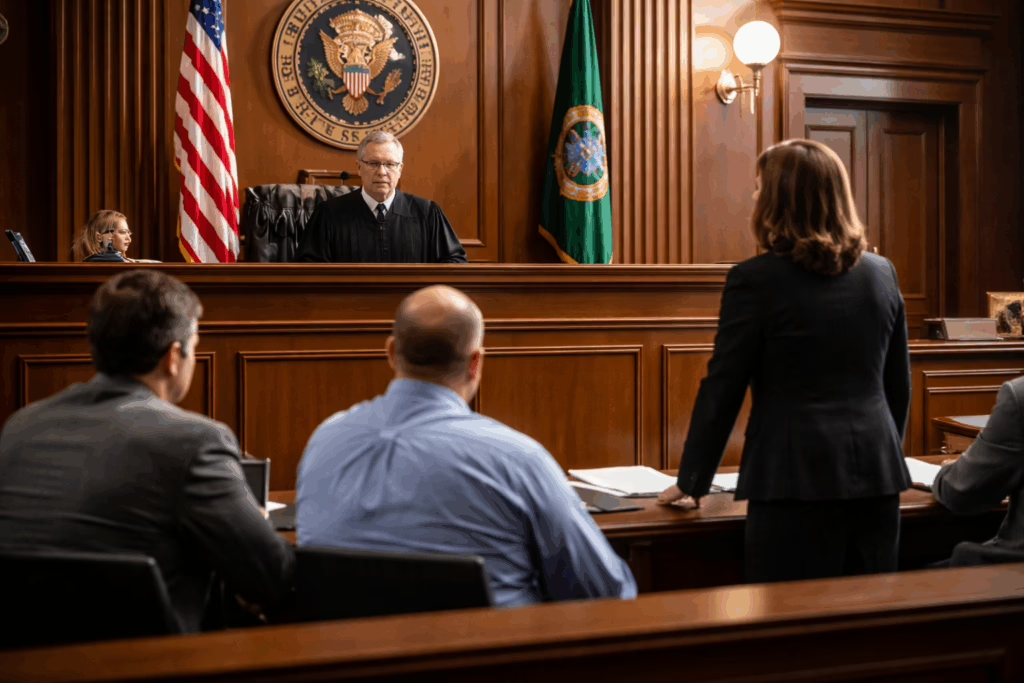
Michael O’Brien was on trial in King County Superior Court when the prosecutor suddenly fell ill with COVID-19 after the jury had been sworn in. The court paused the trial for two days, hoping the illness would be temporary. But when the prosecutor remained unable to appear and no replacement could be secured, the judge declared a mistrial over O’Brien’s objection.
Later, the State retried O’Brien on the same charges. He was convicted and appealed, arguing that the retrial violated the double jeopardy protections guaranteed by both the U.S. and Washington constitutions.
Double Jeopardy in Washington
What is Double Jeopardy?
Double jeopardy prevents the State from:
- Trying a person twice for the same offense after an acquittal
- Trying a person again after a conviction
- Imposing multiple punishments for the same crime
In Washington, this right is protected under:
- The Fifth Amendment to the U.S. Constitution
- Article I, Section 9 of the Washington Constitution
The key question in O’Brien was whether retrying him after the mistrial amounted to a second prosecution for the same offense.
Retrials After a Mistrial: The “Manifest Necessity” Rule
When Is a Mistrial Legitimate?
The U.S. Supreme Court’s 1824 decision in United States v. Perez established that retrial is allowed after a mistrial only if there is “manifest necessity.” Washington courts have followed this principle.
In O’Brien, the Washington Supreme Court used a three-part test:
- Was the defendant given a chance to be heard on the mistrial?
Yes. O’Brien objected to the mistrial on the record. - Did the court consider alternatives to a mistrial?
Yes. The court recessed the trial for two days and explored alternatives, but no substitute prosecutor could be found. - Did the court assess whether the defendant’s right to a single jury outweighed the need for a mistrial?
Yes. The court weighed O’Brien’s objection but found continuing the trial was not feasible.
The Court held the mistrial was justified by manifest necessity due to the unexpected, serious illness of the sole trial prosecutor.
No Bad Faith or Government Misconduct
Another key question in double jeopardy cases is whether the government acted in bad faith — for example, by intentionally causing a mistrial to get a more favorable trial later.
Here, the Court found no evidence of misconduct. The prosecutor’s illness was unforeseeable, and there was no indication the State created or exploited the situation.
Why This Case Matters
This case clarifies that retrials after a mistrial are not automatically barred. Instead, Washington courts:
- Look at the facts behind the mistrial
- Require manifest necessity
- Assess whether the government acted in bad faith
The outcome in O’Brien confirms that retrials can proceed lawfully when a genuine emergency — like a sudden medical issue — makes it impossible to complete the original trial.
Call to Action
If you’re facing criminal charges and believe your constitutional rights have been violated, including protection against double jeopardy, contact Blanford Law today.
📧 ken@blanfordlaw.com
📞 253‑720‑9304
Additional Resources
- Bellevue v. Redlack: Double Jeopardy and DUI in Washington
This article explores how double jeopardy protections apply to DUI cases and administrative license suspensions in Washington.
https://blanfordlaw.com/bellevue-v-redlack-double-jeopardy-and-dui-in-washington/ - Negligent Driving and Intoxication: Analysis of Bellevue v. Redlack
A deep dive into how courts distinguish between DUI and negligent driving charges and the role of intoxication evidence.
https://blanfordlaw.com/negligent-driving-and-intoxication-analysis-of-bellevue-v-redlack/ - State v. Linden: Discovery Violation
Discusses how a key discovery violation in State v. Linden led to evidentiary exclusion and its broader impact on Washington trial practice.
https://blanfordlaw.com/state-v-linden-discovery-violation/ - Necessity Defense in Civil Disobedience Cases (State v. Spokane Protestors)
Analyzes the limits of the necessity defense in protest-related civil disobedience under Washington appellate precedent.
https://blanfordlaw.com/legal-analysis-the-boundaries-of-necessity-defense-in-civil-disobedience-cases-state-of-washington-ex-rel-lawrence-h-haskell-respondent-v-spokane-13-wn-app-2d-573-wash-ct-app-2020/ - Right to a Fair Trial and Conviction Reversal
Highlights how constitutional trial errors — including biased jury instructions — can lead to reversal on appeal in Washington criminal cases.
https://blanfordlaw.com/56-right-to-fair-trial-conviction-reversal/