
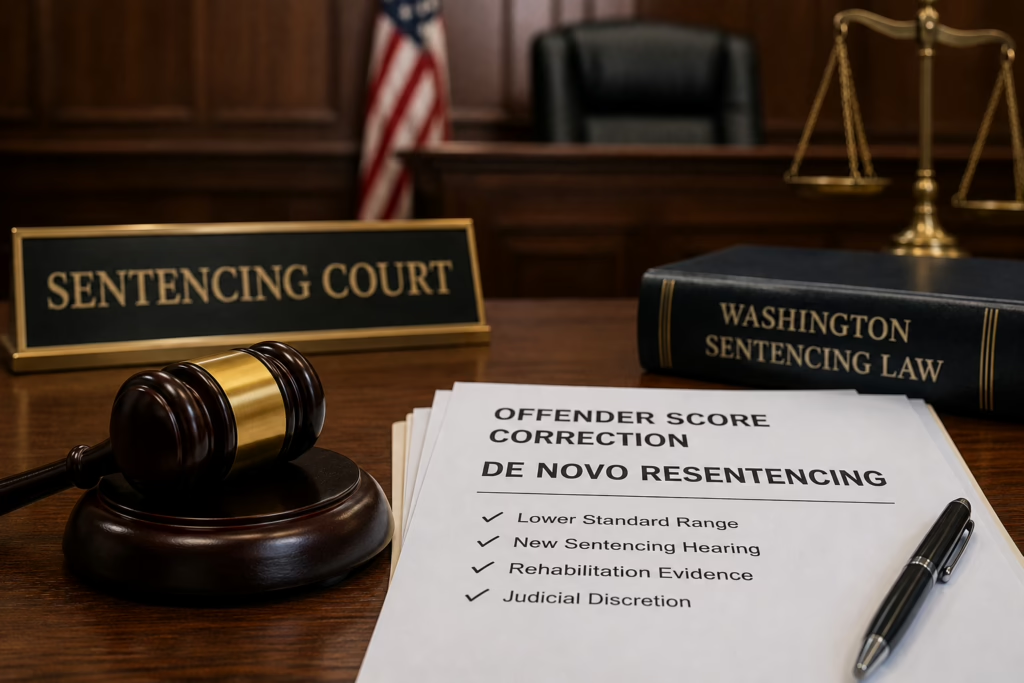
Washington de novo resentencing may be required when correcting an offender score lowers a defendant’s standard sentencing range. A recent Washington Court of Appeals decision, State v. Davis, No. 86986-8-I, illustrates the difference between simply correcting an offender score and conducting a full resentencing hearing where the court exercises new sentencing discretion.
In Davis, Division One held that Gary Davis was entitled to a full de novo resentencing after a prior drug-possession conviction invalidated by State v. Blake was removed from his offender score and his standard sentencing range decreased. The appellate court also addressed two important questions about that new hearing: Davis may present evidence of rehabilitation and other mitigating circumstances, but prior factual findings supporting his exceptional sentence remain available to the resentencing judge.
The decision is particularly important to understand in light of the Washington Supreme Court’s published decision in State v. Ellis, 5 Wn.3d 549, 579 P.3d 37 (2025).
What Happened in State v. Davis?
In 1999, Gary Davis pleaded guilty to attempted first-degree murder with a deadly weapon.
According to the Court of Appeals, Davis admitted constructing an explosive device and placing it in the carport of a community corrections officer. The device exploded as the officer was leaving his home for work, causing severe and life-threatening injuries.
At the time of sentencing, Davis had an offender score of one based on a 1996 conviction for unlawful possession of a controlled substance.
That offender score produced a standard sentencing range of 187 to 249 months, plus a 24-month deadly weapon enhancement.
The sentencing court found multiple aggravating circumstances. Among other things, it found that the attempted murder of a community corrections officer in connection with his official duties, deliberate cruelty, and violation of the victim’s zone of privacy justified an exceptional sentence above the standard range.
The court imposed 460 months plus the 24-month weapon enhancement, for a total sentence of 484 months.
Years later, Washington law concerning Davis’s prior drug-possession conviction fundamentally changed.
How State v. Blake Affected Davis’s Offender Score
In State v. Blake, 197 Wn.2d 170, 481 P.3d 521 (2021), the Washington Supreme Court held Washington’s former felony drug-possession statute unconstitutional.
Davis subsequently sought relief under CrR 7.8 — Relief from Judgment or Order.
His prior possession conviction had contributed one point to his offender score. Removing that conviction reduced his offender score from one to zero.
That change also lowered his standard sentencing range.
Instead of 187 to 249 months, Davis’s corrected standard range became 180 to 240 months.
The superior court corrected the offender score but declined to conduct a full resentencing. It reasoned that the original sentencing judge would have imposed the same exceptional sentence anyway.
Division One concluded that this was error.
Washington De Novo Resentencing Is Required When the Sentencing Range Changes
The key issue was not simply whether Davis’s offender score contained an error.
The important fact was that correcting the offender score changed the applicable standard sentencing range.
The Court of Appeals relied heavily on the Washington Supreme Court’s recent decision in State v. Ellis, 5 Wn.3d 549, 579 P.3d 37 (2025).
In Ellis, the Supreme Court explained that when an offender-score correction lowers the applicable sentencing range, the defendant is entitled to a full resentencing hearing.
As the Supreme Court stated:
“Where an error in a defendant’s offender score affects the applicable sentencing range, resentencing is required.”
The Davis court applied that principle directly.
Because Davis’s offender score decreased from one to zero and his standard range fell from 187–249 months to 180–240 months, simply changing the numbers on the judgment and sentence was insufficient.
The sentencing court had to conduct a de novo resentencing.
What Does De Novo Resentencing Mean in Washington?
A de novo resentencing is more than a clerical correction to an existing sentence.
The resentencing judge must exercise independent sentencing discretion within the scope permitted by the applicable appellate mandate and Washington sentencing law.
The Davis court relied on Ellis and other Washington Supreme Court authority recognizing that, when no appellate mandate limits the resentencing court’s authority, the court may consider issues and evidence that were not part of the earlier proceeding.
Washington’s Sentencing Reform Act also directs courts to consider relevant evidence and argument at sentencing.
See RCW 9.94A.500 — Sentencing hearing and RCW 9.94A.530 — Standard sentence range.
That distinction can be extremely important to someone who has spent many years incarcerated since the original sentencing hearing.
Rehabilitation Evidence Can Be Considered at Resentencing
One of the most significant practical consequences of Washington de novo resentencing is the opportunity to present updated mitigating evidence.
The Court of Appeals specifically stated that Davis may present evidence concerning his rehabilitation since his original sentencing.
Depending on the circumstances of a case, a resentencing court may therefore hear evidence that did not exist when the original sentence was imposed.
That could potentially include evidence concerning rehabilitation, conduct while incarcerated, personal development, treatment, education, or other circumstances relevant to the defendant’s sentencing request.
The resentencing court must exercise its own discretion rather than simply assume that the original sentencing judge would have imposed the same sentence.
That was the central problem with the superior court’s approach in Davis.
Does Blakely v. Washington Apply at the New Resentencing?
Davis raised another significant argument.
He contended that because he was entitled to a de novo resentencing, the constitutional rule announced in Blakely v. Washington, 542 U.S. 296 (2004), should apply.
Under Blakely, a criminal defendant generally has a constitutional right to have a jury determine facts used to support an exceptional sentence above the standard range.
But Davis’s original sentence was imposed in 1999—years before Blakely.
The Washington Supreme Court has held that Blakely does not apply retroactively to cases that were already final. See State v. Evans, 154 Wn.2d 438, 449, 114 P.3d 627 (2005).
Division One therefore rejected Davis’s argument that the new resentencing automatically entitled him to a jury determination of the aggravating facts supporting his original exceptional sentence.
Prior Exceptional-Sentence Findings Can Remain Available
This is one of the more complicated aspects of Davis.
The Court of Appeals held that the factual findings supporting Davis’s original exceptional sentence remain final and may be considered at the new resentencing hearing.
The court relied on the Washington Supreme Court’s decision in State v. Rowland, 174 Wn.2d 150, 272 P.3d 242 (2012), as well as Division Two’s published decision in State v. Anderson, 36 Wn. App. 2d 272, 583 P.3d 38 (2026).
Those authorities distinguish between correcting a sentence and reopening previously final factual findings supporting an exceptional sentence.
The Court Is Not Required to Reimpose the Exceptional Sentence
This distinction is crucial.
Although the old aggravating findings remain available, the resentencing judge is not required to impose the same exceptional sentence.
The judge must conduct the new sentencing hearing and exercise independent discretion.
The Court of Appeals explained that the resentencing court may consider new evidence, rehabilitation evidence, and arguments from both sides.
Depending on that exercise of discretion, the resulting sentence could differ substantially from the original sentence.
Thus, Davis does not mean that eliminating an offender-score point automatically eliminates a prior exceptional sentence. Nor does it mean the original exceptional sentence must automatically be reimposed.
The resentencing court must actually resentence the defendant.
Why the Difference Between an Offender-Score Correction and Resentencing Matters
The difference may appear technical, but it can have significant consequences.
Suppose a defendant was originally sentenced using an incorrect offender score. If correcting that score does not change the standard sentencing range, different legal questions may arise.
But when the correction lowers the applicable range, Ellis establishes that resentencing is required.
In Davis, the original range was:
187–249 months
The corrected range was:
180–240 months
Because the range changed, Division One concluded that the superior court could not merely amend Davis’s offender score while leaving the sentencing decision untouched.
A new exercise of sentencing discretion was required.
State v. Davis Is an Unpublished Opinion
There is an important limitation on the authority of State v. Davis: Division One designated the decision as an unpublished opinion.
That means Davis does not have the same precedential effect as a published Washington appellate decision.
Washington GR 14.1 — Citation to Unpublished Opinions governs the use of unpublished appellate decisions.
Under GR 14.1, qualifying unpublished Washington Court of Appeals opinions filed on or after March 1, 2013, may be cited as nonbinding authority when the requirements of the rule are satisfied.
Unpublished Does Not Mean the Decision Has No Value
It is important to distinguish precedential value from persuasive value.
An unpublished decision such as Davis does not establish binding precedent in the same manner as a published Washington appellate opinion. A court considering a later case is not bound to treat Davis as controlling authority.
But that does not make the opinion meaningless.
An unpublished opinion may illustrate how an appellate panel applied existing binding law to a particular factual situation. Where permitted by GR 14.1, it may also be cited as nonbinding authority.
In Davis, the distinction is especially important because the principal rule requiring resentencing comes from the Washington Supreme Court’s published decision in State v. Ellis.
Likewise, the analysis concerning prior aggravating findings relies on published decisions including Rowland and Anderson.
Accordingly, Davis is best understood as a recent application of established and published Washington sentencing law rather than a new binding rule created by Division One.
What Davis Means for Washington Resentencing Cases
The practical lesson from Davis is that correcting an offender score may involve considerably more than changing a number on a judgment and sentence.
When an offender-score correction reduces the applicable standard sentencing range, Washington de novo resentencingmay require the court to conduct a new sentencing hearing and exercise independent discretion.
That can give the defendant an opportunity to present mitigating evidence that was not available at the original sentencing, including evidence of rehabilitation developed during years of incarceration.
At the same time, resentencing does not necessarily erase every determination made in the original case. As Davisillustrates, previously final factual findings supporting an exceptional sentence may remain available to the resentencing court even though the judge retains discretion over what sentence ultimately should be imposed.
The exact scope of resentencing therefore depends on the reason for resentencing, prior appellate decisions, the applicable mandate, and the procedural history of the individual case.
Speak With a Washington Criminal Defense Attorney About Resentencing
Washington resentencing law has developed significantly following State v. Blake and subsequent Washington Supreme Court decisions. Whether an offender-score error requires a new sentencing hearing—and what issues may be raised at that hearing—depends on the circumstances of the case.
A defendant who may have an incorrect offender score should consider not only whether the score can be corrected, but whether the correction changes the applicable sentencing range and triggers a broader resentencing proceeding.
Contact Blanford Law today at ken@blanfordlaw.com or 253-720-9304 for guidance on your legal matter.
Additional Resources
Washington Blake Resentencing Appeals
Learn how State v. Blake affected Washington sentencing and when an invalid drug-possession conviction may support resentencing or appellate relief.
State v. Drake and Washington Sentencing Law
Read about State v. Drake and how Washington appellate courts address sentencing issues, offender scores, and the scope of relief after sentencing errors.
Washington Offender Scores and State v. Wysgoll
Explore how Washington courts calculate offender scores and why prior convictions can significantly affect the standard sentencing range.
Washington Unpublished Opinion Rule
Learn how Washington treats unpublished appellate opinions, including their nonprecedential status and when GR 14.1 permits citation as persuasive authority.
Ranger v. Pierce: Washington Bail Bond Case
Review Ranger v. Pierce and its discussion of Washington bail bond law, court authority, and procedural issues arising in criminal cases.