
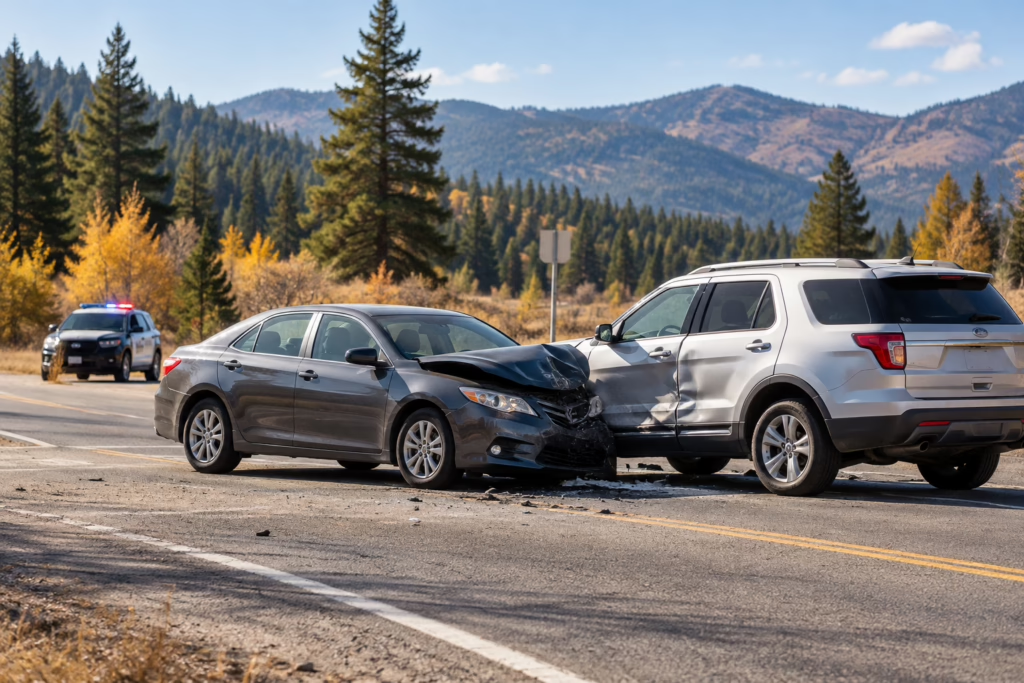
A Cle Elum car accident left three people injured Sunday afternoon after a sedan collided with an SUV on State Route 970 in Kittitas County. According to reports citing the Washington State Patrol (WSP), the collision occurred when a driver allegedly failed to yield while entering the highway from Teanaway Road.
The crash highlights the potentially serious consequences of failure-to-yield collisions and the legal rights that may be available to people injured in Washington car accidents.
Three People Injured in SR-970 Collision
According to the reported crash information, the collision happened at approximately 1:20 p.m. on State Route 970, about seven miles east of Cle Elum.
A sedan driven by 27-year-old Adam Lange of Seattle reportedly collided with an SUV driven by 53-year-old Brandy Nordstrom of Mercer Island. Nordstrom’s SUV was also carrying a 14-year-old passenger.
All three people reportedly suffered injuries.
Lange was transported to Overlake Hospital in Bellevue for treatment. Nordstrom and the teenage passenger were taken by a private party to Kittitas Valley Healthcare in Ellensburg.
The extent of their injuries was not disclosed in the initial report.
According to information attributed to the Washington State Patrol, Lange entered SR-970 from Teanaway Road and struck Nordstrom’s vehicle after allegedly failing to yield.
Troopers reportedly determined that intoxicants were not a factor in the collision. The initial State Patrol report also indicated that charges were pending.
The collision slowed traffic on SR-970 for several hours.
It is important to remember that an initial collision report represents preliminary investigative findings. Any criminal charge, traffic citation, insurance determination, or civil finding of fault would need to be addressed through the appropriate legal process.
Cle Elum Car Accident Highlights Washington Right-of-Way Laws
Failure to Yield Can Lead to Serious Highway Collisions
Drivers entering a state highway must exercise particular care because vehicles already traveling on the highway may be moving at significantly higher speeds.
Washington law establishes right-of-way requirements at intersections controlled by stop and yield signs.
Under RCW 46.61.190, a driver approaching a stop sign must stop as required by law and yield to vehicles already in the intersection or approaching closely enough to constitute an immediate hazard.
Washington law also addresses vehicles entering arterial highways. RCW 46.61.195 generally gives state highways arterial status relative to intersecting roads, subject to exceptions provided by law.
A driver’s failure to comply with applicable right-of-way requirements can become important evidence in a personal injury claim when that conduct causes a collision.
However, determining civil liability requires examining all available evidence rather than relying solely on an initial police report.
Why Failure-to-Yield Accidents Can Cause Serious Injuries
Intersection collisions on rural highways can be particularly dangerous because of vehicle speeds and the limited amount of time motorists may have to react.
A driver entering a highway may misjudge the speed or distance of an approaching vehicle. Visibility can also be affected by roadway design, surrounding terrain, weather, vegetation, or other vehicles.
Other potential contributing factors can include distracted driving, failing to make a complete stop, or entering the highway before there is enough room to do so safely.
Even when alcohol or drugs are not involved, a momentary driving mistake can result in significant injuries.
What Compensation May Be Available After a Washington Car Accident?
When someone’s negligence causes a Washington motor vehicle accident, injured drivers and passengers may have the right to pursue compensation for their losses.
Depending on the circumstances, damages in a personal injury claim may include:
- Emergency medical care and hospitalization
- Follow-up treatment and rehabilitation
- Future medical expenses
- Lost wages
- Reduced future earning capacity
- Physical pain and suffering
- Emotional distress
- Property damage
- Other accident-related losses
The value of a car accident claim depends on the facts of the individual case, including the seriousness of the injuries, the length of recovery, available insurance coverage, and evidence establishing responsibility for the crash.
Insurance companies may attempt to resolve a claim before the full extent of an injured person’s medical condition is known. Accepting a final settlement generally ends the ability to pursue additional compensation for the same claim, making it important to understand the potential value of a case before agreeing to a resolution.
What If a Child Is Injured in a Washington Car Accident?
One particularly concerning aspect of this SR-970 collision is that a 14-year-old passenger was reportedly among those injured.
Children involved in vehicle accidents may require additional medical monitoring or treatment, depending on their injuries.
Washington law also contains special provisions affecting claims involving minors. For example, RCW 4.16.190 can affect the time available to bring certain claims when the injured person is under 18.
Because claims involving children can present additional legal considerations, parents or guardians should consider speaking with an attorney before resolving a minor’s personal injury claim.
What Should You Do After a Car Accident in Kittitas County?
Seek Medical Attention
Anyone injured in a collision should seek appropriate medical attention. Some injuries may not produce obvious symptoms immediately after a crash.
Medical treatment also creates documentation connecting the injuries and treatment to the collision.
Obtain the Washington State Patrol Collision Report
When the Washington State Patrol investigates a crash, its collision records can contain important information about the drivers, vehicles, roadway conditions, witnesses, and investigating trooper’s observations.
The Washington State Patrol provides information about obtaining collision records through its official website.
A collision report can be important evidence, but an investigating officer’s preliminary assessment does not necessarily determine who will ultimately be held legally responsible in a civil personal injury case.
Preserve Evidence
Injured motorists should preserve as much evidence as reasonably possible.
This may include photographs of the vehicles and accident scene, medical records, treatment bills, repair estimates, insurance correspondence, witness information, and documentation showing time missed from work.
Evidence can disappear quickly after a motor vehicle collision, so early preservation can become important if liability or the extent of the injuries is later disputed.
Washington’s Personal Injury Filing Deadline
People injured in Washington should also be aware that personal injury claims are subject to legal deadlines.
Under RCW 4.16.080, most Washington personal injury lawsuits based on negligence are subject to a three-year statute of limitations.
Different rules can apply in certain circumstances, including some claims involving minors or government entities.
Waiting until the deadline approaches can also make an accident more difficult to investigate because witnesses may become harder to locate and physical evidence may disappear.
How Blanford Law Helps Washington Car Accident Victims
A serious collision can leave an injured person dealing with medical treatment, missed work, vehicle damage, insurance adjusters, and uncertainty about what happens next.
Blanford Law’s personal injury practice helps Washington accident victims understand their legal rights and evaluate potential claims for compensation.
A personal injury attorney can investigate how a collision occurred, review police and medical records, identify available insurance coverage, document damages, communicate with insurers, and determine whether a settlement fairly accounts for an injured person’s losses.
The SR-970 collision near Cle Elum demonstrates how an alleged failure to yield can have consequences for multiple drivers and passengers.
While responsibility for this particular accident must ultimately be determined through the appropriate investigative and legal processes, people injured because of another driver’s negligence have the right to understand their options under Washington law.
Contact Blanford Law today at ken@blanfordlaw.com or 253-720-9304 for guidance on your legal matter.
Additional Resources
For more information about Washington personal injury and criminal law, explore these related articles from Blanford Law:
1. Washington Jail Death Lawsuits: When Can a County Avoid Liability?
Learn how Washington law addresses wrongful death and negligence claims involving county jails, including government liability, statutory defenses, and filing requirements.
2. Washington De Novo Resentencing After an Offender Score Changes
Review how Washington courts handle de novo resentencing when a defendant’s offender score changes and what that process can mean for a new sentence.
3. Pierce County Motorcycle Crash: Who Can Recover Compensation After a Serious Accident?
Learn about compensation that may be available after a serious Pierce County motorcycle crash, including medical expenses, lost income, and other accident-related damages.
4. State v. Peterson Drug Court Ruling: Washington Supreme Court Limits Blake Fee Refunds
Explore how the Washington Supreme Court’s State v. Peterson decision affects certain Blake-related fee refund claims involving drug court participants.