
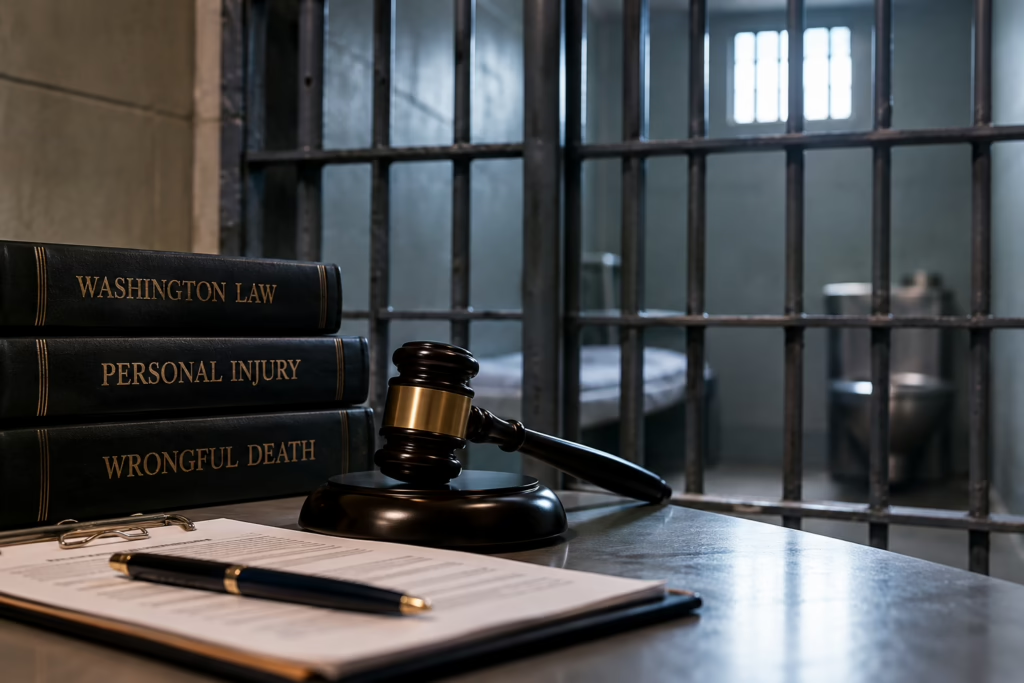
When someone dies in a Washington jail, surviving family members may have questions about whether the death could have been prevented and whether the jail should be held responsible. Washington jail death lawsuits can involve allegations of inadequate medical care, negligent supervision, unsafe conditions, or failures to respond to emergencies. However, even when a correctional facility is accused of negligence, state law may limit a family’s ability to recover damages.
A published October 8, 2026, decision from the Washington Court of Appeals, Anderson v. Grant County, No. 38892-1-III, illustrates how Washington’s felony defense statute can affect wrongful death and personal injury claims against government agencies.
The ruling also highlights an important distinction between incidents occurring before and after Washington lawmakers amended the statute in 2021.
What Happened in Anderson v. Grant County?
The case arose from the death of Derek Batton, who was booked into the Grant County Jail on August 10, 2018.
The following day, another inmate, Jordan Tebow, was booked into the jail and assigned to Batton’s cell. According to the court’s opinion, Tebow had smuggled heroin into the facility. He offered the drug to Batton, who accepted and ingested it.
On August 12, 2018, Batton was found dead in his cell. His death was attributed to acute morphine intoxication, likely caused by heroin.
Batton’s parents and estate filed a lawsuit against Grant County, alleging that the County had negligently failed to:
- Properly search the inmate who brought heroin into the jail.
- Discover the presence of illegal drugs through adequate supervision or video surveillance.
- Detect Batton’s overdose and provide a timely response that could have prevented his death.
These allegations raised significant questions about the responsibilities of correctional facilities to protect individuals in their custody.
However, Grant County argued that the lawsuit was barred by Washington’s felony defense statute.
Understanding Washington’s Felony Defense Statute
Washington law provides certain defenses to personal injury and wrongful death claims when the injured or deceased person was committing a felony that contributed to the injury or death.
Under RCW 4.24.420, the felony defense can, when its statutory requirements are satisfied, completely prevent a plaintiff from recovering damages.
The version of the law applicable to Batton’s 2018 death established a complete defense when:
- The injured or deceased person was engaged in committing a felony at the time of the occurrence causing the injury or death.
- That felony was a proximate cause of the injury or death.
In other words, a defendant could potentially avoid liability even if the plaintiff alleged that the defendant’s own negligence contributed to the incident.
Why Did the Court Consider the Inmate’s Drug Possession Important?
The Estate argued that the relevant occurrence was the jail’s earlier failure to adequately search the inmate who introduced heroin into the facility.
The Court of Appeals disagreed.
In its October 2026 opinion, the court determined that the relevant occurrence was Batton’s possession and ingestion of heroin, rather than the jail’s earlier alleged negligence.
Because Batton’s possession of heroin constituted a felony under the law applicable at the time, and the heroin ingestion caused his fatal overdose, the court concluded that the former version of RCW 4.24.420 provided Grant County with a complete defense.
The court recognized that the jail’s alleged failures might have contributed to the death. Nevertheless, under the former statute, those allegations did not overcome the felony defense.
The appellate court therefore reversed the trial court’s denial of summary judgment and directed entry of judgment in Grant County’s favor.
How Washington Changed the Law in 2021
One of the most important aspects of this decision involves the 2021 amendments to Washington’s felony defense statute.
The Legislature amended RCW 4.24.420 through Engrossed Substitute Senate Bill 5263.
The amended statute distinguishes between ordinary personal injury actions and cases arising from law enforcement activities that result in personal injury or death.
For actions arising from law enforcement activities, the statute now requires a determination beyond a reasonable doubt that the injured or deceased person was committing a felony at the relevant time and that the felony was a proximate cause of the injury or death.
This is an important distinction for families pursuing claims involving police encounters, jail incidents, and other qualifying law enforcement activities.
Why Didn’t the New Law Apply to Batton’s Death?
The Estate argued that the 2021 amendments should apply to its lawsuit.
The Court of Appeals rejected that position.
The court explained that Washington statutes are generally presumed to operate prospectively unless the Legislature clearly provides otherwise.
Although earlier versions of the 2021 legislation included language stating that the amendments would apply retroactively, lawmakers removed that language before passing the final bill.
The appellate court interpreted that deletion as evidence that the Legislature did not intend the amendments to apply to earlier incidents.
Because Batton died in 2018, the court applied the former version of the statute.
For personal injury attorneys and families considering litigation, this distinction is critical. The date of an injury or death may determine which version of Washington law governs the claim.
What Does This Decision Mean for Washington Jail Death Lawsuits?
The ruling in Anderson v. Grant County does not mean that correctional facilities are automatically protected from wrongful death lawsuits.
Instead, it demonstrates how a particular statutory defense can affect a negligence claim depending on the circumstances and the law in effect when the incident occurred.
Several considerations may be important when evaluating a potential claim.
1. Correctional Facilities May Still Face Negligence Claims
Correctional facilities have legal responsibilities concerning the safety and medical needs of individuals in custody.
Depending on the circumstances, allegations involving inadequate supervision, delayed medical treatment, unsafe conditions, or failures to respond to known dangers may support negligence or other legal claims.
Whether a particular claim succeeds depends on the applicable duty of care, the evidence of a breach, causation, damages, and any available legal defenses.
The fact that an inmate was involved in illegal conduct does not automatically establish that every potential claim is barred.
2. The Cause of Injury or Death Matters
In Washington personal injury litigation, causation is often a central issue.
The court in Anderson distinguished between earlier events that may have contributed to the death and the immediate occurrence that produced it.
The court acknowledged that the County’s alleged negligence could have been part of the causal chain. Nevertheless, it determined that Batton’s ingestion of heroin was the relevant occurrence for purposes of the former felony defense statute.
This distinction illustrates why identifying the precise circumstances surrounding an injury or death can be essential to evaluating liability.
3. The 2021 Amendments May Affect More Recent Claims
For injuries and deaths occurring after the 2021 amendments took effect, courts must apply the amended statutory framework when RCW 4.24.420 is at issue.
That framework includes special requirements for actions arising out of law enforcement activities.
Families should not assume that the outcome in Anderson necessarily determines the outcome of a more recent jail death case.
The nature of the alleged misconduct, the applicable statutory provisions, and the facts surrounding the death may lead to a different legal analysis.
4. Federal Civil Rights Claims Require Separate Consideration
Washington’s felony defense statute expressly preserves rights of action under 42 U.S.C. § 1983.
Section 1983 permits certain civil lawsuits alleging violations of federal constitutional rights by persons acting under color of state law.
In some circumstances, deaths occurring in correctional facilities may raise questions about constitutional protections relating to medical care, safety, or conditions of confinement.
These claims have distinct legal requirements and should not be confused with ordinary negligence or wrongful death claims under Washington law.
The Anderson decision did not resolve whether the Estate had a viable federal civil rights claim.
What Should Families Do After a Death in a Washington Jail?
When someone dies while incarcerated, determining what happened can require a careful investigation.
Important evidence may include booking and intake records, medical records, surveillance footage, incident reports, witness statements, and documentation of emergency responses.
Families may also need to determine whether jail personnel knew about a serious medical condition or safety risk and whether reasonable steps were taken in response.
Legal deadlines are another important consideration.
Washington’s general three-year limitation period for many personal injury and wrongful death actions is established in RCW 4.16.080. However, the applicable deadline can depend on the nature of the claim, and claims against local governments may also involve special procedural requirements.
For example, RCW 4.96.020 establishes claim-filing procedures for certain tort claims against local governmental entities.
Failing to comply with applicable deadlines or notice requirements can jeopardize an otherwise valid claim.
For that reason, families considering legal action should seek legal guidance promptly.
Can You Sue a Washington Jail for Negligence or Wrongful Death?
Potentially, yes.
Washington law permits qualifying negligence and wrongful death claims against governmental entities, subject to applicable legal requirements and defenses.
RCW 4.96.010 addresses the tort liability of local governmental entities, including counties.
Washington’s wrongful death statute, RCW 4.20.010, provides a basis for certain actions when a person’s death is caused by the wrongful act, neglect, or default of another.
However, establishing that a death occurred in a jail is not enough by itself to establish liability.
A successful claim generally requires evidence supporting the applicable legal elements and overcoming any available defenses.
The decision in Anderson v. Grant County underscores why a detailed legal analysis is necessary before determining whether a correctional facility can be held financially responsible.
Speak With a Washington Personal Injury Attorney
The death of a loved one in a correctional facility can leave families searching for answers about what happened and whether the tragedy could have been prevented.
Washington’s personal injury and wrongful death laws provide potential avenues for accountability, but statutory defenses, government claim procedures, and filing deadlines can make these cases complicated.
At Blanford Law, we understand the importance of carefully examining the facts, identifying potential legal claims, and explaining the options available under Washington law.
Contact Blanford Law today at ken@blanfordlaw.com or 253-720-9304 for guidance on your legal matter.
Additional Resources
For more information about Washington personal injury law, wrongful death claims, and legal rights, explore these articles from Blanford Law.
1. Wrongful Death Claims on Whidbey Island Learn about wrongful death claims in Washington, including legal considerations for families seeking accountability after losing a loved one because of another party’s alleged negligence.
2. Washington Pedestrian Accident Claims Explore the legal considerations involved in Washington pedestrian accident claims, including negligence, liability, and potential compensation for injuries.
3. Ellensburg Semi-Truck Crashes and Personal Injury Claims Understand how serious commercial truck accidents can lead to personal injury claims and the importance of investigating negligence and determining liability.
4. The Right to Self-Representation in Washington Learn about the right to represent yourself in Washington legal proceedings and the considerations involved in navigating the legal system without an attorney.
5. Whidbey Island Wildlife Collisions Explore legal and safety considerations surrounding vehicle collisions involving wildlife, including potential insurance and personal injury issues.