
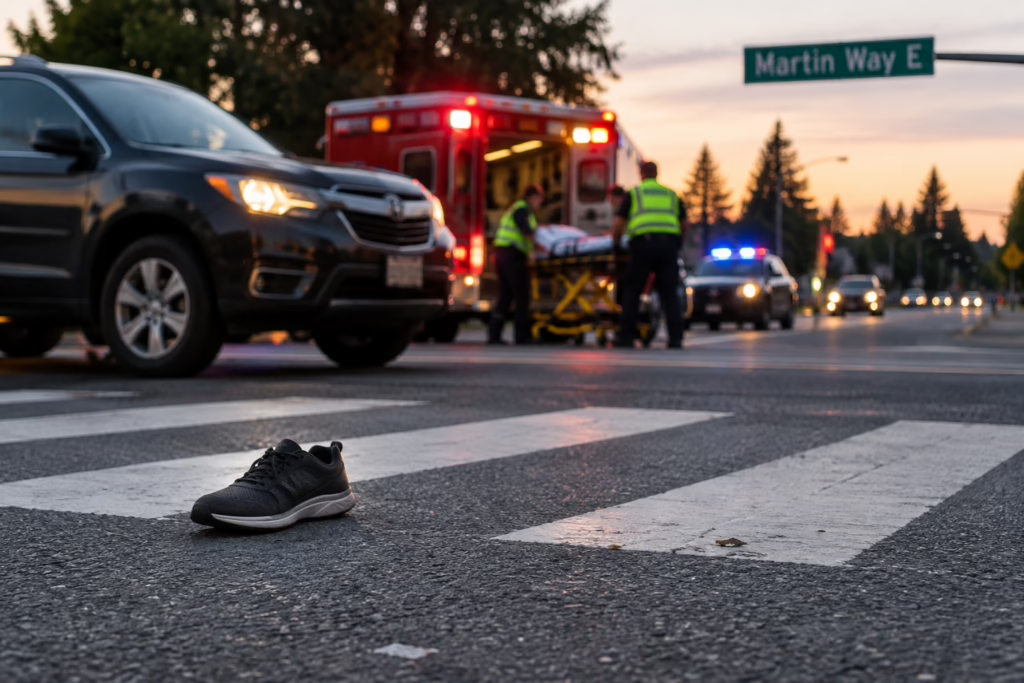
A serious pedestrian collision on Martin Way East in Thurston County highlights several important issues that can arise in a Washington pedestrian accident claim. According to a September 20, 2026 news report, a man in his 50s was injured after being struck by a vehicle in the 9300 block of Martin Way East. The pedestrian was reportedly pinned underneath the vehicle and transported to an area hospital for treatment.
The Thurston County Sheriff’s Office reported that the driver, a woman in her mid-40s, allegedly attempted to walk away from the scene following the collision. She was arrested on suspicion of hit-and-run with injury.
While the circumstances are concerning, an arrest does not determine who was legally responsible for causing the initial collision. The criminal investigation and any potential personal injury claim are separate matters. For an injured pedestrian, determining civil liability requires examining the evidence surrounding how and why the collision occurred.
A Washington Pedestrian Accident Claim Is Separate From a Hit-and-Run Charge
When a pedestrian is struck by a vehicle, there may be both criminal and civil legal issues.
Washington law imposes specific duties on drivers involved in collisions resulting in injury. Under RCW 46.52.020, a driver involved in an accident resulting in injury or death generally must immediately stop at or near the scene, remain there, provide required identifying and insurance information, and render reasonable assistance to an injured person.
Failing to comply with those requirements when an accident results in injury can result in criminal charges.
However, the statute also specifically provides that rendering assistance or otherwise complying with these requirements is not evidence of liability for causing the accident. In other words, determining whether a driver complied with the law after a crash is different from determining who caused the collision.
That distinction can be important in a personal injury case.
What Determines Liability for a Pedestrian Collision?
A personal injury investigation typically looks at what happened in the moments leading up to the collision.
Evidence may include:
- Police and collision reports
- Witness statements
- Surveillance or business security video
- Vehicle damage
- Photographs and measurements from the scene
- Cellphone records when relevant
- Vehicle event data
- Road and lighting conditions
- Traffic signals and signs
- The driver’s speed and actions
- The pedestrian’s location and actions
Washington law also contains specific protections for pedestrians.
For example, RCW 46.61.245 requires drivers to exercise due care to avoid colliding with pedestrians on a roadway and to exercise proper precautions when circumstances warrant.
Washington also establishes rules governing drivers and pedestrians at crosswalks under RCW 46.61.235.
Importantly, the currently available reporting about the Martin Way collision does not establish whether the pedestrian was in a marked or unmarked crosswalk. That fact should therefore not be assumed when evaluating this particular incident.
What If the Pedestrian Was Partially at Fault?
Pedestrian accident cases are not always as simple as deciding that one person was completely responsible.
An insurance company may argue that a pedestrian crossed outside a crosswalk, entered the roadway unexpectedly, failed to observe approaching traffic, or otherwise contributed to a collision.
An allegation of pedestrian fault does not necessarily eliminate a personal injury claim in Washington.
Under Washington’s comparative-fault statute, RCW 4.22.005, contributory fault generally reduces compensatory damages in proportion to the claimant’s share of fault rather than completely barring recovery.
For example, if a pedestrian suffered $200,000 in compensatory damages but was ultimately determined to be 20% responsible for the accident, application of comparative fault would reduce that amount by 20%, to $160,000.
That is one reason injured pedestrians should be cautious about assuming they do not have a claim simply because an insurer alleges that they did something wrong.
What Compensation May Be Available After a Pedestrian Accident?
A pedestrian struck by a motor vehicle can suffer significant injuries. Unlike vehicle occupants, pedestrians have virtually nothing protecting them from the force of a collision.
Depending on the facts and injuries involved, damages in a Washington pedestrian injury case may potentially include compensation for:
- Emergency medical treatment
- Hospitalization
- Surgery
- Rehabilitation and physical therapy
- Future medical treatment
- Lost wages
- Loss of future earning capacity
- Pain and suffering
- Disability or loss of function
- Other accident-related losses
The damages available in any particular case depend on the evidence and circumstances involved.
When an injured person is hospitalized, the full extent of the damages may also be unclear immediately after the collision. Some injuries require extensive follow-up care, rehabilitation, or additional procedures.
Why Evidence Matters After a Serious Pedestrian Crash
Evidence can disappear surprisingly quickly after a pedestrian accident.
Businesses may overwrite surveillance footage. Vehicles may be repaired or destroyed. Witnesses can become difficult to locate, and physical evidence at the collision scene can disappear.
For that reason, investigating a serious pedestrian collision may involve more than obtaining the police report.
An attorney may seek nearby surveillance footage, identify witnesses, photograph the location, preserve evidence involving the vehicle, obtain relevant records, and examine other information that helps reconstruct what occurred.
Evidence can become especially important when the injured pedestrian has limited recollection of the collision because of the severity of the injuries.
Insurance Issues After a Washington Pedestrian Accident
Determining what insurance coverage is available is another important part of a pedestrian injury claim.
The driver’s automobile liability insurance may provide coverage when the driver is legally responsible for the collision. Depending on the circumstances, other insurance coverage may also need to be investigated.
Insurance companies may begin investigating a serious accident almost immediately. An adjuster may request a recorded statement, medical authorization, or other information from the injured person.
Before providing a detailed recorded statement or signing broad medical authorizations, an injured pedestrian may want to understand how the requested information could affect the claim.
A Criminal Investigation Does Not Replace a Personal Injury Claim
The Martin Way incident also illustrates an important distinction between criminal and civil proceedings.
According to the published report, the driver was arrested on suspicion of hit-and-run with injury.
An arrest is not a conviction, and the driver is entitled to the protections applicable in a criminal proceeding. Likewise, the reported arrest does not, standing alone, establish that the driver was negligent in causing the original collision.
For an injured pedestrian, however, a separate civil claim may examine whether another person’s negligence caused the crash and resulting injuries.
The two proceedings have different purposes. A criminal prosecution is brought by the government and concerns alleged violations of criminal law. A personal injury claim is generally brought to seek compensation for losses caused by another party’s negligence or other legally actionable conduct.
Injured in a Pedestrian Accident in Thurston County?
A collision involving a pedestrian can lead to substantial medical bills, time away from work, ongoing treatment, and uncertainty about what comes next. When the circumstances of the collision are disputed, obtaining and preserving evidence early can become particularly important.
If you or a family member has been seriously injured after being struck by a vehicle in Lacey, Olympia, elsewhere in Thurston County, or another Washington community, Blanford Law can evaluate the circumstances and explain the legal options that may be available.
Contact Blanford Law today at ken@blanfordlaw.com or 253-720-9304 for guidance on your legal matter.
Additional Resources
Washington Drug Patch Ruling: Court Protects Pretrial Privacy Rights
Learn how a recent Washington Court of Appeals decision addressed the constitutionality of transdermal drug-monitoring patches imposed as pretrial release conditions in DUI cases.
https://blanfordlaw.com/washington-drug-patch-ruling/
How Long Will Someone Stay in Pierce County Jail?
This guide explains the factors that can affect how long someone remains in Pierce County Jail, including bail, release conditions, warrants, charges, and court orders.
https://blanfordlaw.com/pierce-county-jail-time-2/
Washington Material Witness Warrants: What State v. Denman Shows
Review how Washington courts handle material witness warrants and what the unpublished State v. Denman decision illustrates about subpoenas, witness availability, and trial procedure.
https://blanfordlaw.com/washington-material-witness-warrant/
Washington DUI License Suspension: What Happens After an Arrest?
Learn how Washington’s administrative DUI license suspension process works, including the seven-day deadline to request a Department of Licensing hearing.
https://blanfordlaw.com/washington-dui-license-suspension/