
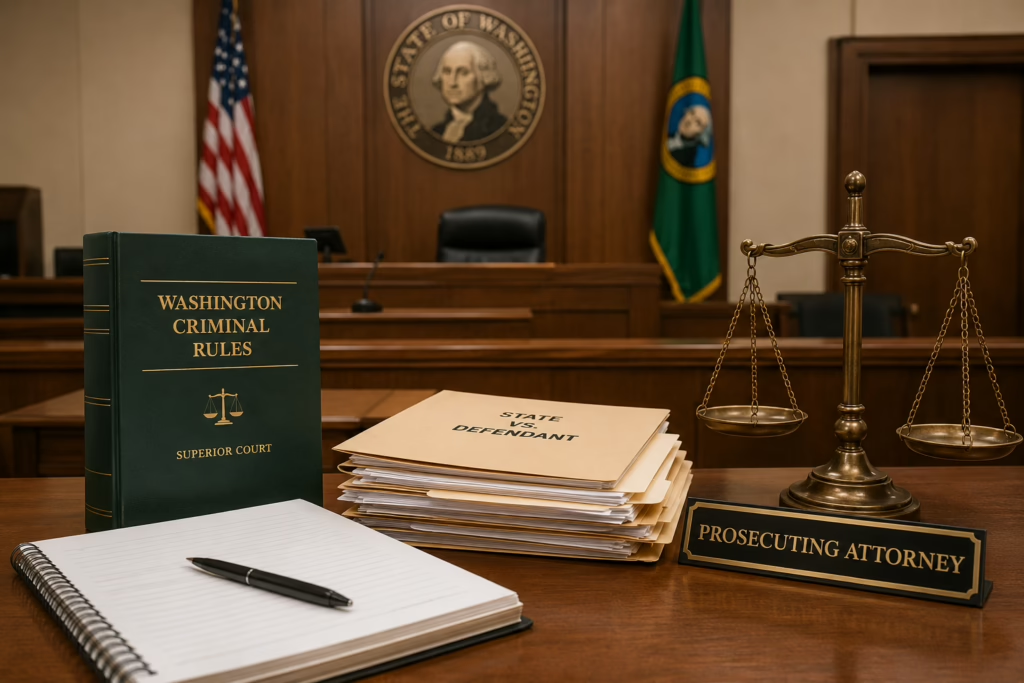
When people think of a criminal prosecution in Washington, they often picture the elected county prosecuting attorney handling the case. In reality, many different attorneys and authorized individuals may appear on behalf of the State. CrR 1.4 provides a simple but important definition that clarifies who the term “prosecuting attorney” includes throughout the Washington Superior Court Criminal Rules.
Although the rule contains only one sentence, it helps ensure that the criminal justice system functions efficiently by recognizing that prosecutorial duties are often performed by deputy prosecutors or other individuals authorized by law.
What Does CrR 1.4 Say?
CrR 1.4 states:
“Whenever used in these rules, prosecuting attorney shall include deputy prosecuting attorneys, or such other person as may be designated by statute.”
You can read the official rule on the Washington Courts website here:
Washington Superior Court Criminal Rule 1.4 – Prosecuting Attorney Definition:
https://www.courts.wa.gov/court_rules/pdf/CrR/SUP_CrR_01_04_00.pdf
Why the CrR 1.4 Prosecuting Attorney Definition Matters
At first glance, this rule may seem purely administrative. However, it serves several important purposes.
Deputy Prosecutors Can Perform Official Duties
Most criminal cases are not personally handled by the elected county prosecutor. Instead, deputy prosecuting attorneys appear in court, negotiate plea agreements, file motions, and conduct trials.
Without CrR 1.4, parties might argue that certain procedural rules apply only to the elected prosecutor. The rule eliminates that uncertainty by making clear that references to the “prosecuting attorney” include deputy prosecutors.
Statutorily Authorized Individuals May Also Act
The rule also recognizes that Washington statutes may authorize other individuals to perform prosecutorial functions.
This language provides flexibility for circumstances where another attorney or official has statutory authority to prosecute a case. Rather than requiring every criminal rule to list every possible authorized prosecutor, CrR 1.4 incorporates those statutory designations automatically.
How CrR 1.4 Affects Criminal Cases
Because the definition applies throughout the Superior Court Criminal Rules, it impacts numerous stages of a criminal case, including:
- Filing criminal charges
- Responding to defense motions
- Negotiating plea agreements
- Participating in hearings
- Conducting jury trials
- Appearing during sentencing proceedings
Whenever another criminal rule assigns a responsibility to the “prosecuting attorney,” CrR 1.4 clarifies that those responsibilities may be carried out by deputy prosecutors or another person authorized by statute.
What This Means for Defendants
For defendants, CrR 1.4 generally does not change the rights available in a criminal case. Instead, it clarifies who may exercise the State’s authority under the court rules.
Whether you are negotiating a plea agreement, attending an arraignment, or preparing for trial, the attorney appearing on behalf of the State is typically a deputy prosecuting attorney acting with the same authority recognized by CrR 1.4.
If questions arise regarding whether a particular individual has authority to prosecute a case, that authority may depend on the applicable Washington statutes in addition to the court rules.
CrR 1.4 Keeps Washington Criminal Procedure Consistent
Many court rules repeatedly refer to the “prosecuting attorney.” Rather than redefining that term every time it appears, CrR 1.4 provides a single definition that applies throughout the Superior Court Criminal Rules.
Although brief, this rule promotes consistency, avoids unnecessary disputes over terminology, and ensures that criminal proceedings can move forward efficiently with authorized representatives of the State.
Contact Blanford Law
If you have been charged with a crime or have questions about Washington criminal procedure, experienced legal guidance can make a significant difference.
Contact Blanford Law today at ken@blanfordlaw.com or 253-720-9304 for guidance on your legal matter.
Additional Resources
To learn more about Washington criminal procedure and the role of prosecutors in criminal cases, explore these related articles from Blanford Law:
- Washington CrR 1.1 – Scope of the Criminal RulesLearn when Washington’s Superior Court Criminal Rules apply and why they are the foundation for criminal procedure throughout the state.
- Washington CrR 1.2 – Purpose and ConstructionDiscover how courts interpret the criminal rules to ensure fairness, simplicity, and the just determination of every criminal proceeding.
- CrR 1.3 – Effect of These RulesUnderstand how the criminal rules interact with Washington statutes and why CrR 1.3 is important when procedural conflicts arise.
- Prosecutor Ethical Duties in WashingtonExplore the ethical obligations prosecutors owe to the court, defendants, victims, and the public while seeking justice rather than simply obtaining convictions.
- The Right to Counsel in Washington Criminal CasesLearn about a defendant’s constitutional right to legal representation and why effective counsel is critical throughout the criminal justice process.