
IRLJ 4.1 governs when a Washington court must notify the Department of Licensing (DOL) after a traffic infraction is adjudicated. The rule applies in courts of limited jurisdiction handling traffic infractions.
It does not address hearings, subpoenas, or payment plans. It specifically governs reporting obligations to DOL.
(a) Generally — Mandatory Reporting After Judgment
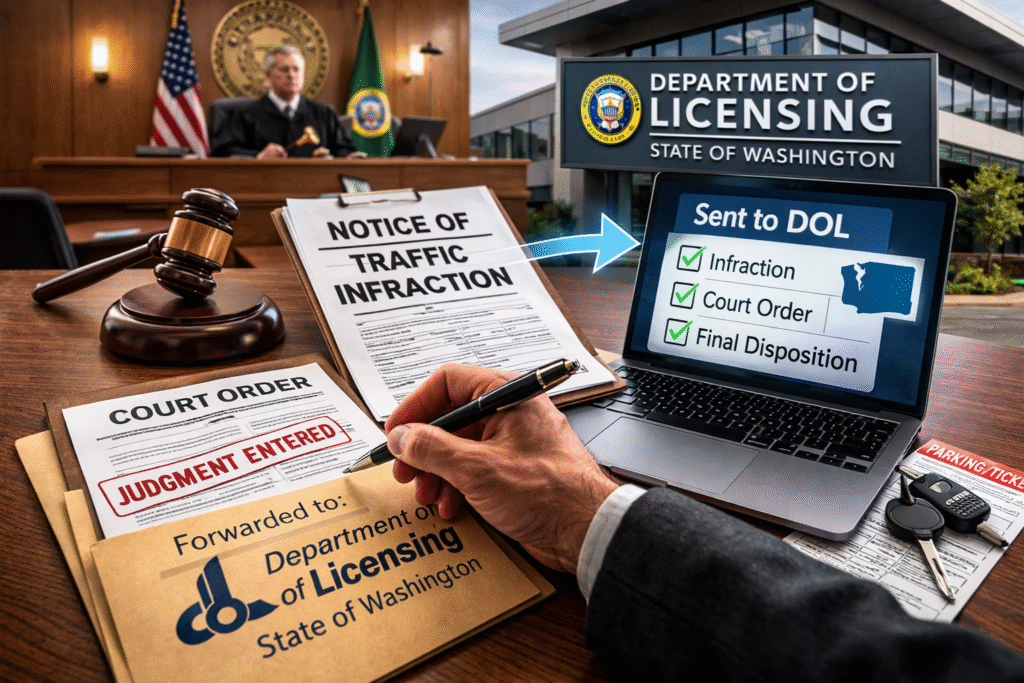
Under subsection (a), after a judgment that a traffic infraction was committed, the court shall forward to the Department of Licensing:
- A copy of the notice of traffic infraction, and
- An abstract of the court’s order.
The rule also permits courts to forward this information electronically under procedures established by the Department of Licensing and the Administrative Office of the Courts (AOC).
The use of the word “shall” makes this reporting mandatory once a traffic infraction judgment is entered.
(b) Parking, Standing, Stopping, and Pedestrian Infractions
Subsection (b) limits reporting.
The court shall not notify the Department of Licensing of:
- Parking infractions,
- Standing infractions,
- Stopping infractions, or
- Pedestrian infractions,
except as permitted under RCW 46.20.270.
This subsection creates a clear exclusion category. Not all infractions are reportable to DOL under IRLJ 4.1.
(c) Failure to Appear Set Aside
Subsection (c) addresses situations where a judgment for failure to appear has been entered and later set aside.
If a failure-to-appear judgment is set aside:
- The Department of Licensing must be notified that the failure-to-appear judgment was set aside.
- Once a final disposition is entered in the case, DOL must also be informed of that final disposition.
This ensures that DOL records accurately reflect both the removal of the failure-to-appear status and the ultimate outcome of the infraction.
Practical Impact of IRLJ 4.1 DOL Notification
IRLJ 4.1 establishes a reporting framework between Washington courts and the Department of Licensing.
It:
- Requires reporting of most traffic infraction judgments,
- Excludes specified non-moving violations unless statutory exceptions apply,
- Requires corrective reporting when failure-to-appear judgments are vacated.
Because DOL maintains driver records, compliance with IRLJ 4.1 directly affects the accuracy of those records following court proceedings.
Review our client resources here
Contact us anytime for your urgent legal needs.
About Blanford Law:
We are no-nonsense, relentless, fair, and honest. We are great listeners instead of fast talkers, that is just who we are. More than 20 years ago, Ken began practicing law with a deeply-seeded belief that every person has the right to the best legal representation available. He built his law firm on that belief. Another belief that he strongly adheres to is his fundamental belief that clients deserve respect, with no assumptions or preconceived notions.
If you or someone you know is accused of a crime or injured as a result of the negligence of another, please have them call us at 253-720-9304 or email us at info@blanfordlaw.com.
Additional Resources
Trust Account Overdraft Notification in Washington
Explains how trust account overdraft notifications work, reporting requirements, and the professional responsibility implications for attorneys.
https://blanfordlaw.com/trust-account-overdraft-notification/
IRLJ 3.2 Failure to Appear
Details the procedures and consequences when a defendant fails to appear in a Washington infraction case.
https://blanfordlaw.com/irlj-3-2-failure-to-appear/
42 Blue Form Substance Abuse Compliance
Provides guidance on Washington’s “42 Blue Form” requirements and compliance issues related to substance abuse monitoring.
https://blanfordlaw.com/42-blue-form-substance-abuse-compliance/
Washington DOL Suspension for CDL Serious Traffic Offenses
Explains how serious traffic offenses can trigger Department of Licensing suspension of a commercial driver’s license in Washington.
https://blanfordlaw.com/20-washington-dol-suspension-cdl-serious-traffic-offenses/
Decoding Bail Bond Notifications – State v. Parada (75 Wn. App. 224)
Analyzes the Washington Court of Appeals decision addressing bail bond notification procedures and legal implications.
https://blanfordlaw.com/decoding-bail-bond-notifications-a-legal-guide-to-state-v-parada-75-wn-app-224-wash-ct-app-1994/