
IRLJ 6.2 Penalties: Understanding Washington Traffic Infraction Fines
If you receive a traffic ticket in Washington, one of the first questions you probably have is, “How much is my ticket going to cost?” The answer often begins with IRLJ 6.2, the rule that establishes the monetary penalty schedule for many Washington traffic infractions.
Although statutes create the traffic offenses themselves, IRLJ 6.2 provides the standard base penalties used by courts throughout Washington. The rule also explains when courts may reduce a penalty and how penalties are calculated for infractions not specifically listed.
What Is IRLJ 6.2?
IRLJ 6.2 is part of the Infraction Rules for Courts of Limited Jurisdiction. It establishes a statewide monetary penalty schedule for many common traffic infractions.
The rule promotes consistency by ensuring that courts generally apply the same base penalties throughout Washington.
Local Courts Generally Cannot Change Scheduled Penalties
One of the most important provisions of IRLJ 6.2 states that local courts may not change the penalties listed in the statewide schedule through local court rules.
However, a judge may impose a lesser penalty in an individual case when appropriate.
This means:
- The statewide penalty schedule applies uniformly.
- Judges retain discretion to reduce a fine in certain cases.
- Courts cannot create their own higher or lower standard penalty schedules for listed infractions.
What Happens if an Infraction Is Not Listed?
Not every traffic infraction appears in the penalty schedule.
For unscheduled infractions, IRLJ 6.2 provides a default base penalty of $48, excluding statutory assessments. A local court may adopt a different penalty for those unscheduled violations through local rule.
Parking and Pedestrian Infractions
IRLJ 6.2 does not apply to every type of infraction.
The rule specifically excludes penalties for:
- Parking violations
- Standing violations
- Stopping violations
- Pedestrian infractions established by local ordinance
Those penalties are generally established by statute or local government.
Examples of Infractions Covered by IRLJ 6.2
The penalty schedule includes many common traffic offenses, including:
- Speeding
- Failure to stop
- Failure to yield
- Failure to signal
- Improper lane usage
- Following too closely
- Wrong-way driving
- Expired vehicle registration
- Driver licensing violations
- Equipment violations
Many penalty amounts depend on the specific circumstances of the violation.
For example, speeding penalties increase based on:
- The posted speed limit.
- How many miles per hour the driver exceeded the limit.
Additional Assessments May Apply
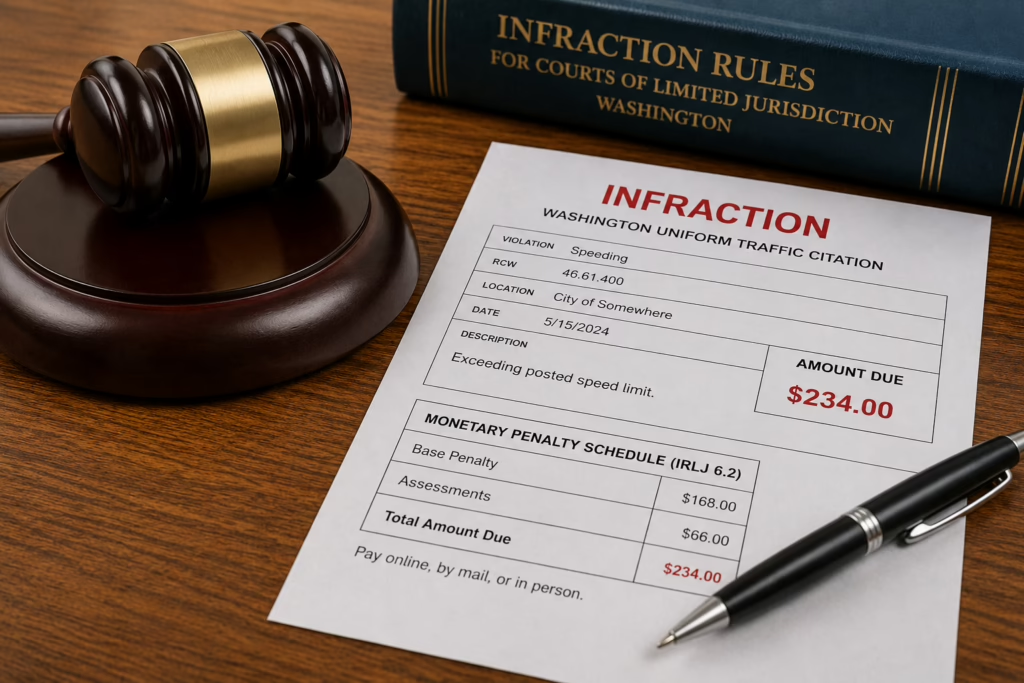
The amounts listed in IRLJ 6.2 are base penalties.
In most cases, additional statutory assessments, fees, and surcharges are added before the final amount owed is calculated. As a result, the amount printed on your traffic ticket may be higher than the base penalty shown in the rule.
Can a Traffic Ticket Be Reduced?
Possibly.
Depending on the facts of your case and the practices of the court, you may be able to:
- Contest the infraction.
- Request a mitigation hearing.
- Seek a reduction of the monetary penalty.
- Negotiate an amended infraction when appropriate.
Because every case is different, it is often beneficial to consult an attorney before paying a citation.
Why IRLJ 6.2 Matters
Understanding IRLJ 6.2 helps drivers know:
- How traffic fines are established.
- Why penalties are generally consistent across Washington.
- When a judge may reduce a penalty.
- Why the total amount due may exceed the published base penalty.
Knowing the rules can help you make informed decisions about whether to pay, mitigate, or contest a traffic ticket.
Contact Blanford Law
If you have questions about a Washington traffic ticket or would like assistance contesting an infraction, contact Blanford Law today at ken@blanfordlaw.com or 253-720-9304 for guidance on your legal matter.
Additional Resources
IRLJ 4.1: Traffic Infractions in Washington
Learn how IRLJ 4.1 governs the adjudication of traffic infractions, including hearings, findings, and court procedures.
https://blanfordlaw.com/irlj-4-1-traffic-infractions/
Earned Release Time in Washington
Understand how earned release time works in Washington, including eligibility requirements and how sentence reductions are calculated.
https://blanfordlaw.com/earned-release-time-washington/
IRLJ 6.2: Monetary Penalties for Traffic Infractions
Explore how IRLJ 6.2 establishes the statewide monetary penalty schedule and when courts may reduce traffic infraction fines.
https://blanfordlaw.com/irlj-6-2-monetary-penalties/
IRLJ 2.06: Scheduling of Hearings
Learn how Washington courts schedule hearings for contested and mitigation traffic infractions under IRLJ 2.06.
https://blanfordlaw.com/irlj-2-06-scheduling-of-hearings/
IRLJ 2.6: Scheduling Hearings
Discover the procedures and timelines for scheduling traffic infraction hearings in Washington courts under IRLJ 2.6.
https://blanfordlaw.com/irlj-26-scheduling-hearings/