
Traffic infractions in Washington can lead to fines, collections, and other legal consequences. In some situations, however, the person named in the citation may not actually be the person who committed the infraction. To address these situations, Washington courts provide procedures allowing defendants to challenge judgments entered because of mistaken identity.
Under IRLJ 6.7 identity challenges, individuals may seek relief from traffic infraction judgments by demonstrating they were incorrectly identified as the person responsible for the violation. The rule also governs motions to vacate judgments, suspend fines, and request alternative penalties.
The rule was amended several times over the years, including updates effective July 9, 2024.
What Is IRLJ 6.7?
IRLJ 6.7 is part of Washington’s Infraction Rules for Courts of Limited Jurisdiction. The rule addresses two major areas:
- Relief from judgment under CRLJ 60(b); and
- Identity challenges involving mistaken identification in traffic infraction cases.
The rule provides procedural protections for defendants who failed to respond to a notice of infraction because they were not actually the person involved.
Relief From Judgment Under IRLJ 6.7
Motions to Vacate or Modify Judgments
Subsection (a) explains that requests involving traffic infraction judgments are governed by Civil Rule for Courts of Limited Jurisdiction (CRLJ) 60(b).
Under this section, a person may ask the court to:
- Vacate a judgment;
- Suspend or waive fines;
- Convert monetary penalties to community restitution; or
- Obtain other forms of post-judgment relief.
CRLJ 60(b) generally applies in situations involving:
- Mistake;
- Excusable neglect;
- Newly discovered evidence;
- Fraud; or
- Other equitable reasons justifying relief.
The motion process can be complex, particularly when default judgments and collections are already involved.
Identity Challenges Under IRLJ 6.7
Mistaken Identity Claims
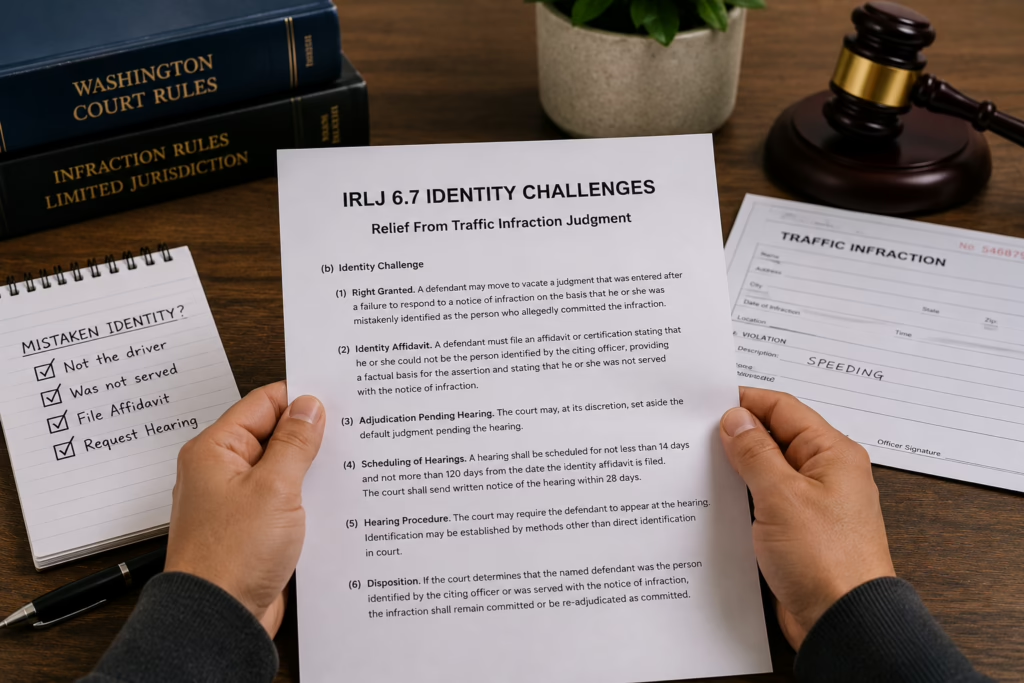
The most unique aspect of IRLJ 6.7 identity challenges is the rule allowing defendants to challenge judgments based on mistaken identification.
This commonly arises when:
- Someone else used the defendant’s identity;
- A citation was issued to the wrong person;
- Records contain clerical errors; or
- The defendant never received the notice of infraction.
The rule specifically applies when a judgment was entered after a failure to respond to the infraction notice.
Filing an Identity Affidavit
Required Affidavit or Certification
To begin the process, the defendant must file an affidavit or certification with both:
- The court handling the infraction; and
- The prosecuting authority assigned to the court.
The affidavit must state:
- That the defendant could not have been the person identified by the officer;
- The factual basis supporting that claim; and
- That the defendant was not served with the notice of infraction.
The affidavit is a critical part of the process because it formally places the mistaken identity issue before the court.
Importance of Supporting Facts
Defendants should provide as much factual detail as possible. Examples may include:
- Proof of being in another location;
- Employment records;
- Witness statements;
- Vehicle ownership records; or
- Physical descriptions inconsistent with the citation.
Strong documentation can significantly improve the likelihood of relief.
Temporary Relief Before the Hearing
Setting Aside Default Judgments
After receiving the affidavit, the court has discretion to temporarily set aside the default judgment while the identity challenge is pending.
This can be important because default judgments may already have triggered:
- Collections;
- Wage garnishment;
- Additional penalties; or
- Credit-related consequences.
Temporary relief may help prevent further financial harm while the court reviews the claim.
Scheduling Identity Hearings
Required Timeframes
IRLJ 6.7 establishes timelines for identity challenge hearings.
The hearing must generally be scheduled:
- No sooner than 14 days after filing the affidavit; and
- No later than 120 days after filing.
The defendant may agree to a different timeline if necessary.
Additionally, the court must send written notice of the hearing date within 28 days after receiving the request.
These deadlines help ensure defendants receive a prompt opportunity to contest mistaken identification.
Hearing Procedures Under IRLJ 6.7
Court Appearance Requirements
The court may require the defendant to personally appear at the hearing.
At the hearing, identification may be established using evidence other than direct in-court identification. For example, the court may consider:
- Officer testimony;
- DMV records;
- Surveillance evidence;
- Vehicle registration information; or
- Other documentary evidence.
The court ultimately decides whether the named defendant was the person identified by the citing officer or properly served with the notice.
Possible Outcomes of an Identity Challenge
If the Court Rejects the Challenge
If the judge determines the defendant was properly identified or served, the infraction remains committed or may be re-adjudicated.
The defendant may remain responsible for:
- Fines;
- Court costs;
- Collection fees; and
- Other associated penalties.
If the Court Grants Relief
If the court determines mistaken identity occurred, the judgment may be vacated and the defendant relieved from responsibility for the infraction.
This can eliminate substantial financial and legal consequences.
Why IRLJ 6.7 Matters
The IRLJ 6.7 identity challenges rule provides important due process protections for Washington residents facing traffic-related judgments they believe were entered in error.
Mistaken identity situations can have serious consequences, particularly when defendants are unaware that a citation or default judgment exists until collection activity begins.
The rule helps ensure courts have procedures for correcting these errors while balancing the need for efficient traffic infraction enforcement.
Anyone facing a default judgment or collections related to a traffic infraction they did not commit should promptly review available legal remedies and procedural deadlines.
Contact Blanford Law
Contact Blanford Law today at ken@blanfordlaw.com or 253-720-9304 for guidance on your legal matter.
Additional Resources
- IRLJ 3.2 Failure to Appear
Learn what happens when a person fails to respond or appear for a Washington traffic infraction hearing.
URL: https://blanfordlaw.com/irlj-3-2-failure-to-appear/ - State v. Strong Washington
An analysis of a Washington appellate case involving criminal procedure and evidentiary issues.
URL: https://blanfordlaw.com/state-v-strong-washington/ - The Cheapest Lawyer Mistake
A discussion of the risks associated with choosing legal representation based solely on price.
URL: https://blanfordlaw.com/cheapest-lawyer-mistake/ - Understanding RCW 9A.16.025: Use of Force When Unjustified and Victim Identity
An overview of Washington law involving use-of-force claims and disputes concerning victim identification.
URL: https://blanfordlaw.com/understanding-rcw-9a-16-025-use-of-force-when-unjustified-victim-identity/ - Understanding RCW 9A.08.040: Diminished Capacity and Victim Identity in Washington State
A guide discussing diminished capacity defenses and legal issues involving victim identification under Washington law.
URL: https://blanfordlaw.com/understanding-rcw-9a-08-040-diminished-capacity-and-victim-identity-in-washington-state/