
Introduction
In State v. Yellowcalf (2025), the Washington Court of Appeals clarified how courts must analyze single-photo identification Washington cases under constitutional due process standards. While courts recognize that single-photo identifications are inherently suggestive, this case emphasizes that suggestiveness alone is not enough to exclude the evidence. Instead, trial courts must also decide whether the procedure was necessary under the circumstances before suppressing an identification.
This decision is significant for defendants, prosecutors, and defense attorneys handling eluding, assault, and other cases that rely heavily on eyewitness identification.
Background of State v. Yellowcalf
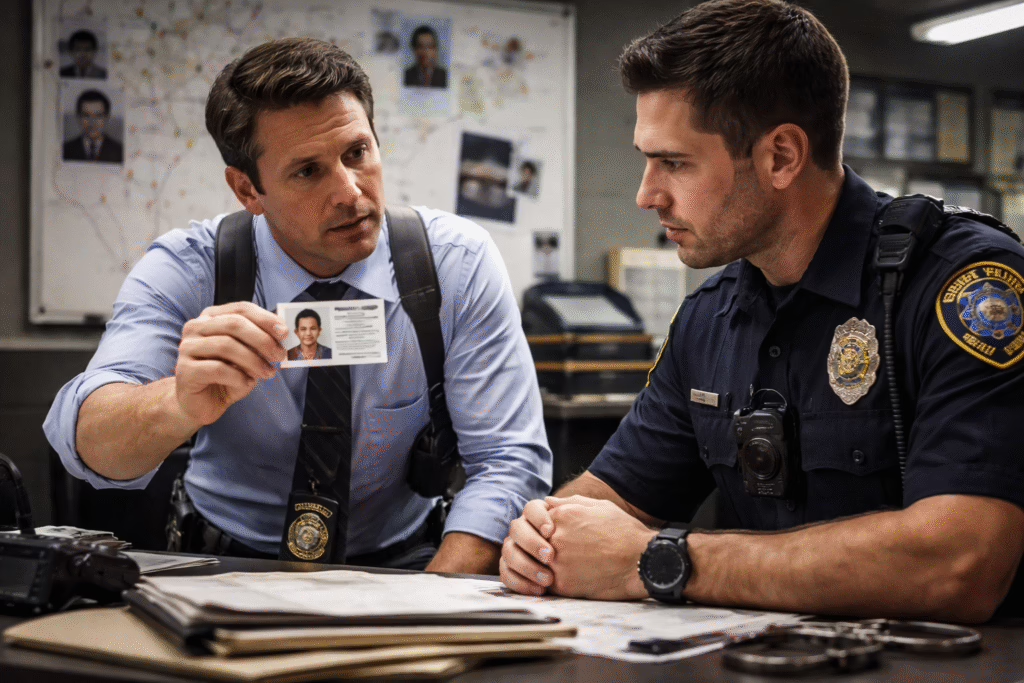
The case arose from a police pursuit in Sedro-Woolley. An officer briefly observed a driver who fled at high speeds and later received a single Department of Licensing (DOL) photograph from another officer. After viewing only that one photograph, the pursuing officer identified John Yellowcalf as the driver.
The State charged Yellowcalf with attempting to elude a pursuing police vehicle. Before trial, Yellowcalf moved to suppress the identification, arguing that the single-photo procedure violated due process under the Fourteenth Amendment.
The trial court agreed, suppressed both the out-of-court and in-court identifications, and dismissed the charge with prejudice. The State appealed.
The Legal Standard for Single-Photo Identification in Washington
The Brathwaite Two-Step Test
Washington courts apply the two-part test from Manson v. Brathwaite, adopted and reaffirmed in cases such as State v. Derri:
- Was the identification procedure both suggestive and unnecessary?
- If so, was the identification nonetheless reliable under the totality of the circumstances?
If the defendant fails to prove both suggestiveness and lack of necessity, the inquiry ends and the identification may be admitted.
Why the Trial Court Erred
Failure to Analyze Necessity
In State v. Yellowcalf, the Court of Appeals agreed with the trial court on one point:
Single-photo identifications are “highly suggestive.”
However, the trial court stopped there.
The appellate court held that this was legal error because the trial court never analyzed whether the single-photo identification was necessary under the circumstances—such as whether it functioned as a prompt showup during an active investigation.
Under Washington law, even highly suggestive procedures may still be constitutional if they are justified by exigent circumstances, such as:
- A need for quick confirmation
- Ongoing efforts to locate a fleeing suspect
- Fresh memory shortly after the incident
Because the necessity prong was never addressed, the suppression order rested on an incorrect legal standard.
Reliability Factors Still Matter
Although the court reversed on the first step, it also addressed the reliability analysis to guide the trial court on remand.
The Biggers Factors Applied
The court reviewed the five Neil v. Biggers reliability factors:
- Opportunity to view: Weighed against reliability due to conflicting police reports
- Degree of attention: Weighed against reliability due to divided attention
- Accuracy of description: Weighed against reliability due to vague descriptors
- Level of certainty: Favored reliability
- Time between event and identification: Favored reliability
Even though several factors cut against reliability, the appellate court emphasized that reliability is only analyzed after necessity is established.
Why This Case Matters
State v. Yellowcalf reinforces a critical point in Washington criminal law:
👉 Courts must complete both steps of the constitutional analysis.
For defense attorneys, the case provides a roadmap for challenging identifications by focusing not only on suggestiveness, but also on whether police truly needed to use a one-photo procedure.
For prosecutors and law enforcement, it underscores the importance of articulating why a suggestive identification method was necessary at the time.
Call to Action
If you are facing criminal charges involving eyewitness identification, the constitutional issues can be complex and outcome-determinative.
Contact Blanford Law today at ken@blanfordlaw.com or 253-720-9304 for guidance on your legal matter.
Additional Resources
- Washington RPC 3.1 – Frivolous Claims and Defenses
An overview of Rule of Professional Conduct 3.1, explaining when legal claims cross the line into frivolous filings under Washington law.
https://blanfordlaw.com/washington-rpc-3-1-frivolous-claims/ - Roslyn DUI Injury Claim on I-90
A case analysis discussing DUI-related injury claims arising from a collision on Interstate 90 near Roslyn, Washington.
https://blanfordlaw.com/roslyn-dui-injury-claim-i90/ - Washington Uniform Regulation Act Explained
A breakdown of the Uniform Regulation Act and how it governs traffic infractions and enforcement procedures statewide.
https://blanfordlaw.com/uniform-regulation-act/ - RCW 2.42.160 – Washington Judicial Ethics
An explanation of RCW 2.42.160 and how Washington law addresses judicial disqualification and ethical considerations.
https://blanfordlaw.com/rcw-2-42-160/ - IRLJ 3.5 – Written Statements in Traffic Cases
A practical guide to IRLJ 3.5 and how written statements are used and challenged in Washington traffic and infraction hearings.
https://blanfordlaw.com/irlj-3-5-written-statement/