
A new published Washington Court of Appeals decision provides important guidance on Washington restitution for property damage when damaged property is old, depreciated, or near the end of its useful life. In State v. Charles, No. 40514-1-III (Wash. Ct. App. Aug. 6, 2026), Division Three reversed a $14,563.49 restitution order because the State failed to prove the hospital’s actual loss.
The decision establishes an important point for Washington criminal cases: the cost of purchasing a brand-new replacement does not automatically establish the value of older property that a defendant damaged or destroyed.
What Happened in State v. Charles?
In August 2023, Scott Charles was being escorted down a hallway at Providence Holy Family Hospital when he turned toward a medical device and threw it on the floor. The device was a Marco 5 Ultra Slit Lamp used by the hospital for eye examinations.
Charles was charged with first-degree malicious mischief and later pleaded guilty.
The State subsequently requested $14,563.49 in restitution—the amount the hospital paid for a new slit lamp.
But the damaged equipment was old.
Hospital maintenance records showed that approximately one year before the incident, a technician had described the slit lamp as an “old horse” that needed to be “put out to pasture” and recommended that the hospital obtain a newer model.
Charles challenged the requested restitution amount. Among other things, he submitted information indicating that the manufacturer believed the device could be repaired for $330.90. The State later submitted a declaration from the hospital technician stating that the device could not be repaired, along with the receipt showing that the hospital paid $14,563.49 for a new slit lamp.
The trial court ordered Charles to pay the full $14,563.49.
The Washington Court of Appeals reversed that restitution order and sent the case back for a new evidentiary hearing.
Washington Restitution for Property Damage Is Limited by Actual Loss
Washington courts do not have unlimited authority to impose restitution. Their authority comes from statute.
The primary statute is RCW 9.94A.753 — Restitution.
Under RCW 9.94A.753(3)(a), restitution generally must be based on easily ascertainable damages for injury to or loss of property, actual treatment expenses for injuries, and lost wages resulting from injury.
More importantly for Charles, the statute provides that:
“The amount of restitution shall not exceed double the amount of the offender’s gain or the victim’s loss from the commission of the crime.”
The statute also generally requires restitution when an offense results in injury to a person or damage to or loss of property, unless extraordinary circumstances make restitution inappropriate. See RCW 9.94A.753(5).
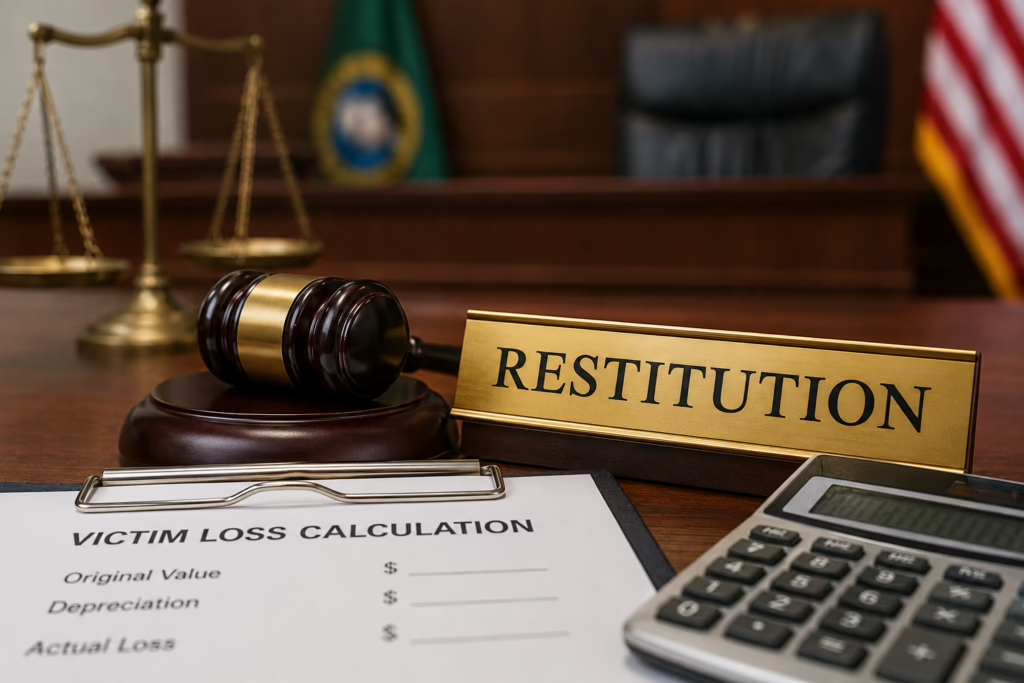
In Charles, the key question was therefore not simply how much the hospital spent on a new machine. The relevant question was how much the hospital actually lost when its old machine was destroyed.
Replacement Cost Does Not Automatically Prove the Victim’s Loss
The Court of Appeals found that the State had presented evidence showing what the hospital paid for the new slit lamp.
But that did not establish the value of the old slit lamp.
That distinction was critical because the hospital’s own maintenance records indicated that the old machine was near the end of its useful life.
The Court of Appeals relied in part on State v. Morley, 119 Wn. App. 939, 944, 83 P.3d 1023 (2004), where the court recognized that the market value of a new generator was not the appropriate measure of the value of a stolen used generator.
In Charles, the State acknowledged that it had been unable to find a readily accessible way to determine the value of that specific model of used medical equipment. It therefore asked the trial court to use the $14,563.49 replacement price.
Division Three rejected that approach.
The court emphasized that even when a victim’s precise loss is difficult to establish, the statutory limitation still applies. A court cannot avoid determining the victim’s loss simply because valuing used property is difficult.
What Must the State Prove at a Washington Restitution Hearing?
When a defendant disputes facts relevant to restitution, the State must prove the damages by a preponderance of the evidence.
The Court of Appeals explained that the claimed loss does not have to be established with exact precision. However, it must be supported by substantial evidence that gives the court a reasonable basis for estimating the loss rather than forcing the court to rely on speculation or conjecture.
That requirement comes from Washington restitution cases including State v. Kinneman, 155 Wn.2d 272, 285, 119 P.3d 350 (2005), State v. Griffith, 164 Wn.2d 960, 965, 195 P.3d 506 (2008), and State v. Hughes, 154 Wn.2d 118, 154, 110 P.3d 192 (2005).
In Charles, Division Three went further and stated:
“In fact, the State presented no evidence whatsoever of the hospital’s loss.”
The $14,563.49 receipt established the price of the replacement. It did not establish the value of the old equipment immediately before Charles damaged it.
That difference ultimately required reversal of the restitution order.
How Can Older Property Be Valued for Restitution?
The Charles decision is particularly useful because the Court of Appeals explained how the State could potentially establish the value of property when there is no readily available used-property market.
The court identified evidence such as:
- the year the property was purchased;
- its approximate purchase price; and
- an estimate of its remaining useful life before it was damaged.
With that information, the trial court could calculate what Division Three described as a “pro rata useful life value” for the property.
This does not mean that every Washington restitution case involving used property must employ a particular depreciation formula. Rather, Charles demonstrates that there must be evidence providing a reasonable basis for determining the victim’s loss.
That distinction can become extremely important when expensive property is already old or nearing replacement.
Why State v. Charles Matters in Washington Restitution Cases
Although Charles involved specialized medical equipment, its reasoning may be important in other restitution cases involving older or depreciating property.
Consider property such as vehicles, machinery, computers, electronics, tools, or business equipment. Replacing an older item with a new one may cost substantially more than the value of the property immediately before it was damaged.
After Charles, a defendant confronted with a replacement-cost restitution request should consider several questions.
How old was the damaged property?
Age can be highly relevant when an item has a limited useful life.
What condition was the property in?
Maintenance records, repair histories, photographs, inspections, and testimony from people familiar with the property may help establish its condition immediately before the offense.
How much useful life remained?
This issue received particular attention in Charles. Evidence showing that property was already approaching replacement may substantially affect the calculation of the victim’s actual loss.
Is the State proving actual loss or merely replacement cost?
An invoice establishes what the victim spent. It does not necessarily establish what the victim lost.
That distinction is at the heart of State v. Charles.
What About First-Degree Malicious Mischief?
Charles pleaded guilty to malicious mischief in the first degree.
Under RCW 9A.48.070 — Malicious Mischief in the First Degree, a person can commit first-degree malicious mischief by knowingly and maliciously causing physical damage to another person’s property in an amount exceeding $5,000. The offense is a class B felony.
It is important, however, not to read the restitution holding in Charles too broadly.
The published portion of the opinion addressed the restitution order. Charles later attempted to challenge his Alford plea based on the State’s failure to establish the used equipment’s market value, but the Court of Appeals declined to consider that issue because it was not raised in his opening brief.
The restitution ruling therefore should not be interpreted as a holding that the State failed to establish the elements of Charles’s underlying malicious mischief conviction.
Can Replacement Cost Ever Be Used for Restitution?
Charles does not establish a categorical rule prohibiting replacement-cost evidence.
The Court of Appeals discussed State v. Smith, 42 Wn. App. 399, 711 P.2d 372 (1985), where insurers were required under their contracts to pay replacement costs for property stolen from burglary victims. Because the insurers themselves were victims and those payments represented their actual losses, the restitution award was consistent with the statutory limitation.
Division Three also distinguished the unpublished decision State v. Waters, No. 69932-6-I (Wash. Ct. App. Apr. 28, 2014), involving stolen cattle guards. In that case, there was no evidence that the property had a limited useful life comparable to the aging medical equipment in Charles.
The important issue, therefore, is not simply whether the State labels an amount “replacement cost.” The question is whether the evidence establishes a legally permissible measure of the victim’s actual loss.
Challenging a Restitution Amount in Washington
A restitution hearing can have substantial financial consequences.
When the State seeks restitution for damaged or destroyed property, the defense should examine the evidence supporting the requested amount rather than assume that a receipt or replacement invoice conclusively establishes the loss.
Depending on the property involved, relevant evidence may include its age, original purchase price, condition, repair history, depreciation, fair market value, remaining useful life, and the availability and price of comparable used property.
State v. Charles reinforces a fundamental limitation imposed by RCW 9.94A.753: restitution cannot exceed twice the offender’s gain or the victim’s loss from the crime.
When the State seeks the cost of replacing old property with something new, determining the victim’s actual loss may therefore become one of the most important issues at the restitution hearing.
Speak With a Washington Criminal Defense Attorney About Restitution
Restitution should not be treated as an automatic calculation simply because the State presents a bill or replacement invoice. When the amount is disputed, the evidence supporting the claimed loss matters.
The published decision in State v. Charles illustrates why defendants should carefully review restitution requests involving older, depreciated, or damaged property and determine whether the State’s evidence actually establishes the victim’s loss.
Contact Blanford Law today at ken@blanfordlaw.com or 253-720-9304 for guidance on your legal matter.
Additional Resources
Washington Criminal Restitution Laws Explained
Learn how Washington criminal restitution laws determine which financial losses may be recovered and why a direct causal connection between the crime and the victim’s loss matters.
“Modest Pause” Requested for I-90 Overpass Project Near Cle Elum
Read about the damaged I-90 overpass near Cle Elum and local officials’ request to consider long-term transportation and infrastructure needs before replacement.
IRLJ 4.2 Failure to Pay in Washington
Learn how Washington’s IRLJ 4.2 addresses failure to pay traffic-infraction penalties or complete court-ordered community restitution and when courts notify the Department of Licensing.
Roslyn DUI Injury Claim: What Victims Can Do After an I-90 Rollover
Explore how Washington law may allow an injured passenger to pursue compensation following a DUI-related crash, including medical expenses, lost income, and other damages.
IRLJ 4.2 Failure to Pay Traffic Infractions in Washington
Review Washington’s rules governing unpaid traffic infractions, court reporting requirements, and the potential consequences of failing to resolve traffic-related financial obligations.